
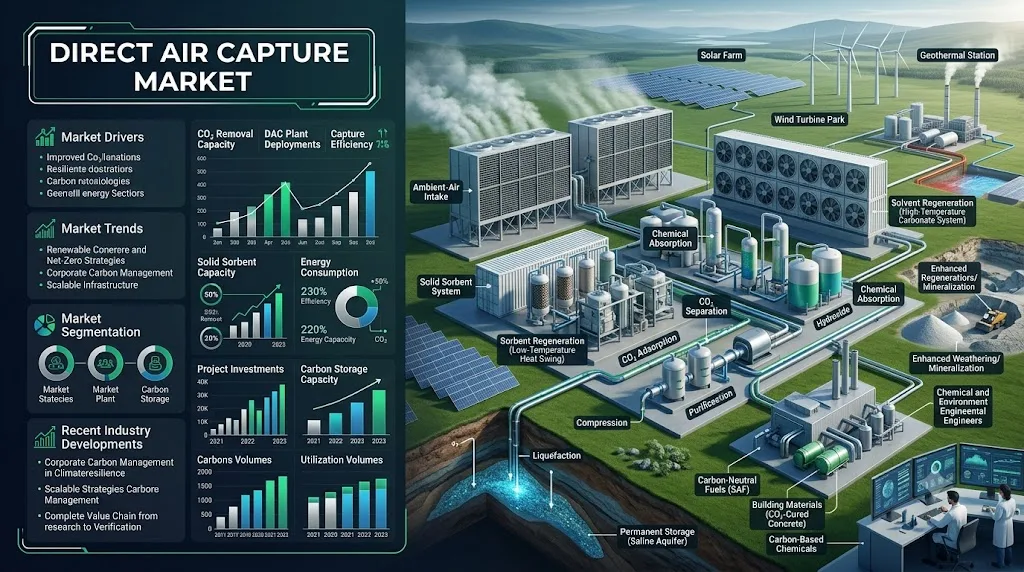
Market Overview:
According to IMARC Group's latest research publication, "Direct Air Capture Market: Global Industry Trends, Share, Size, Growth, Opportunity and Forecast 2026-2034", The global direct air capture (DAC) market size was valued at USD 134.4 Million in 2025. Looking forward, IMARC Group estimates the market to reach USD 10,658.6 Million by 2034, exhibiting a CAGR of 60.69% from 2026-2034.
This detailed analysis primarily encompasses industry size, business trends, market share, key growth factors, and regional forecasts. The report offers a comprehensive overview and integrates research findings, market assessments, and data from different sources. It also includes pivotal market dynamics like drivers and challenges, while also highlighting growth opportunities, financial insights, technological improvements, emerging trends, and innovations. Besides this, the report provides regional market evaluation, along with a competitive landscape analysis.
How Corporate Net-Zero Commitments Are Reshaping the Direct Air Capture Market
- Corporations across aviation, cement, and steel are locking in long-term carbon removal credit purchases, since these sectors cannot fully eliminate emissions through operational changes alone and are turning to DAC as a scalable offset mechanism.
- Advances in sorbent and solvent chemistry are steadily improving how much CO₂ each unit of energy can capture, making DAC installations more commercially viable than earlier-generation systems.
- Integration of artificial intelligence and automation into plant operations is helping developers fine-tune capture cycles, cut downtime, and lower the operating cost per ton of CO₂ removed.
- Growth of the voluntary carbon market is strengthening demand for DAC-based credits, which buyers increasingly view as a verifiable, high-quality removal option compared to nature-based alternatives.
- Government-backed hub programs are anchoring large, multi-partner DAC projects, giving developers the funding certainty needed to move from pilot to commercial-scale operation.
- In 2025, RepAir Carbon partnered with Shell and Mitsubishi to deploy its electrochemical direct air capture technology at a carbon removal hub in Louisiana, backed by a Department of Energy grant aimed at scaling low-energy DAC units toward hundreds of kilotons of annual capture by 2030.
Download a sample PDF of this report: https://www.imarcgroup.com/direct-air-capture-market/requestsample
Key Trends in the Direct Air Capture Market
- Expansion of Carbon Utilization and Storage Infrastructure: The buildout of dedicated CO₂ pipelines, storage sites, and enhanced oil recovery operations is giving DAC developers viable, large-scale outlets for captured carbon, which is steadily improving the commercial case for new facilities. Emerging downstream uses for captured CO₂, including synthetic fuels, chemicals, and construction materials, are widening the pool of buyers beyond traditional carbon credit purchasers. As transportation and storage networks mature, DAC is increasingly being positioned as a core component of the broader carbon management value chain rather than a standalone technology. In late 2025, Deep Sky's flagship Canadian carbon removal facility added a new direct air capture unit supplied by a major aerospace manufacturer, expanding a multi-technology testbed that already hosts several other DAC developers at the same site.
- Development of Low-Cost and Energy-Efficient Capture Processes: Continued innovation in sorbent materials, regeneration techniques, and system design is reducing the energy intensity of DAC operations, which remains one of the biggest barriers to widespread commercial adoption. Developers are increasingly pairing capture units with waste heat, geothermal, and other low-carbon power sources to cut both operating costs and the carbon footprint of the capture process itself. Modular manufacturing approaches are also lowering upfront capital requirements, making it easier for smaller developers to deploy DAC units at meaningful scale. These efficiency gains are gradually pushing the cost of removal closer to price points that make DAC credits attractive to a broader range of corporate buyers.
- Growth of Government-Backed DAC Hub Programs: Large public funding programs are playing an outsized role in determining which DAC projects move from demonstration to commercial operation, particularly in North America where hub-style funding supports shared pipeline and storage infrastructure across multiple developers. Policy continuity has become a closely watched factor for the sector, since funding delays or reversals can directly affect project timelines. In April 2026, a major DAC hub funding program in the United States was reaffirmed after a period of uncertainty, unlocking over a billion dollars earmarked primarily for two large-scale commercial facilities designed to each remove roughly one million metric tons of CO₂ annually.
- Regional and Community-Led Carbon Removal Initiatives: State and regional governments are increasingly opening dedicated funding rounds and demonstration programs to support local DAC deployment, often tying awards to community engagement and social licensing requirements rather than technical merit alone. This regional approach is helping diversify where DAC capacity gets built, moving the industry beyond a handful of flagship national projects. In May 2026, a U.S. state energy agency opened a new grant funding round specifically for pre-commercial DAC demonstration projects that include structured community partnership components.
- Growing Diversification of End-Use Applications: Beyond traditional carbon storage, captured CO₂ is finding new outlets in synthetic fuel production, carbon mineralization, food and beverage carbonation, and enhanced oil recovery, giving developers multiple revenue paths beyond credit sales alone. This diversification is helping some DAC operators reduce their dependence on a single buyer type and build more resilient business models as the market matures.
The data center virtualization market report provides a comprehensive overview of the industry. This analysis is essential for stakeholders aiming to navigate the complexities of the biochar market and capitalize on emerging opportunities.
Growth Factors in the Direct Air Capture Market
- Rising Corporate Net-Zero Commitments: A growing number of large corporations are formalizing net-zero targets that require permanent carbon removal rather than simple offsetting, and DAC is one of the few technologies capable of delivering verifiable, long-duration removal at scale, sustaining steady demand for future credit volumes.
- Sustained Government Funding and Policy Support: Large-scale public funding commitments, tax incentives, and hub-style infrastructure programs, particularly across North America and Europe, continue to de-risk early-stage DAC projects and accelerate the transition from pilot facilities to commercial-scale deployment.
- Falling Capture Costs Through Technological Innovation: Ongoing improvements in sorbent efficiency, energy integration, and modular plant design are gradually lowering the cost per ton of CO₂ removed, making DAC increasingly competitive with other carbon removal pathways and expanding the pool of buyers willing to pay for credits.
- Expansion of the Voluntary Carbon Market: As more companies seek high-quality, independently verifiable carbon removal to back their sustainability claims, DAC-generated credits are gaining preference over less durable nature-based alternatives, reinforcing long-term offtake demand for developers.
- Growing Investment and Strategic Partnerships: Increased participation from venture capital, energy majors, and industrial conglomerates is bringing both capital and technical expertise into the sector, helping developers scale manufacturing, secure storage access, and accelerate commercialization timelines.
Leading Companies Operating in the Global Direct Air Capture Industry:
- Climeworks
- Carbon Engineering ULC
- Heirloom Carbon Technologies
- Skytree
- Carbyon
Direct Air Capture Market Report Segmentation:
Breakup By Technology:
- Solid-DAC
- Liquid-DAC
- Electrochemical-DAC
- Others
Solid-DAC accounts for the largest share at 57.2% due to its higher efficiency, lower energy usage, faster regeneration cycles, and easier integration with renewable power sources compared to other capture methods.
Breakup By Energy Source:
- Electricity
- Heat
Electricity leads with a 57.5% share, driven by its versatility, growing availability from renewable sources, and ability to scale from small modular units to large industrial facilities.
Breakup By Application:
- Carbon Capture, and Storage
- Carbon Capture Utilization and Storage
Carbon Capture and Storage dominates with a 77.5% share, supported by its ability to deliver long-term, large-scale emission reductions for hard-to-decarbonize sectors such as cement, steel, and power generation.
Breakup By End Use:
- Agriculture
- Chemicals and Fuels
- Carbon Mineralization
- Food and Beverages
- Oil and Gas
- Others
Breakup By Region:
- North America (United States, Canada)
- Europe (Germany, France, United Kingdom, Italy, Spain, Others)
- Asia Pacific (China, Japan, India, South Korea, Australia, Indonesia, Others)
- Latin America (Brazil, Mexico, Others)
- Middle East
- Africa
North America holds the leading position with over 44% share, supported by strong government incentives, an established carbon storage infrastructure, and growing corporate sustainability commitments.
Recent News and Developments in the Direct Air Capture Market
- 2025: RepAir Carbon partnered with Shell and Mitsubishi to deploy its electrochemical direct air capture technology at a Gulf Coast carbon removal hub in Louisiana, backed by a Department of Energy grant supporting a scale-up toward hundreds of kilotons of annual CO₂ capture by 2030.
- Late 2025: A major aerospace manufacturer delivered a new direct air capture unit to a flagship Canadian carbon removal facility, becoming the latest technology partner to join a multi-developer testbed site alongside several other DAC companies.
- April 2026: A U.S. federal DAC hub funding program, previously under threat of cancellation, was reaffirmed with over a billion dollars redirected primarily toward two large commercial-scale facilities in Texas and Louisiana, each designed to remove roughly one million metric tons of CO₂ annually.
Note: If you require specific details, data, or insights that are not currently included in the scope of this report, we are happy to accommodate your request. As part of our customization service, we will gather and provide the additional information you need, tailored to your specific requirements. Please let us know your exact needs, and we will ensure the report is updated accordingly to meet your expectations.
About Us:
IMARC Group is a global management consulting firm that helps the world's most ambitious changemakers to create a lasting impact. The company provides a comprehensive suite of market entry and expansion services. IMARC offerings include thorough market assessment, feasibility studies, company incorporation assistance, factory setup support, regulatory approvals and licensing navigation, branding, marketing and sales strategies, competitive landscape and benchmarking analyses, pricing and cost research, and procurement research.
Contact Us:
IMARC Group
134 N 4th St. Brooklyn, NY 11249, USA
Email: [email protected]
Tel No: (D) +91 120 433 0800
United States: +1-201-971-6302