Most industrial modernization initiatives stall not from a lack of executive ambition, but from starting in the wrong operational quadrant. Industrial enterprises frequently invest in disconnected Internet of Things (IoT) sensors or standalone analytics dashboards, only to find that operational silos remain unbroken. Engaging specialized digital transformation consulting services provides engineering and manufacturing leaders with the architectural clarity required to escape "pilot purgatory." Real transformation begins where product data originates: within the engineering definition. By anchoring digital initiatives in authoritative CAD design models and product lifecycle management (PLM), specialized consultants help discrete manufacturers build a connected digital thread that links initial design concepts directly to the factory floor.
Key Takeaways
- Engineering as the Anchor: Sustainable digital transformation begins with product definition—standardizing CAD data, Model-Based Definition (MBD), and PLM configurations before scaling shop-floor tools.
- Escaping Pilot Purgatory: Isolated smart-factory experiments fail when disconnected from upstream engineering change management and downstream ERP systems.
- Actionable Digital Roadmaps: Structured roadmaps prioritize high-impact architectural bottlenecks over cosmetic software adoptions.
- Domain-Specific Advisory: Generalist IT consultancies often lack the mechanical, electrical, and manufacturing domain depth required to resolve complex data-handoff friction.
Why Manufacturing Digital Transformation Stalls in Pilot Purgatory
A persistent challenge in modern manufacturing digital transformation is the proliferation of isolated technology pilots. Plant managers deploy predictive maintenance algorithms on select machines, while systems engineering teams test augmented reality (AR) work instructions, and quality departments trial automated inspection cells. While each initiative demonstrates local potential, they rarely deliver enterprise return on investment.
These initiatives stall because they treat digital tools as standalone remedies rather than nodes in an interconnected ecosystem. When an engineering change order (ECO) occurs in the design office, manual translation is often still required to update shop-floor routing, work instructions, and supplier specifications. This latency creates scrap, inflates rework costs, and leaves decision-makers working from conflicting versions of operational truth. Without unified architectural guidance, technology deployments add complexity rather than velocity.
Anchoring the Digital Thread in Authoritative CAD and PLM Architecture
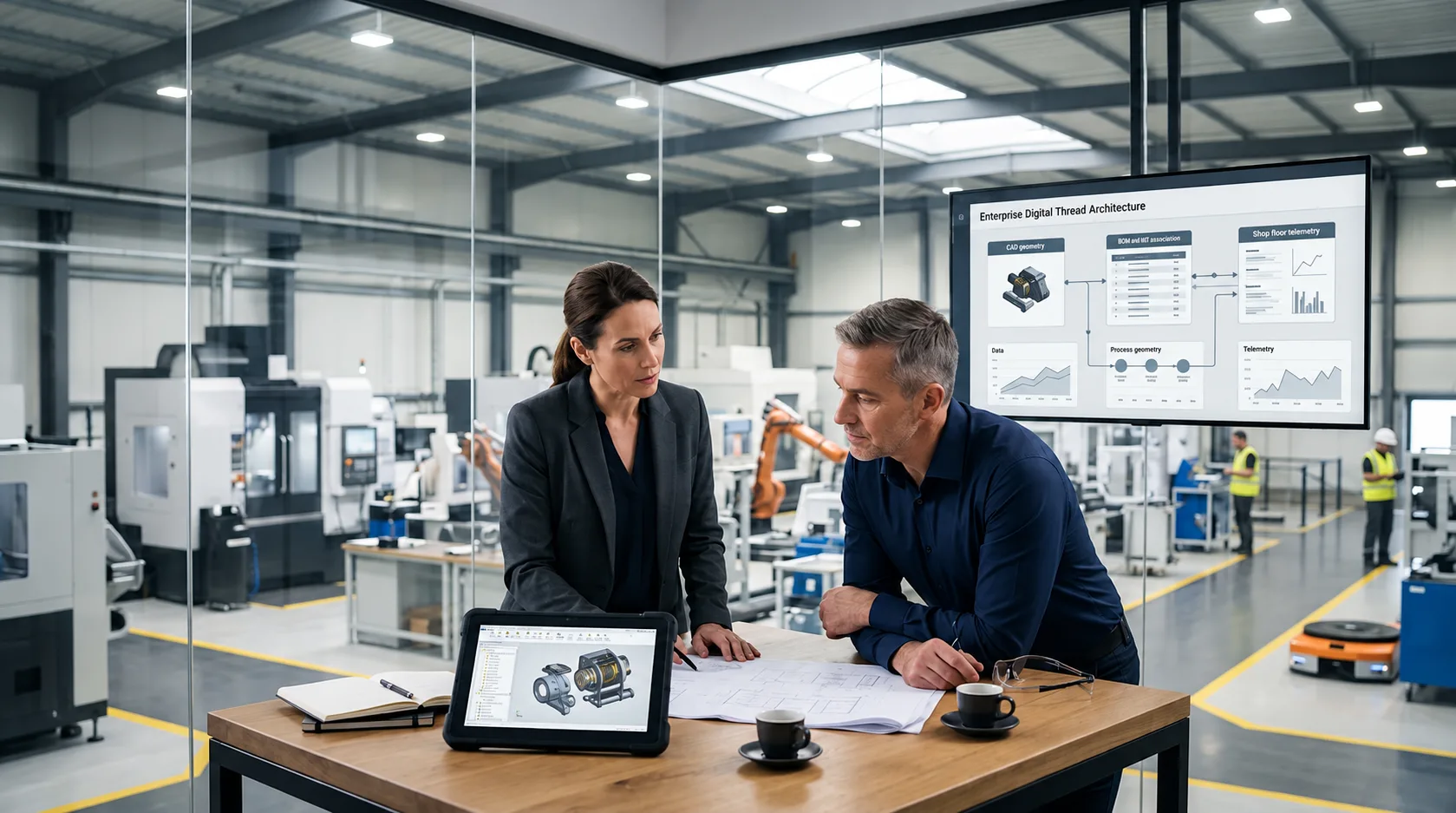
True operational agility requires an unbroken digital thread—a seamless stream of digitized, synchronized product data spanning design, simulation, manufacturing, and field service.
The digital thread cannot begin on the assembly floor; it must originate where the product is authored. In complex discrete manufacturing—such as aerospace, defense, automotive, and medical devices—the core geometric and functional definition lives in 3D CAD platforms like PTC Creo. Modernizing this foundation involves critical architectural transitions:
- Model-Based Definition (MBD): Transitioning from ambiguous 2D drawings to fully annotated 3D models embedding geometric dimensioning and tolerancing (GD&T) directly into the geometry.
- Unified Bill of Materials (BOM) Governance: Aligning the engineering bill of materials (eBOM) with the manufacturing bill of materials (mBOM) inside PLM to prevent discrepancy errors during production release.
- Automated Downstream Consumption: Feeding authoritative CAD design geometry directly into computer-aided manufacturing (CAM), coordinate measuring machines (CMM), and digital work instructions without manual re-keying.
When the engineering source of truth is disciplined and digitally accessible, downstream manufacturing operations can automate with confidence.
How Digital Transformation Consulting Services Build an Executable Roadmap
Navigating the transition from fragmented legacy operations to an integrated enterprise requires structured methodologies. Seasoned digital transformation consulting services do not offer one-size-fits-all software deployments. Instead, they diagnose technical debt, map data dependencies, and co-author a realistic digital transformation roadmap.
Evaluation DimensionIsolated Technology PilotsUnified Digital Thread ArchitectureData ArchitecturePoint-to-point custom integrations; high maintenance overheadCentralized, synchronized PLM/ERP/MES digital threadEngineering SourceStatic 2D drawings requiring manual interpretationSemantic 3D CAD models (MBD) driving downstream automationChange PropagationAsynchronous email threads and PDF sign-offsClosed-loop automated Engineering Change Orders (ECO)Operational ImpactLocalized efficiency gains trapped in functional silosEnterprise throughput, reduced scrap, and shortened time to marketBy engaging experienced engineering advisors like 3HTi, industrial manufacturers evaluate their technical maturity and pinpoint exact integration bottlenecks. Through specialized digital transformation services, leadership teams establish measurable milestones that balance immediate operational wins with long-term technological scale.
The 4-Stage Starting Framework for Industrial Enterprises
For engineering and operations leaders asking where to begin, structured digital transformation consulting services deploy a phased framework that mitigates risk while accelerating time-to-value:
1. The Engineering Baseline and Process Audit
Before purchasing new software, consultants conduct a thorough diagnostic of how engineering artifacts flow through the enterprise. This stage uncovers hidden manual handoffs, redundant data entry points, and legacy CAD migration requirements that compromise data integrity.
2. Digital Product Definition Standardization
Phase two establishes data hygiene at the source. This involves standardizing CAD design modeling practices, harmonizing parameters, and implementing MBD standards. Clean, structured product data is the fuel that powers every downstream manufacturing application.
3. Cross-Functional PLM-ERP-MES Synchronization
Once data authoring is stabilized, consultants align core enterprise systems. The PLM platform is configured as the single source of product truth, feeding released revisions directly into enterprise resource planning (ERP) for procurement and manufacturing execution systems (MES) for shop-floor tracking.
4. Edge Connectivity and Closed-Loop Feedback
With a stable digital pipeline established, manufacturers can integrate Industrial Internet of Things (IIoT) sensors and edge telemetry. Machine utilization data, tolerance deviations, and field performance metrics flow back into engineering, informing real-time design improvements and generative optimization.
Selecting an Advisory Partner: Engineering Expertise vs. Generalist IT
Many enterprise consulting engagements fail because generalist IT firms treat manufacturing transformation as an IT infrastructure project. Industrial transformation is intrinsically mechanical, physical, and operational.
A viable consultancy must understand parametric modeling kernels, tolerance stack-up analysis, PLM release schemes, and machine-tool kinematics. Without deep engineering domain knowledge, consultants cannot anticipate how a minor configuration change in a PLM workflow impacts shop-floor setup times or regulatory traceability. Industrial leaders must partner with advisors who speak the language of engineering design and factory-floor execution.
Conclusion
Embarking on enterprise modernization does not require a disruptive, multi-year overhaul before seeing tangible returns. By partnering with dedicated digital transformation consulting services, industrial manufacturers replace speculative technology investments with an engineering-anchored roadmap. By connecting parametric CAD models, PLM systems, and production operations through an unbroken digital thread, enterprises eliminate scrap, accelerate engineering changes, and establish an adaptable platform for long-term manufacturing competitiveness.
FAQs
Where should a mid-sized manufacturer begin digital transformation?
Manufacturers should begin by auditing the handoff between engineering and production. Resolving discrepancies between CAD models, eBOMs, and shop-floor mBOMs within an integrated PLM system delivers immediate cost reductions and creates the foundation for broader digital initiatives.
What is the core difference between IT transformation and manufacturing digital transformation?
IT transformation typically focuses on back-office operations, cloud infrastructure, and business applications. Manufacturing digital transformation integrates physical operations with digital models, connecting CAD design data, product lifecycle governance, plant machinery, and factory-floor execution systems.
What role does CAD design play in an enterprise digital thread?
CAD design is the foundational origin of the digital thread. The 3D model contains the geometric parameters, material properties, and manufacturing tolerances that downstream systems—such as CAM, CMM inspection, simulation, and automated assembly instructions—rely on to operate accurately.
How does a digital transformation consulting engagement prevent pilot purgatory?
Consultants establish an enterprise architecture baseline before technology selection. They ensure every digital pilot connects to core data repositories (PLM/ERP), addresses measurable operational bottlenecks, and features clear governance criteria for enterprise-wide scaling.