Digital marketing has changed how businesses reach customers, build trust, and generate leads. That is why learning digital marketing can be useful for students, freshers, business owners, freelancers, and working professionals who want to build a new skill.
The right Digital Marketing Course should give you a clear path instead of throwing dozens of topics at you at once. You need to understand the basics first, then learn how each channel works and finally put those skills into practice.
Worth knowing: Google recommends creating content for people first rather than writing only to gain search traffic. Its current guidance also highlights experience, expertise, authority, and trust as useful ways to judge content quality.
What Should You Learn in a Digital Marketing Course?
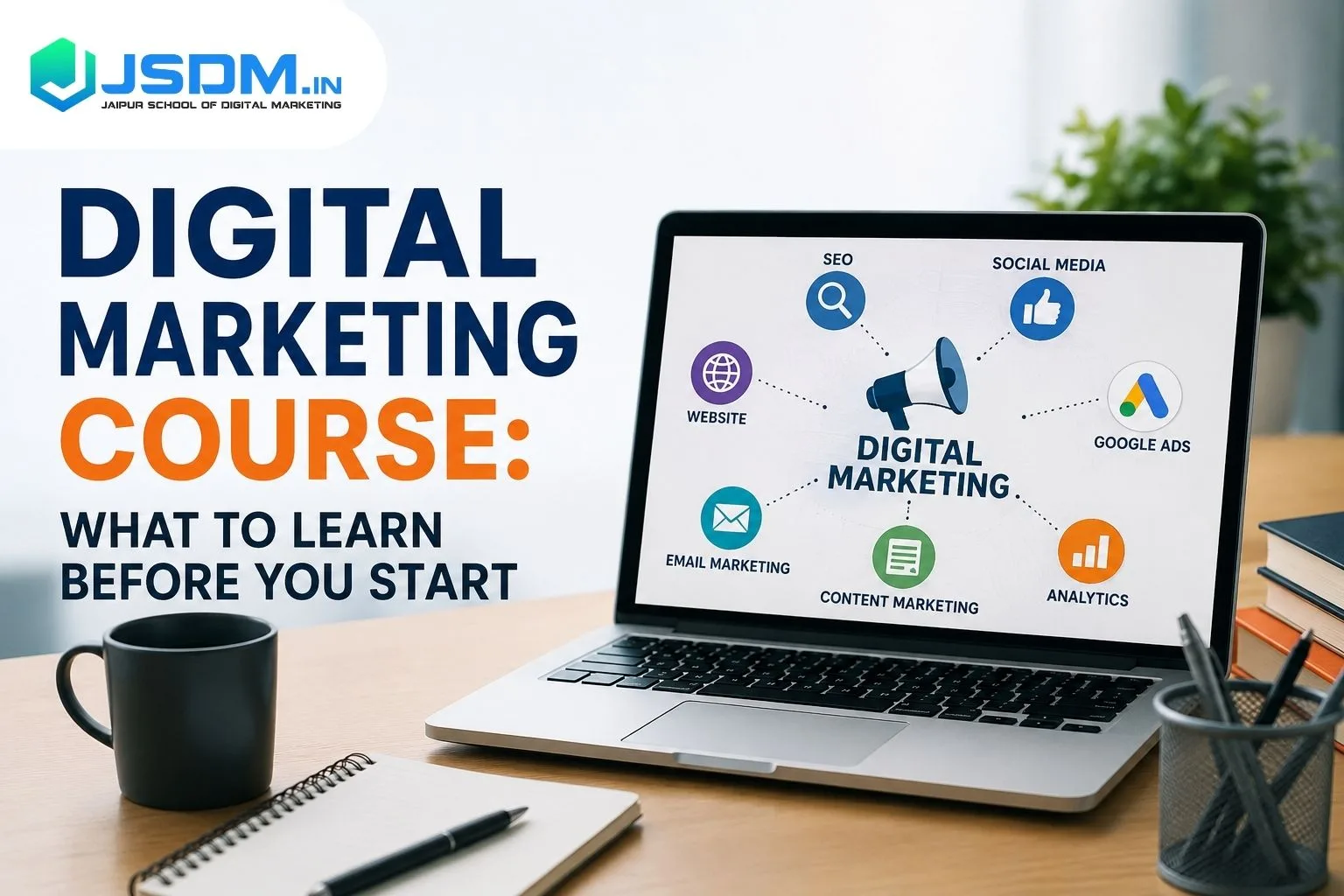
Digital marketing covers many areas, so a useful course should have a broad but structured syllabus. Core topics can include marketing fundamentals, market research, copywriting, content writing, SEO, social media, Google Ads, email marketing, analytics, and website planning.
That's not all. Modern training can also cover WordPress, Shopify, local SEO, affiliate marketing, freelancing, online reputation management, video marketing, and AI tools.
The curriculum published by JSDM lists 50+ modules across areas such as SEO, SMM, Google Ads, WordPress, Shopify, analytics, email, LinkedIn, freelancing, local SEO, SEM, and ORM.
This wide mix matters because digital marketing is not one single job. Different roles need different combinations of skills.
Why Practical Training Matters
Watching videos and reading notes can help you understand a concept. Yet marketing becomes much easier to understand when you actually use the tools and make decisions.
For example, SEO practice can involve keyword research, page optimisation, content planning, and link building. Paid advertising practice can involve campaign setup, audience selection, ad copy, budgets, and performance checks. Social media work can involve planning posts, studying audiences, and reviewing campaign results.
The catch? A certificate alone does not show what you can actually do. A portfolio of useful work can give you something concrete to discuss during interviews or with potential clients.
The JSDM course pages describe practical, real-time project work, live campaigns, assignments, and hands-on learning as parts of their training approach.
Learning Social Media Marketing in Jaipur
Social media is now a key part of many digital campaigns. It can help brands reach specific audiences, share content, build awareness, and support lead generation.
If your main interest is social media, SMM training in Jaipur can help you focus on platforms such as Facebook and Instagram and understand how paid campaigns work.
One useful part of learning SMM is campaign practice. You should learn how to set up campaigns, choose audiences, create suitable ad messages, manage budgets, and check performance rather than only learning definitions.
The official JSDM SMM course page describes a three-week program covering Facebook and Instagram advertising, with classroom and online training and practical campaign work.
Worth knowing: social media changes often, so your learning should also teach you how to test, measure, and improve campaigns instead of relying on one fixed formula.
SEO and Paid Advertising Skills
SEO and paid advertising solve different marketing needs, but both are useful skills to understand.
SEO focuses on helping search engines understand pages and helping users find relevant information through organic search. Google recommends using the words people search for in useful places such as page titles, headings, and descriptive links, while keeping the content helpful and reliable.
Paid advertising works differently. Instead of waiting for organic visibility, marketers create campaigns and pay for selected placements or clicks.
A strong Digital Marketing Course should help learners understand both sides. JSDM's published modules include on-page and off-page SEO, Google Ads, SEM, analytics, and performance marketing.
The goal is not to memorise every tool. It is to understand why a marketer chooses a channel, how the campaign is built, and how its results are measured.
Projects, Trainers, and Career Preparation
Choosing a course is not only about the syllabus. Look at who teaches you, how much practice you receive, and whether you get support when you are stuck.
JSDM states that its founder, Ashish Malik, has more than 15 years of digital marketing experience. Its trainer page also lists instructors with experience in areas such as PPC, SEO, web development, and social media.
That's important because digital marketing is a practical field. A trainer who can explain why a campaign worked, why a page lost traffic, or how a client brief should be handled can add value beyond a textbook.
Career preparation should also include practical tasks, portfolio work, interview preparation, and an understanding of how agencies and businesses operate. JSDM's current program pages mention live projects, mentorship, portfolio building, and career or placement support.
Who Can Learn Digital Marketing?
You do not need to be a marketing graduate to start learning digital marketing. The field includes skills that can be useful across different backgrounds.
Students and freshers may use training to explore career options. Working professionals can add digital skills to an existing role. Business owners can learn enough to understand their online marketing and make better decisions. Freelancers can focus on selected services and build a client portfolio.
For beginners, the best approach is to start with marketing basics and then move into specific channels. Trying to learn everything at once can make the subject feel harder than it is.
The current JSDM program information says its training is intended for groups including students, freshers, working professionals, freelancers, marketers, business owners, and agency owners.
The key is simple: choose the learning path that matches your actual career goal.
How to Choose the Right Training
Before joining any Digital Marketing Course, compare the course structure instead of choosing only by price or the word "best" in an advertisement.
First, check the syllabus. Does it cover the skills you want to learn? Next, ask how much of the course involves practical work. You should also check the training mode, class schedule, trainer background, project work, study material, and support after classes.
Worth checking: ask whether you will build something that can become part of your portfolio. That could be a website, SEO work, content plan, social campaign, paid advertising exercise, or another practical project.
Also check current course details directly with the institute because batches, fees, schedules, and offers can change. The official contact page currently lists a Jaipur centre in Mansarovar and provides contact details for enquiries.
A careful comparison can help you avoid choosing a course based only on promotional claims.
Conclusion
Digital marketing is a broad field, so the quality of your training depends on more than the course title. Look for a clear syllabus, practical tasks, experienced trainers, project work, and support that helps you apply what you learn.
A good Digital Marketing Course should leave you with more than notes and a certificate. You should understand how different marketing channels work and have enough practical exposure to keep building your skills.
That's the real value of learning digital marketing: you develop skills that can be used across businesses, agencies, freelance work, and your own projects.
Google's current Search guidance also supports this people-first approach. Useful, original content should satisfy the reader rather than exist only to target search engines.
FAQs
Is a Digital Marketing Course suitable for beginners?
Yes. Beginners can start with marketing fundamentals and gradually move into SEO, social media, advertising, content, analytics, and other areas. A structured course can make the learning path easier to follow.
What is covered in digital marketing training?
Topics vary by program. JSDM's published curriculum includes marketing fundamentals, SEO, content, SMM, Google Ads, analytics, WordPress, Shopify, email, local SEO, SEM, freelancing, ORM, and other modules.
Is SMM training in Jaipur useful for beginners?
It can be useful if you want to focus on social media advertising. Practical SMM training should cover campaign setup, audience targeting, ad creation, budgets, and performance tracking rather than theory alone.
Should I learn SEO or social media first?
There is no single answer. If you enjoy search, websites, research, and content, SEO may suit you. If you prefer social platforms, creative work, audiences, and campaigns, SMM may be a better starting point.
Can digital marketing be learned without a technical background?
Yes. Many digital marketing tasks do not require advanced programming. You can start with basic marketing concepts and build technical skills such as website management, analytics, SEO, and advertising as you progress.