
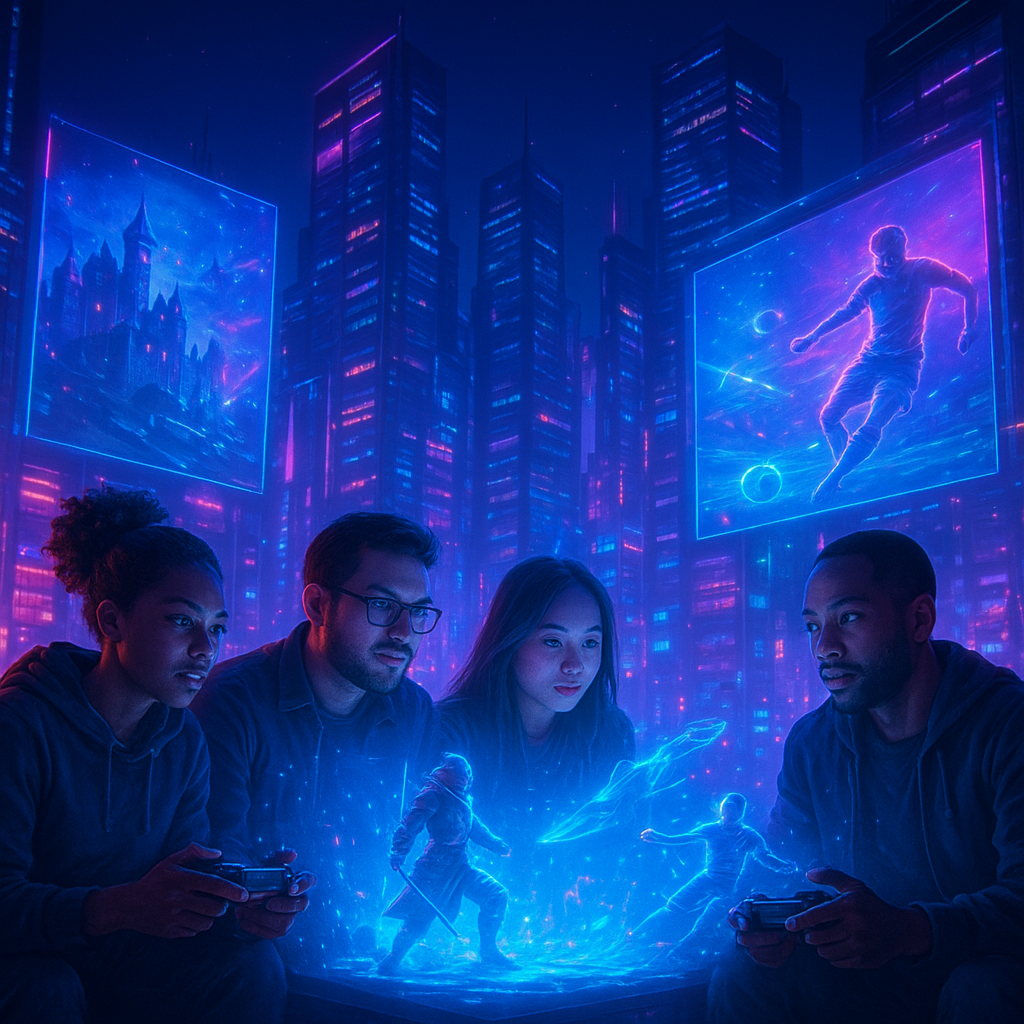
Immersed in Pixels: The Rise of Video Games as a Cultural Force
It is estimated that by early 2026, over 3.5 billion people worldwide engage in video gaming regularly, crossing diverse demographics and geographies. From the dimly lit arcades of the 1980s to today's sprawling virtual worlds rendered in photorealistic detail, video games have evolved from niche entertainment into a dominant cultural and technological phenomenon. In bustling urban centers and remote villages alike, gaming now influences social interactions, creative expression, and even economic models.
Consider the city of Seoul, South Korea, where competitive gaming isn’t just a pastime but a national sport drawing millions of spectators both in arenas and via streaming platforms. The global esports industry alone generated an estimated $2.8 billion in revenue in 2025, a figure that continues to surge, reflecting the sector’s economic vitality and cultural relevance.
Yet, video games are more than just entertainment or commerce; they are shaping how societies conceptualize identity, narrative, and community. The rise of massively multiplayer online games (MMOs) and metaverse environments has blurred the lines between reality and virtuality, prompting new questions about social norms and human connection.
"Video games have transcended their original purpose as leisure activities to become platforms for social interaction, creative collaboration, and cultural expression," says Dr. Marina Letourneau, professor of media studies at the University of Toronto.
From Pixels to Polygons: Tracing the Evolution of Gaming Technology
The journey of video games from simple pixelated graphics to complex, AI-driven ecosystems is a testament to relentless innovation. The 1972 launch of "Pong" marked the commercial dawn of gaming, but it was the 1990s' 3D graphics revolution and the early 2000s' emergence of online multiplayer that set foundational pillars for the modern industry.
Advances in hardware—such as the leap from 8-bit to 128-bit consoles—paralleled software breakthroughs that introduced open-world exploration and dynamic storytelling. The 2010s saw the rise of mobile gaming, making video games accessible to billions globally, while cloud gaming platforms debuted in the early 2020s, enabling high-fidelity experiences without expensive hardware.
2026 continues this trajectory with the integration of AI-powered game design, procedural content generation, and haptic feedback suits that provide unprecedented immersive experiences. Industry pioneers like NeuralPlay Studios have developed adaptive AI NPCs that learn and evolve with player behavior, creating deeply personalized narratives.
"The future of gaming lies in intelligent worlds that respond uniquely to each player, breaking the mold of static storytelling," notes NeuralPlay CEO Arjun Mehta.
Data-Driven Insights: The Gaming Market and Player Behavior in 2026
According to Statista data, the global video game market revenue surpassed $220 billion in 2025, growing at an annual rate of approximately 8%. Mobile gaming accounts for 45% of this revenue, with console and PC segments making up the remainder. Notably, subscription-based models and in-game purchases drive a substantial portion of income, reflecting shifts in monetization strategies.
Player demographics have diversified significantly. Women constitute nearly 48% of gamers worldwide, and the average gamer age is now 31 years, debunking stereotypes of gaming as a youth-only domain. Social aspects of gaming have also expanded, with 67% of players engaging in multiplayer or social games regularly.
Emerging markets in Southeast Asia, Latin America, and Africa are experiencing explosive growth due to increased smartphone penetration and affordable internet access. This expansion fuels a new wave of culturally localized content, with developers incorporating indigenous stories and aesthetics.
- Top genres by revenue: Action-adventure, Battle Royale, and Role-Playing Games (RPGs)
- Average daily playtime: 1.8 hours globally, with hardcore gamers exceeding 4 hours
- Esports viewership: Estimated at 700 million regular viewers worldwide
These figures underscore not only the economic heft of gaming but also its entrenched role in daily life and entertainment.
2026 Innovations: AI, VR, and Blockchain Transforming Gameplay
The year 2026 marks a pivotal moment in gaming technology integration. Artificial intelligence is now embedded not only in NPC behavior but also in game development pipelines, where machine learning algorithms optimize level design and player experience testing. Virtual reality (VR) has reached new heights with devices offering seamless wireless connectivity and ultra-high-resolution displays, enabling deeply immersive worlds.
Blockchain technology, once viewed as experimental within gaming, has matured to underpin secure in-game economies and digital asset ownership. Non-fungible tokens (NFTs) are now widely adopted for trading unique in-game items, with major publishers collaborating on interoperable marketplaces. This shift empowers players by granting true ownership and resale rights over digital possessions.
Moreover, cloud gaming services have expanded their geographic reach, reducing latency and broadening accessibility. Hybrid cross-platform titles allow seamless play across consoles, PCs, and mobile devices, enhancing community cohesion.
- AI-driven content personalization: Adaptive story arcs and difficulty scaling
- VR hardware breakthroughs: Lightweight headsets with full sensory immersion
- Blockchain adoption: Transparent, player-owned economies with real-world value
These developments are reshaping player expectations and redefining what games can offer, merging entertainment with technology in unprecedented ways.
Voices from the Industry: Experts Reflect on Gaming’s Broader Impact
Leading developers, cultural analysts, and economists emphasize that video games are no longer isolated entertainment but integral to multiple sectors. Dr. Samuel Ortiz, a game sociologist, highlights the medium's role in education and mental health: "Serious games are now employed in therapeutic settings and classroom environments to enhance engagement and learning outcomes."
Financial analysts point to gaming as a bellwether for digital economic trends. The rise of in-game economies mirrors broader shifts towards virtual commerce and decentralized finance.
Meanwhile, creative directors like Lila Chen of the acclaimed indie studio Moonspire Games argue that narrative depth and artistic innovation have never been stronger. "Indie games are pushing boundaries, introducing diverse voices and experimental mechanics that challenge mainstream conventions," she explains. For those interested in exploring this dynamic sector, TheOmniBuzz’s in-depth coverage of indie games offers valuable insights.
Industry leaders also caution about the ethical challenges ahead, including data privacy, addiction risks, and equitable access. The convergence of gaming with social media and virtual economies necessitates ongoing vigilance and regulatory frameworks.
Looking Forward: Trends and Opportunities in the Gaming Horizon
As we look beyond 2026, the trajectory of video games points toward increasingly personalized, interconnected, and immersive experiences. Key trends to watch include the rise of AI-generated games, which could democratize creation by enabling anyone to design rich interactive worlds without coding expertise.
The expansion of the metaverse concept will continue, blending gaming with social networking, commerce, and entertainment into unified digital ecosystems. This evolution raises questions about digital identity, ownership, and governance that will shape policy debates and industry standards.
Moreover, sustainability is becoming a priority. Developers and hardware manufacturers are exploring eco-friendly production methods and energy-efficient technologies to reduce the environmental footprint of gaming.
For newcomers interested in entering this vibrant realm, resources like TheOmniBuzz’s beginner’s roadmap to gaming provide accessible entry points and community connections.
- AI-powered procedural content creation enabling limitless game worlds
- Cross-reality (XR) experiences merging AR, VR, and physical environments
- Enhanced social integration fostering global communities and collaboration
- Regulatory evolution addressing privacy, fairness, and digital rights
- Environmental sustainability in gaming hardware and cloud services
Each of these elements will play a critical role in shaping how video games continue to influence culture, technology, and society at large.
Video games, once a niche pastime, have become a multifaceted phenomenon driving innovation and cultural dialogue worldwide. Their impact extends beyond pixels and code into the fabric of human interaction and creative expression. As this dynamic medium evolves, understanding its history, present, and future is essential for players, creators, and observers alike.