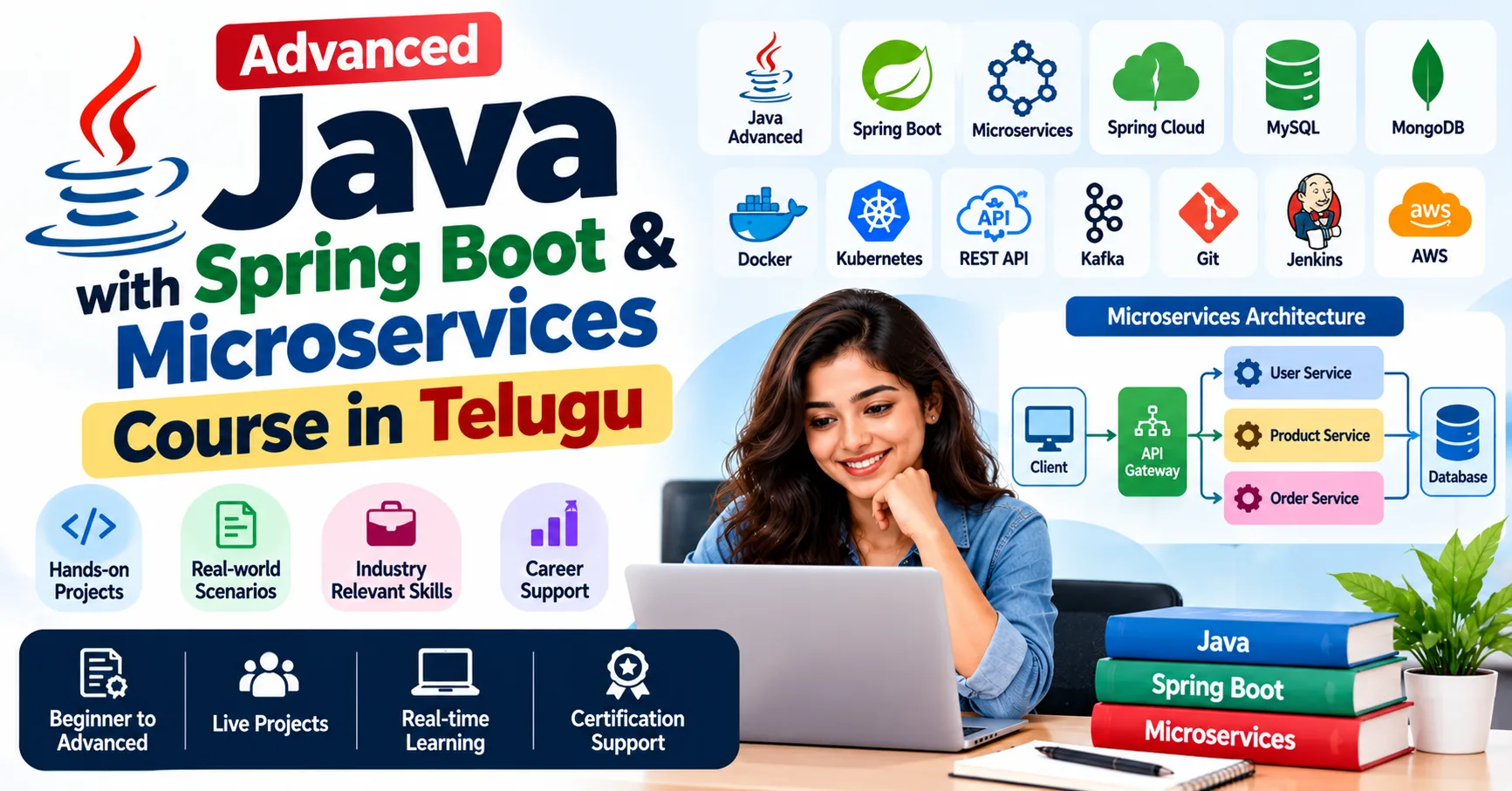
Modern software applications must handle growing numbers of users, increasing amounts of data, and changing business requirements. Traditional monolithic applications can become difficult to maintain and scale as they grow. Microservices architecture provides an alternative by dividing an application into smaller, independent services that communicate with each other. Learning these concepts through an Advanced Java with Spring Boot & Microservices Course in Telugu can help aspiring developers understand modern backend development and build practical application development skills.
What Is Microservices Architecture?
Microservices architecture is a software design approach in which a large application is divided into multiple small, independent services. Each service is responsible for a specific business function and can be developed, deployed, and maintained separately.
For example, an e-commerce application may contain separate services for:
- User registration and authentication
- Product management
- Shopping cart operations
- Order processing
- Payment processing
- Notifications and email alerts
Instead of managing every feature inside one large codebase, developers can organize these functions into individual services. Each service can have its own business logic and, when appropriate, its own database.
This approach can improve flexibility and maintainability, provided that services are designed with clear responsibilities and reliable communication patterns.
Why Are Scalable Applications Important?
Scalability refers to an application's ability to handle increasing workloads without an unacceptable reduction in performance or reliability.
Consider an online shopping platform during a major sale. Thousands of customers may browse products, place orders, and make payments simultaneously. If the application cannot handle this increase in traffic, users may experience slow responses, failed transactions, or service interruptions.
Scalable application development helps teams prepare for such situations.
Important benefits include:
1. Handling increased traffic: Services can be scaled according to their individual workloads.
2. Better maintainability: Smaller services can be easier to understand, test, and update.
3. Independent deployment: A team can update one service without necessarily redeploying the entire application.
4. Improved fault isolation: A failure in one service does not always need to bring down the entire application, especially when suitable resilience mechanisms are implemented.
5. Technology flexibility: Different services may use different technologies when there is a clear technical or business reason to do so.
However, microservices also introduce challenges, including network failures, distributed data management, monitoring complexity, and deployment overhead. They are most useful when the benefits of independent services justify this additional complexity.
How Java Supports Microservices Development
Java is widely used for backend development because of its mature ecosystem, object-oriented programming capabilities, extensive libraries, and support for enterprise applications.
Developers can use Java to implement business logic, process requests, interact with databases, and create APIs. Its strong typing and established development tools also support building applications that are easier to test and maintain.
Before moving into microservices, learners should understand essential Java concepts such as:
- Classes, objects, inheritance, and polymorphism
- Collections and exception handling
- Generics and the Java Stream API
- Multithreading and concurrency fundamentals
- JDBC and database connectivity
- Build tools such as Maven or Gradle
- Unit testing and debugging
A solid Java foundation makes it easier to understand how individual services are implemented and how they interact within a larger system.
The Role of Spring Boot in Microservices
Spring Boot simplifies the process of creating standalone, production-oriented Java applications. It provides auto-configuration, starter dependencies, embedded servers, and integration with the broader Spring ecosystem.
Developers can use Spring Boot to create independent services without configuring every component manually.
Some important concepts include:
1. Creating REST APIs
REST APIs allow services and client applications to exchange information over HTTP. Spring Boot supports API development through annotations such as @RestController, @GetMapping, and @PostMapping.
For example, a product service may expose an endpoint that returns product details in JSON format. An order service can use that information when processing a customer order.
2. Connecting to Databases
Spring Boot integrates with technologies such as Spring Data JPA and Hibernate to simplify database operations.
A product service may store product information, while an order service maintains order records. Separating data ownership can help services evolve independently, although distributed transactions and consistency require careful planning.
3. Validating Requests and Handling Errors
Applications must validate incoming data and return meaningful error responses. Developers can use validation annotations, exception handlers, and appropriate HTTP status codes to improve API reliability.
4. Managing Configuration
Different environments may require different database connections, API addresses, or security settings. Externalized configuration helps teams manage these settings without hardcoding them into application logic.
Essential Components of a Scalable Microservices System
A production-ready microservices application often includes several supporting components.
API Gateway: Provides a common entry point for client requests and can handle routing, authentication integration, and request policies.
Service Discovery: Helps services locate one another when service instances change dynamically.
Inter-Service Communication: Services may communicate synchronously through HTTP APIs or asynchronously through messaging systems, depending on the use case.
Load Balancing: Distributes requests across available service instances to help manage traffic.
Resilience Mechanisms: Timeouts, retries, circuit breakers, and bulkheads can help reduce the impact of service failures when configured appropriately.
Centralized Logging and Monitoring: Helps developers trace requests, identify errors, and understand application performance across multiple services.
Security: Authentication, authorization, secure communication, and appropriate secret management help protect services and their data.
These components should be selected according to application requirements rather than added automatically to every project.
Practical Example: Building an E-Commerce Application
An e-commerce platform is a useful project for understanding how scalable applications can be developed using Java and Spring Boot.
The application can be divided into several services.
User Service: Manages user profiles, registration, and authentication-related functionality.
Product Service: Maintains product details, categories, prices, and inventory information.
Order Service: Creates orders and tracks their status.
Payment Service: Integrates with a payment provider and processes payment-related events.
Notification Service: Sends order confirmations and status updates.
A simplified workflow looks like this:
- A customer selects a product and submits an order.
- The Order Service validates the request and records the order.
- The required services coordinate inventory and payment processing.
- The system updates the order status based on the outcome.
- The Notification Service sends a confirmation when appropriate.
In a real implementation, developers must account for payment failures, duplicate requests, unavailable services, and partial transaction failures. Techniques such as idempotency, event-driven communication, and saga patterns can help manage these situations.
Steps to Develop Scalable Microservices Applications
Developing microservices requires more than splitting a codebase into smaller projects. A structured approach helps ensure that each service has a clear purpose.
Step 1: Identify Business Responsibilities
Start by identifying the application's main business functions. Define service boundaries around cohesive responsibilities rather than dividing the system arbitrarily.
Step 2: Design API Contracts
Specify request formats, response structures, validation rules, and error handling before connecting services. Clear contracts make integration and testing easier.
Step 3: Build Services with Spring Boot
Create separate Spring Boot applications for the required services. Organize the code into appropriate layers, such as controllers, services, and repositories.
Step 4: Implement Data Management
Choose suitable storage and data ownership strategies. Avoid unnecessary shared database dependencies that tightly couple otherwise independent services.
Step 5: Add Security and Resilience
Implement authentication and authorization, configure timeouts, and introduce suitable error-handling strategies. Ensure that failures are handled without creating uncontrolled retry loops.
Step 6: Test the Application
Use unit tests, integration tests, and API tests to verify individual services and their interactions. Test failure scenarios as well as successful requests.
Step 7: Deploy and Monitor
Deploy services using an appropriate environment. Containerization with Docker and orchestration platforms such as Kubernetes may be useful when the application's operational needs justify them.
Monitor latency, error rates, resource usage, and service health to identify bottlenecks and scaling requirements.
Real-Time Projects to Practise
Practical projects help learners connect theoretical concepts with development tasks.
1. E-Commerce Backend: Build product, order, user, and payment-related services with clear API contracts.
2. Online Learning Platform: Create course, enrollment, user, and notification services.
3. Banking Transaction Simulator: Develop account and transaction services, focusing on validation, audit trails, idempotency, and secure access.
4. Food Delivery Application: Build restaurant, order, delivery tracking, and notification services.
5. Employee Management System: Create employee, department, leave, and reporting services.
For each project, focus on API design, database integration, testing, error handling, logging, and documentation. Start with a small working system and introduce additional infrastructure only when you understand the problem it solves.
Common Mistakes to Avoid
Microservices can create unnecessary complexity if they are not designed carefully. Avoid these common mistakes:
- Splitting an application into too many services too early.
- Creating services that depend heavily on one another.
- Sharing databases without clearly defined ownership.
- Ignoring authentication and authorization.
- Using retries without timeouts or retry limits.
- Failing to monitor requests across services.
- Testing services individually without testing their integration.
- Choosing Kubernetes or other infrastructure before understanding deployment requirements.
For many small applications, a well-structured monolithic application is a reasonable starting point. Microservices become more attractive when independent scaling, deployment, team ownership, or fault isolation provide meaningful benefits.
Career Opportunities in Java and Microservices Development
Learning Java, Spring Boot, REST API development, database integration, testing, and microservices architecture can support preparation for several software development roles, including:
- Java Developer
- Backend Developer
- Spring Boot Developer
- Microservices Developer
- Software Engineer
- API Developer
Employers may also look for practical knowledge of Git, SQL, automated testing, cloud fundamentals, Docker, CI/CD pipelines, and application monitoring.
Career opportunities depend on an individual's technical skills, project experience, interview performance, and the requirements of the role. Building and documenting complete projects can help demonstrate practical ability.
Frequently Asked Questions
1. What is the main purpose of microservices?
Microservices organize an application into independently managed services, helping teams develop, deploy, and scale specific business functions separately.
2. Is Java suitable for microservices development?
Yes. Java and Spring Boot provide mature tools for building REST APIs, integrating databases, implementing business logic, and developing backend services.
3. Should beginners learn Spring Boot before microservices?
Beginners should first understand core Java and basic backend development. Learning Spring Boot, REST APIs, and database integration before studying distributed systems makes the transition easier.
4. Do microservices always improve application performance?
No. Microservices can improve independent scaling and fault isolation, but network communication and distributed operations introduce overhead. Good architecture and performance testing are essential.
5. Which tools are useful for microservices development?
Common tools include Java, Spring Boot, Maven or Gradle, Git, SQL databases, API testing tools, Docker, messaging systems, and monitoring solutions. The exact combination depends on the application.
6. How can I practise microservices development?
Start with a small Spring Boot REST API, add database integration, and then build a second service that communicates with it. Gradually introduce testing, security, resilience, and deployment practices.
Conclusion
Developing scalable applications using microservices requires a combination of Java programming, Spring Boot development, API design, database management, testing, security, and distributed systems fundamentals. By learning these concepts step by step and applying them to practical projects, aspiring developers can build a stronger foundation in modern backend engineering.
Focus on understanding why each architectural decision is necessary, not just how to implement it. A well-designed application should meet its business requirements, remain maintainable, and scale appropriately as its workload grows.