
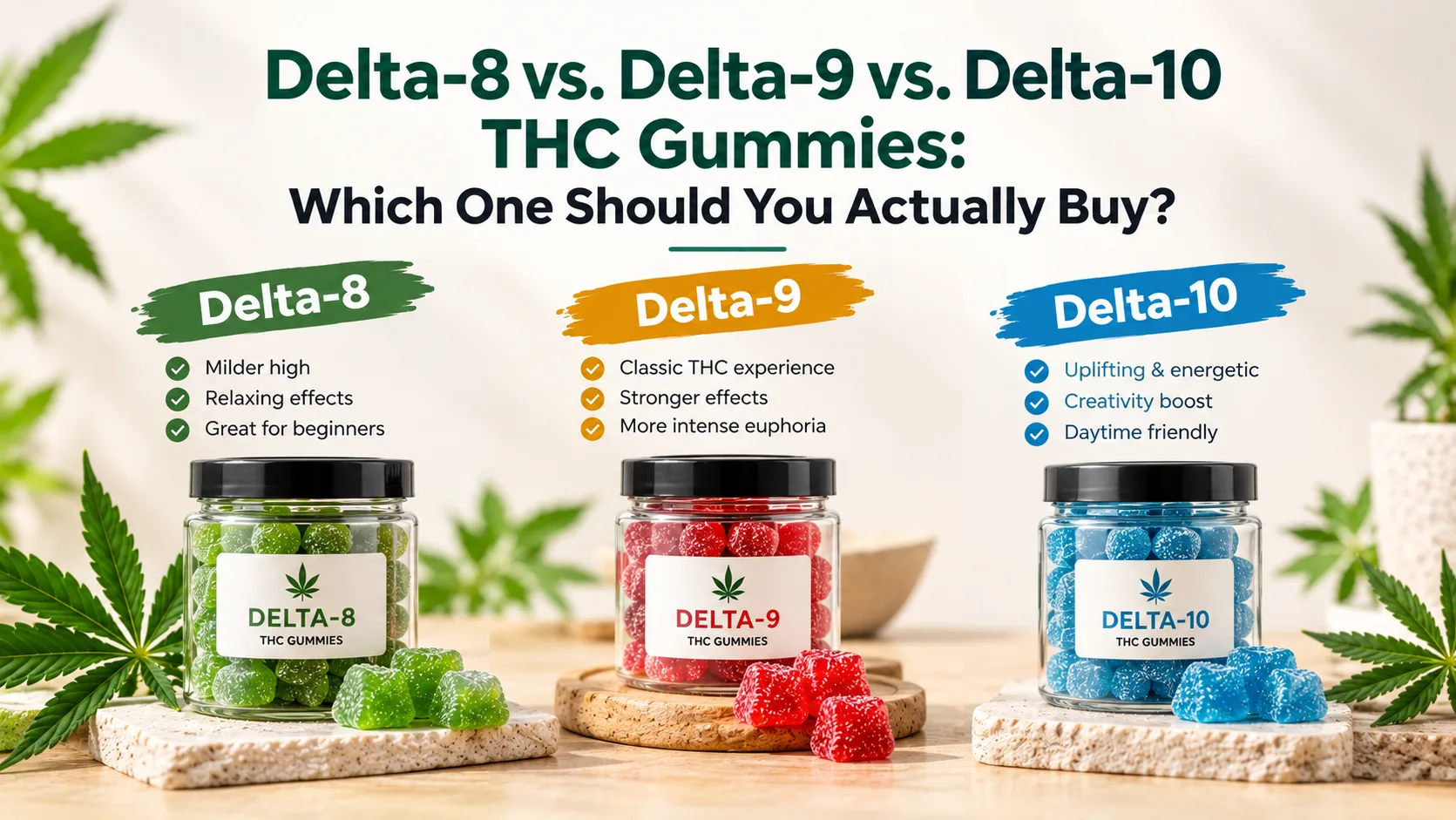
Scroll through a shelf of THC gummies and you'll notice they're not all labeled the same way. Some say Delta-9. Others say Delta-8. A smaller but growing number say Delta-10. They all fall under the "THC gummies" umbrella, but the cannabinoid behind each one changes the experience in ways that actually matter — intensity, legal status, and even the time of day you'd reach for one.
This guide breaks down what separates these three cannabinoids, how the gummy experience differs between them, and how to figure out which one actually fits what you're looking for.
The Core Difference: Molecular Structure, Real-World Effect
Delta-8, Delta-9, and Delta-10 are all isomers of THC — meaning they share the same chemical formula but differ in where a double bond sits on the molecule. That small structural difference is enough to change how each one interacts with your body's cannabinoid receptors, which is why the three produce noticeably different experiences despite being closely related compounds.
Delta-9 THC is the cannabinoid most people mean when they say "THC" — it's the one responsible for cannabis's classic, well-known euphoric high. In the hemp-derived gummy market, Delta-9 products are formulated to stay at or under the federal 0.3% threshold by dry weight, which is what makes them legal to sell under the 2018 Farm Bill despite containing the same cannabinoid found in traditional cannabis.
Delta-8 THC occurs naturally in the plant only in trace amounts, so most commercial Delta-8 is produced through a conversion process starting from CBD. It's intoxicating, but generally described as milder and smoother than Delta-9 — often characterized as a more clear-headed, relaxed experience without the intensity some people associate with Delta-9.
Delta-10 THC is a newer, less common cannabinoid in the hemp market, also typically produced through a conversion process. It's generally described as more energizing and uplifting than Delta-8 or Delta-9 — closer to a sativa-style effect, with less of a heavy body sensation.
Comparing the Gummy Experience
Intensity. Delta-9 is generally considered the strongest of the three per milligram, which is part of why Delta-9 gummies often come in lower mg doses (2–5mg per piece for beginners) compared to Delta-8 gummies, which are frequently sold in 25mg or even 50mg doses to achieve a comparable effect.
Feel and character. Users commonly describe Delta-9 as the most classic, full-spectrum "high," Delta-8 as smoother and more relaxed, and Delta-10 as lighter and more energizing or focus-oriented. These are general patterns reported across the category, not guarantees — individual response to any cannabinoid varies based on body chemistry, tolerance, and the specific product.
Onset and duration. All three follow the same general edible timeline regardless of cannabinoid — expect 60–90 minutes for onset (sometimes longer) and 4–8 hours of total duration, since the delay comes from digestion and liver metabolism, not the cannabinoid itself.
Legal status. This is the area with the most real variation. Delta-9 hemp gummies are federally legal under the 0.3% threshold but some states restrict or ban hemp-derived Delta-9 products specifically. Delta-8 occupies genuinely unsettled legal ground — some states have banned or restricted it outright even though it's federally derived from legal hemp. Delta-10 is less commonly regulated simply because it's newer and less widespread, but that could change as more states catch up with Delta-8-style restrictions. Always check your specific state's current rules before buying, since this is one of the more actively shifting areas of hemp law.
Which One Should You Choose?
If you want the most classic, well-documented cannabis experience — Delta-9 is the closest to what most people associate with "a THC gummy," and it's the most widely available and tested cannabinoid in the category.
If you want something milder, more relaxed, and more forgiving for a first try — Delta-8 is often recommended for people who want to ease into THC gummies without the intensity some associate with Delta-9, though doses can run higher in mg terms to compensate.
If you're looking for something more energizing for daytime use — Delta-10 is the cannabinoid most associated with a lighter, more uplifting effect, making it a common choice for people who don't want a heavy, sedating experience.
If you're not sure — Starting with a low-dose Delta-9 gummy (2.5–5mg) is a reasonable default, since it's the most studied and widely available option, and the low starting dose limits the risk of an uncomfortably strong first experience regardless of which cannabinoid you eventually settle on.
Blended and Specialty Formulations
Beyond single-cannabinoid gummies, many brands now offer blends designed around a specific goal:
- CBD/THC blends pair a lower THC dose with CBD, often marketed for a more balanced, less intense experience than THC alone.
- CBN-infused blends combine THC with CBN, a cannabinoid commonly associated with nighttime and sleep-focused formulations.
- CBG blends pair THC with CBG for what some brands market as a more "clear-headed" combination.
These blends exist precisely because the three main THC isomers aren't a one-size-fits-all answer — mixing cannabinoids lets brands target more specific use cases than a single-cannabinoid gummy can.
You can browse the full range — Delta-8, Delta-9, Delta-10, and blended formulations — in our edibles & gummies category.
What to Check Before Buying, Regardless of Cannabinoid
- A current, batch-specific Certificate of Analysis (COA) confirming which cannabinoids are actually present and at what concentration — this matters even more with Delta-8 and Delta-10 since conversion processes can leave behind unwanted byproducts if not done carefully. Check ours on our Lab Reports page, and our guide to reading a hemp COA explains exactly what to look for.
- Milligram dose per gummy, and whether that dose is appropriate for the specific cannabinoid (remember: Delta-8 doses often run higher than Delta-9 doses for a comparable effect).
- Your state's current legal status for each cannabinoid, since this is one of the more actively shifting areas of hemp regulation.
- Manufacturing transparency — a reputable brand should be able to explain how their Delta-8 or Delta-10 was produced, not just that it tests compliant.
Start Low Regardless of Which You Choose
No matter which cannabinoid you land on, the same beginner guidance applies across the board: start with the lowest available dose, wait a full two hours before deciding whether you need more, and take it with a small amount of food for a more predictable experience. The slow, digestive onset of a gummy is the same regardless of whether it's Delta-8, Delta-9, or Delta-10 — the cannabinoid changes the character of the effect, not the timeline.
The Bottom Line
Delta-9, Delta-8, and Delta-10 gummies all deliver THC through the same slow-onset, edible pathway, but the cannabinoid behind each one shapes a genuinely different experience — Delta-9 for the most classic and well-documented high, Delta-8 for something milder and more relaxed, and Delta-10 for a lighter, more energizing effect. None is universally "better"; the right pick depends on the kind of experience you're after and what's legal where you live.
Not sure where to start? Stop by our Pineville, NC store and our staff can walk you through the differences in person, or browse the full edibles & gummies lineup and check lab results before you buy online. You can also explore the full shop for other formats if gummies aren't the right fit.