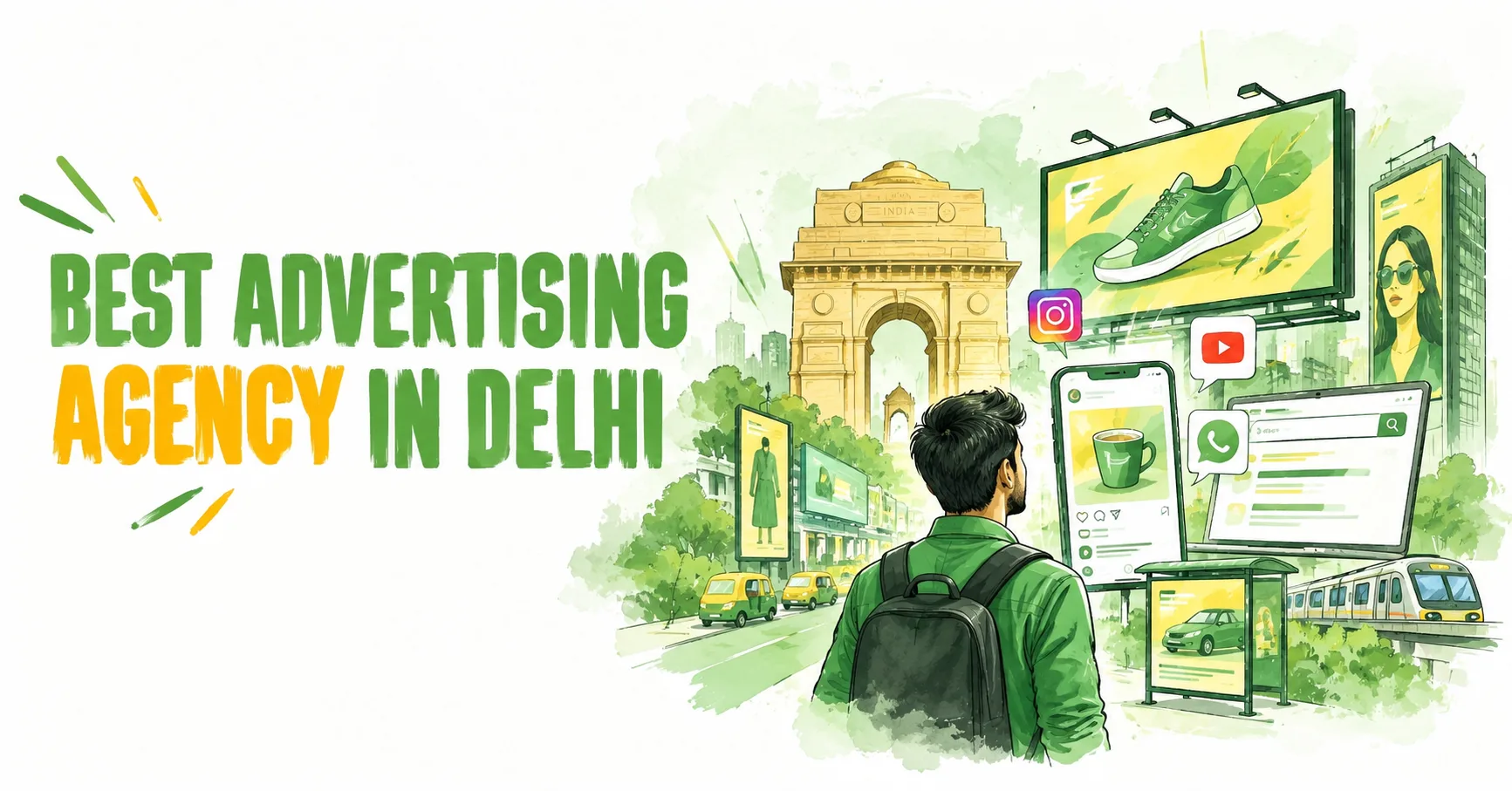
Delhi is a noisy market for brands.
A customer can notice a billboard while travelling, scroll past a sponsored Reel, search for a service on Google, watch a YouTube review, and receive a promotional message on WhatsApp—all within the same day.
There is no shortage of advertising. There is a shortage of attention that actually means something.
That changes the job of advertising.
For years, brands could focus heavily on reach, frequency, and visibility. Those metrics still have their place, but being seen is no longer enough. A campaign has to give people a reason to pause, understand the message, and remember who said it.
This is where a best advertising agency in Delhi can bring something more valuable than another media plan or a collection of attractive creatives: a clear understanding of what the brand needs to communicate, who needs to hear it, and why that message should matter.
Delhi Has an Attention Problem, Not an Advertising Problem
Walk through a busy part of Delhi, and advertising is everywhere.
Look at a phone, and the same thing happens digitally.
The challenge is not getting another message into the customer's field of vision. It is avoiding the fate of becoming one more message they forget five seconds later.
People have developed habits for filtering commercial content. They skip videos, scroll through posts, ignore banners, and often make quick judgments based on the first few seconds of an interaction.
That does not make advertising ineffective. It raises the standard.
A useful campaign needs to fit the way people actually behave.
A young consumer discovering a fashion brand on Instagram is in a very different mindset from someone searching Google for a lawyer, school, hospital, or B2B service. A person watching a video for entertainment has a different level of purchase intent from someone actively comparing products.
Treating these situations as identical is where many campaigns lose their edge.
A Good Campaign Starts Before Anyone Designs an Ad
The temptation is to begin with the creative.
- “What should the poster look like?”
- “What should the Reel say?”
- “What headline should we put on the search ad?”
Those are useful questions—but they come later.
Before any of them, a Best advertising agency in Delhi should be asking what the customer already knows about the brand and what remains unclear.
Maybe the business has a good product but an indistinct position.
Maybe customers understand the category but cannot see why this particular company is different.
Maybe the product is strong, but the benefit is buried beneath technical language.
Or perhaps the company is speaking to several customer groups with one generic message.
These are communication problems. No amount of visual polish can completely compensate for an unclear proposition.
The better starting point is simple:
What should the customer remember after encountering this brand?
Once that is clear, the creative direction becomes much easier to shape.
The Best Ideas Often Come From Customer Behaviour
Marketing teams have access to plenty of data.
Search queries show what people want to know. Campaign reports reveal what gets clicks. Website analytics show where visitors spend time. Sales teams hear objections directly from potential customers.
Put those pieces together and interesting patterns appear.
Perhaps customers repeatedly ask the same question before buying.
Perhaps a product is being compared with a cheaper alternative even though the brand competes on a completely different benefit.
Perhaps people recognize the company's name but cannot explain what it actually offers.
These observations can become the foundation for advertising.
This is one area where an advertising agency in Delhi can add strategic value. Instead of treating customer data as a reporting exercise, the agency can use it to find the human insight behind the numbers.
The best creative work often starts there.
Creative Does Not Mean Complicated
There is a common misconception that creative advertising needs to be unusual, humorous, or visually elaborate.
Not necessarily.
Sometimes the most effective idea is remarkably simple.
A familiar customer situation can be presented in a way people immediately recognize. A complicated service can be explained through one clear analogy. A product benefit can be demonstrated instead of described.
The creative job is not to make advertising look clever.
It is to make the message easier to notice and remember.
A creative advertising agency should therefore think about the connection between the idea and the brand. If people remember the joke but not the advertiser, the campaign has created entertainment without enough brand value.
Distinctive design, recurring visual cues, an ownable tone and a consistent central idea can help solve that problem.
Stop Asking Every Platform to Do the Same Job
One campaign does not have to look identical everywhere.
In fact, it probably shouldn't.
Someone who searches Google for a specific service is already signalling intent. A person scrolling Instagram may be much earlier in the decision process. Someone watching a product demonstration on YouTube may need more information before taking action.
The platform changes the context.
Search advertising can capture an existing need.
Social content can create interest or familiarity.
Video can demonstrate something that is difficult to explain in a static format.
Outdoor advertising can build broad recognition.
Email can reconnect with an existing audience.
The mistake is choosing a channel first and then forcing the campaign into it.
The better approach is to decide what the brand needs to achieve and select the channels that support that objective.
Digital Advertising Has Made Targeting Easier. It Hasn't Made Messaging Easier.
A digital advertising agency in Delhi can reach remarkably specific groups.
You can build audiences around interests, behaviour, search intent, location and previous interactions with a brand. Campaigns can be tested, adjusted and measured much faster than many traditional advertising formats allow.
But precise targeting cannot rescue a weak message.
If an advertisement does not explain the benefit, targeting more people like the first person who ignored it will not necessarily improve the outcome.
The creative still has to earn attention.
It needs to make sense quickly, fit the audience, and give people a reason to continue.
This is why media buying and creative development should not operate as separate worlds. The people deciding where an advertisement appears need to understand the idea, while the creative team needs to understand the environment in which that idea will be seen.
Performance Numbers Tell You What Happened. They Don't Always Tell You Why.
Modern advertising produces an enormous amount of data.
- Clicks.
- Views.
- Reach.
- Cost per lead.
- Conversions.
- Engagement.
- Frequency.
These numbers are useful, but they can become misleading when treated without context.
Imagine two advertisements.
The first generates inexpensive clicks but very few qualified enquiries.
The second attracts fewer clicks but produces conversations with people who are much closer to buying.
Which one taught the marketing team more?
This is where performance advertising and creative thinking need to work together.
Performance data can reveal where something is happening. Human analysis is needed to work out why.
Perhaps the first advertisement promised something the landing page did not deliver. Perhaps the second spoke to a more relevant customer problem. Perhaps the visual attracted attention, but the offer was unclear.
The numbers should start a conversation rather than end it.
Social Advertising Has to Compete With Everything People Actually Want to See
Social media advertising has a particularly difficult job.
People did not open Instagram, Facebook, or another social platform specifically to see a company's advertisement. They arrived for entertainment, information, conversation, or connection.
That means the ad has to earn its place.
This doesn't require every brand to chase memes or manufacture controversy.
A better approach is to understand what makes the audience stop naturally.
- A product demonstration can work.
- A relatable situation can work.
- A useful explanation can work.
- An unexpected visual can work.
- A strong customer observation can work.
- The common thread is relevance.
If the advertisement feels completely disconnected from the environment in which it appears, people have little reason to give it attention.
Brand Awareness Should Mean More Than Being Recognized
Businesses often say they want greater brand awareness.
Fair enough—but awareness needs definition.
What exactly should people remember?
- A name?
- A product category?
- A particular benefit?
- A distinctive personality?
- A reputation for solving a particular problem?
Suppose someone sees a campaign several times but cannot remember which company created it. The campaign may have generated exposure without building much useful memory.
Now imagine the same person later faces a problem and immediately recalls a particular brand because of an idea or message associated with it.
That is a more meaningful outcome.
Advertising should help create those mental connections.
This is particularly important in crowded categories where several competitors make almost identical promises.
Advertising Services Should Solve Problems, Not Fill a Menu
Many agencies present long lists of advertising services in Delhi.
- Creative development.
- Media planning.
- Social campaigns.
- Search advertising.
- Video production.
- Outdoor.
- Influencer marketing.
- Performance campaigns.
The list can be impressive, but the number of services does not tell a business whether the agency can solve its particular problem.
A better conversation begins with the objective.
- Does the brand need to enter a new market?
- Is awareness low?
- Are people aware of the company but unclear about its offering?
- Is the product being considered but losing at the final stage?
- Is customer acquisition becoming expensive?
- Does the brand look interchangeable with competitors?
Each problem calls for a different response.
Sometimes the answer is a large campaign.
Sometimes it is a sharper proposition and a smaller, more focused media plan.
Good advertising should be proportionate to the problem.
When Creative and Performance Teams Stop Competing
Creative teams and performance teams have historically approached campaigns from different angles.
One thinks about ideas, storytelling, and brand memory.
The other thinks about numbers, acquisition and conversion.
Neither perspective is sufficient on its own.
A memorable campaign that produces no meaningful business outcome has a problem. A campaign optimized entirely around immediate clicks can also struggle if the brand becomes forgettable or indistinguishable.
The opportunity lies in combining the two.
Creative gives the campaign something worth noticing.
Performance measurement shows how people respond.
The resulting feedback can improve the next iteration.
This creates a healthier cycle than declaring one approach more important than the other.
AI Is Changing Production. It Is Not Replacing the Need for Ideas.
AI can now generate copy variations, visual concepts, scripts, and other production assets at remarkable speed.
That is useful.
It also creates a new problem: when every brand can produce more content, producing more content stops being a meaningful advantage.
The scarce resource becomes judgment.
- Which idea deserves attention?
- Which customer insight is worth building around?
- Which claim can the brand genuinely support?
- Which execution feels like this brand rather than any other company using the same AI tools?
These decisions still require people who understand the market and the business.
Google's guidance around generative AI in Search similarly emphasizes useful, original value rather than creating large quantities of low-value material simply to gain visibility.
The same lesson applies to advertising.
Faster production is useful.
Better thinking is still the differentiator.
What Should a Delhi Business Ask an Advertising Agency?
Before signing with an agency, ask questions that reveal how the team thinks.
- How would you describe our customer in one sentence?
- What do you think our current advertising is communicating?
- Where do you see a gap between what we want to say and what customers actually need to hear?
- How would you decide which channels deserve our budget?
- What would you measure beyond impressions and clicks?
- How would creative decisions change if the campaign data contradicted the original assumption?
The answers can tell you more than a large portfolio of attractive work.
A capable advertising company in Delhi should be comfortable discussing business objectives, customer behaviour, creative reasoning and measurement, not just production.
Sociostreet, for example, can bring creative, digital and performance thinking into the same conversation instead of treating every advertising requirement as an isolated deliverable.
A Campaign Should Feel Like One Brand, Not Five Different Departments
Customers do not divide brands into marketing departments.
They see the company.
They may first encounter a social post, later search for the business, visit the website, and eventually speak to sales.
Each interaction contributes to their overall impression.
If every channel uses a different message, personality, and visual identity, the customer has to work harder to understand the brand.
An integrated campaign does not mean every advertisement must be identical.
It means the underlying idea remains recognizable.
A social video may tell the story differently from a billboard. A search ad may use fewer words. A landing page may provide much more detail.
But they should feel as though they belong to the same brand.
Delhi Brands Don't Need to Shout Louder
There is always pressure to increase reach.
- More platforms.
- More posts.
- More impressions.
- More variations.
- More budget.
But more is not always the answer.
Sometimes a brand needs a clearer thought.
Sometimes it needs a better understanding of its customer.
Sometimes the product benefit needs to be explained more simply.
And sometimes the campaign is perfectly capable of attracting attention but gives people no reason to remember the advertiser.
The role of a Best advertising agency in Delhi should be to identify that difference.
Advertising is ultimately a communication discipline.
The media can put a message in front of someone.
Creative thinking gives that message meaning.
Strategy gives it direction.
Measurement tells the team what happened next.
When those pieces work together, advertising becomes less about occupying space and more about earning a place in the customer's mind.
The New Advertising Advantage Is Relevance
Delhi is not going to become quieter.
There will be more platforms, more creators, more brands, and more ways for businesses to communicate with customers.
The answer is unlikely to be simply producing more advertisements.
The brands that stand apart will be the ones that know what they want to be remembered for and can express that idea clearly wherever customers encounter them.
That is what a modern Best advertising agency in Delhi should help create: not just exposure, but meaningful communication that connects the business with the people it actually wants to reach.
The strongest campaigns don't ask customers to pay attention.
They give customers a reason to.
FAQs: Best Advertising Agency in Delhi
1. What does the Best advertising agency in Delhi do?
A Best advertising agency in Delhi should help a business understand its audience, sharpen its message, develop creative ideas, select suitable media, and assess the results. The agency's value should extend beyond producing advertisements.
2. How can I choose an advertising agency in Delhi?
When comparing an advertising agency in Delhi, look at its understanding of customer behaviour, relevant industry experience, creative work, media knowledge, and reporting approach. Ask how the team would solve your specific business challenge.
3. What does an advertising company in Delhi offer?
An advertising company in Delhi may provide campaign strategy, creative development, media planning, digital advertising, social campaigns, video, outdoor advertising, and performance marketing. The exact combination differs from one agency to another.
4. When is a digital advertising agency in Delhi useful?
A digital advertising agency in Delhi can help when a business wants to reach defined online audiences, generate enquiries, promote products, run paid search or social campaigns, or measure customer actions more closely.
5. What makes a creative advertising agency different?
A creative advertising agency places greater emphasis on campaign ideas, messaging, visual concepts, and storytelling. Its job is not simply to make advertisements attractive but to make the brand's message distinctive and easier to remember.
6. What can advertising services in Delhi include?
Advertising services in Delhi can cover campaign planning, creative development, media buying, search campaigns, social advertising, video production, outdoor media, and performance measurement. The right combination depends on the company's objectives.
7. Is digital advertising always better than traditional advertising?
Not necessarily. Digital channels offer detailed targeting and measurement, while traditional media can provide strong visibility and broad geographic reach. The appropriate choice depends on the audience, message, location, and campaign objective.
8. How does social media advertising help brands?
Social media advertising gives brands opportunities to reach specific audience groups and test different creative approaches. Results depend on the quality of the message, audience relevance, platform behaviour and the action the campaign encourages.
9. Why does performance advertising need creative input?
Performance advertising can measure clicks, enquiries, purchases and other actions, but measurement alone cannot create a compelling message. Creative thinking helps determine what customers notice, understand and remember.
10. Can Sociostreet combine creative and performance marketing?
Sociostreet can bring creative strategy, digital communication and performance thinking into the same campaign framework. This allows businesses to consider the idea, audience, media, and measurable outcomes together instead of treating them as disconnected activities.