The growth of blockchain technology and decentralized finance has created new opportunities for businesses looking to build financial applications without depending entirely on traditional centralized infrastructure. Among the most important innovations in this ecosystem are decentralized applications, commonly known as DApps.
A DeFi DApp combines decentralized application architecture with financial functionality to create blockchain-powered solutions for activities such as lending, borrowing, staking, yield farming, decentralized trading, and other digital-asset use cases. For businesses planning to enter this growing ecosystem, selecting an experienced DeFi DApp Development Company can be an important step toward transforming an idea into a functional decentralized application.
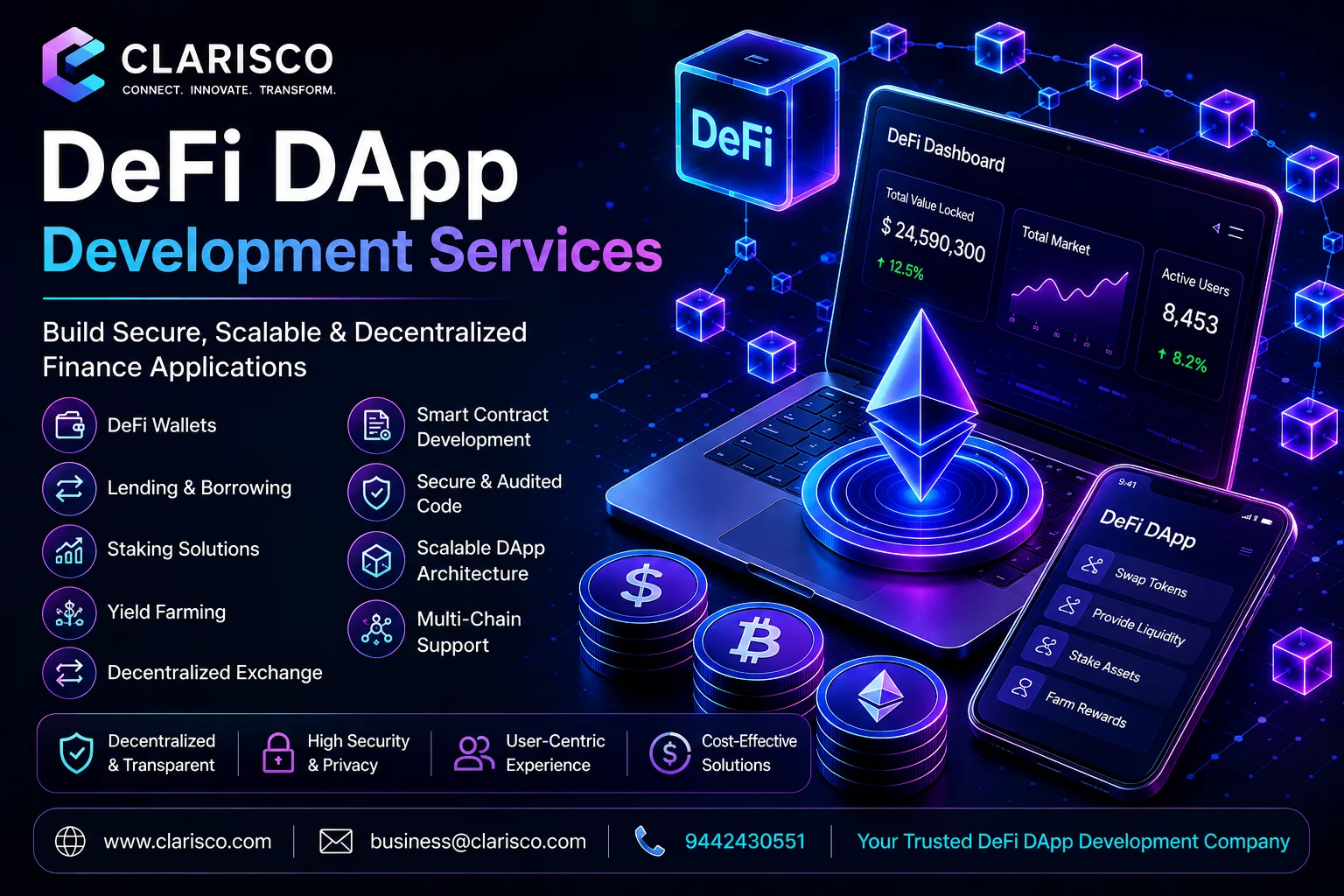
Clarisco provides DeFi DApp Development Services for businesses looking to develop customized decentralized finance applications. Its development offering focuses on blockchain-based applications supported by smart contracts and includes solutions for several DeFi use cases.
What Is a DeFi DApp?
A DeFi DApp is a decentralized application designed to provide financial functionality through blockchain technology. Unlike conventional applications that generally rely on centralized servers and controlling entities, DApps operate through decentralized networks and can use smart contracts to execute predefined functions.
Clarisco's page describes DApps as applications that are not controlled by a central authority and that use peer-to-peer networks, open-source technology, and smart contracts. The page specifically discusses Ethereum-based DApps and financial use cases such as lending, borrowing, transactions, betting, cash flow, and yield farming.
This architecture can give businesses the ability to develop financial applications where transaction records and application logic are connected to blockchain infrastructure.
Why DeFi DApps Are Important
Traditional financial applications typically depend on centralized organizations to manage transactions, records, and access. DeFi DApps introduce another approach by using decentralized networks and programmable smart contracts.
The Clarisco page highlights characteristics such as decentralization, public transaction records, open-source architecture, transparency, privacy, and reduced dependence on intermediaries as important aspects of DApps.
For businesses, this can open opportunities to create financial products designed around blockchain-native users and digital assets.
DeFi DApp Development Services
A professional DeFi DApp Development Company can provide the technical expertise required to combine blockchain infrastructure, smart contracts, application interfaces, and financial functionality.
Clarisco's DeFi DApp Development Services cover the creation of decentralized applications for different financial use cases. The page also references related DeFi development capabilities including smart-contract development, lending and borrowing platforms, DeFi wallets, and yield farming development.
Some of the major areas include:
1. DeFi Lending and Borrowing DApps
Lending and borrowing are among the major use cases of decentralized finance. A DeFi DApp can be designed to facilitate blockchain-based lending and borrowing activities through smart-contract functionality.
Instead of relying completely on a traditional financial intermediary, the application's rules can be implemented through programmable blockchain logic.
Businesses can develop customized lending and borrowing DApps according to their supported assets, blockchain network, user requirements, and financial model.
2. DeFi Yield Farming DApps
Yield farming is another important DeFi use case highlighted on the Clarisco page.
A yield farming DApp can provide users with an interface for participating in decentralized finance protocols according to predefined rules and smart-contract mechanisms.
Businesses interested in this model can develop customized interfaces and blockchain functionality around their intended yield farming ecosystem.
3. DeFi Staking DApps
Staking can also be incorporated into decentralized finance applications. A staking DApp can allow users to interact with blockchain-based staking mechanisms through a decentralized interface.
The development process can involve smart contracts, wallet integration, user dashboards, transaction handling, and blockchain connectivity depending on the project's requirements.
4. Decentralized Trading Applications
DeFi DApps can also be designed for decentralized trading. These applications can connect users with blockchain-based trading mechanisms while reducing dependence on centralized intermediaries.
A development company can customize the application's interface, supported assets, blockchain network, smart-contract functionality, and transaction workflow.
5. DeFi Wallet Integration
Wallets are an important part of the DeFi ecosystem because users need a way to interact with decentralized applications and manage digital assets.
Clarisco's DeFi development offering includes DeFi wallet development alongside DApp development.
Wallet integration can allow users to connect their assets with the DApp and interact with supported blockchain functions.
Smart Contracts in DeFi DApp Development
Smart contracts are a fundamental component of many DeFi DApps. They can encode the rules and conditions that govern transactions and financial operations.
For example, a lending DApp can use smart contracts to manage lending conditions, while a staking application can use them to implement staking-related logic.
Because smart contracts can directly influence financial operations, testing and auditing should be considered important parts of a DeFi DApp development strategy. Clarisco's page specifically emphasizes serious audit and testing before smart-contract deployment because deployed code may not be editable afterward.
DeFi DApp vs Traditional Application
One of the primary differences between a DeFi DApp and a traditional application is the underlying architecture.
Traditional applications generally depend on centralized infrastructure, while DApps can operate through decentralized blockchain networks.
The Clarisco page identifies several differences, including decentralization, blockchain-based data storage, reduced dependence on third parties, extensive testing requirements, public transaction records, and privacy-oriented user interaction.
This makes the development process different from conventional web or mobile application development.
Key Benefits of DeFi DApps
DecentralizationDApps can operate without a single central authority controlling the complete application.
TransparencyBlockchain networks can provide publicly verifiable transaction records, depending on the network and application design.
Data IntegrityBlockchain-based records can provide strong resistance to unauthorized modification.
Reduced IntermediariesDeFi applications can automate certain financial operations through smart contracts, reducing reliance on traditional intermediaries for supported functions.
Open-Source DevelopmentThe Clarisco page highlights open-source characteristics of DApps, allowing code to be examined and potentially improved by developers and communities.
Global AccessibilityDeFi applications can be designed for users connected to the internet, subject to the applicable technical and regulatory requirements.
Important Considerations When Building a DeFi DApp
Developing a DeFi application requires careful planning. Businesses should consider:
- Blockchain network selection
- Smart-contract architecture
- Wallet integration
- User-interface design
- Transaction functionality
- Token standards
- Security testing
- Smart-contract auditing
- Scalability
- Gas and transaction costs
- Backend requirements
- User experience
- Regulatory considerations
The technical architecture should be selected according to the project's actual business requirements rather than simply following a popular blockchain trend.
Why Choose a DeFi DApp Development Company?
Building a DeFi application involves multiple technical layers. A business may need blockchain developers, smart-contract developers, frontend developers, backend engineers, security specialists, and testing professionals.
Working with an experienced DeFi DApp Development Company can bring these capabilities together under one development process.
Clarisco states that it has experience developing DeFi DApps and related blockchain solutions and offers services such as smart-contract development, DeFi lending and borrowing platforms, DeFi wallets, and yield farming development.
How to Start Your DeFi DApp Project
The first step is to define the purpose of the DApp and identify the financial use case.
Next, determine the required blockchain network, smart-contract functionality, token requirements, wallet integration, user interface, and security architecture.
After the technical specifications are finalized, the development team can move through design, smart-contract development, application development, integration, testing, auditing, deployment, and maintenance.
A clearly defined roadmap can help reduce development complexity and ensure that the final DApp remains aligned with its business objective.
The Future of DeFi DApp Development
DeFi continues to be an important area within the broader blockchain ecosystem. As decentralized applications evolve, businesses are exploring new ways to provide financial services through programmable blockchain infrastructure.
DApps can serve as the user-facing layer connecting people with decentralized protocols and digital financial services.
For entrepreneurs and organizations interested in this space, the opportunity is not simply to launch another blockchain application, but to create a useful product with strong technology, intuitive user experience, reliable smart contracts, and a clear business model.
Conclusion
DeFi DApps are changing how businesses can approach blockchain-based financial applications. From lending and borrowing to staking, yield farming, decentralized trading, and wallet-based services, decentralized applications can support a wide range of financial use cases.
Choosing the right DeFi DApp Development Company can help businesses bring together blockchain development, smart contracts, application design, wallet integration, testing, and deployment.
With its DeFi DApp Development Services, Clarisco provides development solutions for businesses looking to explore decentralized finance and build customized blockchain-powered applications.