
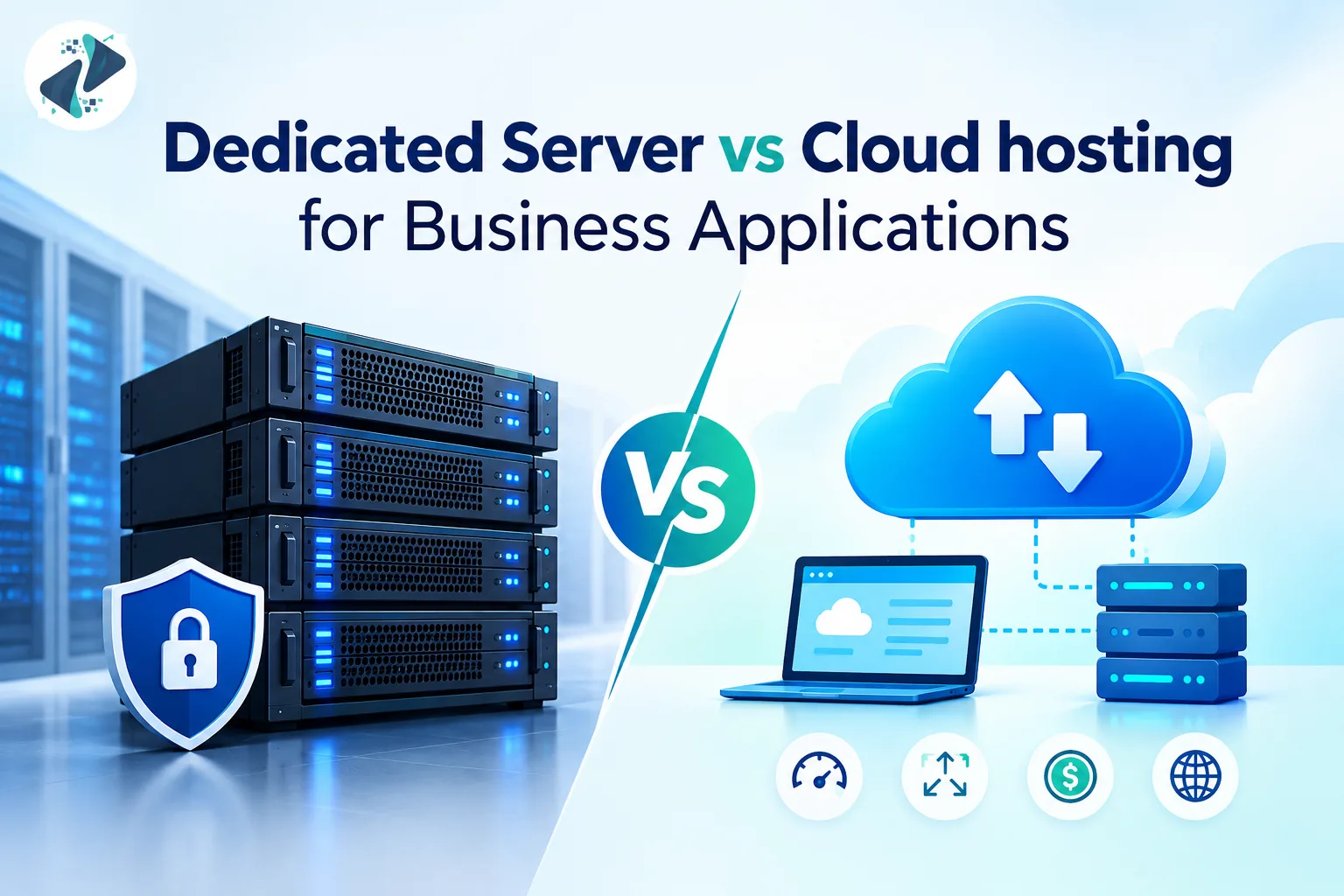
Every business decision that touches your IT infrastructure carries real weight. Choosing the wrong hosting environment for your business applications does not just slow down a website, it can affect your operations, your team's productivity, and ultimately your bottom line.
The debate on dedicated server vs cloud hosting for business applications has been going on for years. And while "it depends" is technically the correct answer, it is not a particularly useful one. What businesses actually need is a clear breakdown of what each option offers, where each one falls short, and how to match the right hosting type to the right use case.
This guide gives you exactly that — a straightforward, practical comparison of dedicated hosting for business versus cloud hosting for business applications, so you can make a decision that fits your actual workload, budget, and growth plans.
What Is a Dedicated Server?
A dedicated server is a physical machine allocated entirely to one client. There is no sharing of CPU, RAM, disk, or bandwidth with other businesses or websites. You get the full resources of that server — period.
This type of hosting is typically used by businesses that run resource-heavy applications, handle sensitive data, or need consistent, predictable performance around the clock. Think database-heavy ERP systems, large ecommerce platforms processing thousands of transactions daily, or enterprise software that cannot tolerate performance fluctuations.
With a managed dedicated server, a hosting provider takes care of the hardware maintenance, security patching, and monitoring — while you retain full control over the software environment. With an unmanaged setup, your in-house team handles everything on top of the hardware.
What Is Cloud Hosting?
Cloud hosting for business applications runs your workloads across a network of virtual servers. Instead of relying on a single physical machine, cloud infrastructure distributes resources dynamically. If one server experiences issues, your workload shifts to another — automatically and without downtime.
The defining feature of scalable cloud hosting is elasticity. You can increase or decrease resources based on demand, often within minutes. You pay for what you use, which appeals to businesses with fluctuating traffic or variable workloads.
Cloud platforms are now the default for startups, SaaS companies, and businesses that need to scale quickly without investing in physical hardware upfront.
Dedicated Server vs Cloud Hosting: A Head-to-Head Comparison
1. Performance and Reliability
This is where dedicated hosting for business typically wins on paper. Because no other tenant is using the server, your applications get consistent access to the full processing power. There is no "noisy neighbor" problem — a common cloud hosting issue where other users on the same infrastructure affect your performance.
For applications that require sustained high performance — such as real-time financial processing, large-scale data analytics, or gaming servers — a dedicated server provides the kind of stable throughput that cloud environments can struggle to guarantee consistently.
That said, modern cloud hosting has come a long way. Enterprise-grade cloud platforms now offer dedicated virtual resources and performance SLAs that approach bare-metal levels for many standard business applications. The gap has narrowed significantly over the past five years.
2. Scalability
Cloud hosting wins this round clearly. Scaling a dedicated server means ordering new hardware, waiting for it to be provisioned, and migrating workloads — a process that can take days. Scaling in the cloud takes minutes, sometimes seconds.
If your business runs a seasonal ecommerce store that sees a 10x traffic spike every November, cloud hosting handles that without panic. You scale up before the rush and scale back down when it passes. You only pay for the elevated resources during the period you actually need them.
Dedicated servers are better suited to workloads with predictable, steady resource demands. They are not the right fit for businesses whose compute needs vary dramatically from week to week.
3. Security and Compliance
For businesses operating under strict regulatory requirements — HIPAA, PCI-DSS, GDPR, or financial services compliance frameworks—dedicated hosting for business often has a natural advantage. You have physical isolation from other tenants, which simplifies compliance audits and reduces the attack surface.
With a dedicated server, you know exactly what is running on the hardware. There are no shared kernel vulnerabilities introduced by neighboring tenants. For industries that handle sensitive customer data, payment information, or medical records, this level of isolation is not just a preference — it is often a requirement.
Cloud environments have made massive investments in security, and major cloud providers now offer compliance-ready configurations for many regulated industries. However, the shared infrastructure model still introduces a layer of complexity when it comes to proving isolation to auditors.
4. Cost Structure
The cost comparison between dedicated server vs cloud hosting is less straightforward than most people assume.
Dedicated servers come with fixed monthly costs — you know exactly what you are paying regardless of usage. For businesses with high, steady workloads, this predictability is a financial advantage. Over time, a dedicated server can be significantly more cost-efficient than paying cloud rates for equivalent compute power at scale.
Cloud hosting offers lower entry costs and pay-as-you-go billing. For businesses just starting out or running variable workloads, the flexibility is genuinely valuable. But as usage grows, cloud bills can escalate quickly — a phenomenon sometimes called "cloud bill shock." Businesses that move large workloads to the cloud without careful cost modeling often find their monthly spend exceeds what a dedicated server would have cost.
5. Management and Control
With a dedicated server, you have full root access and complete control over the server environment. You can configure the OS, install custom software, optimize networking settings, and build an environment precisely tailored to your application's needs. This level of control is valuable for businesses with specific technical requirements that cloud platforms cannot accommodate out of the box.
Cloud environments, while highly configurable, come with constraints. Some configuration options are simply not available on shared cloud infrastructure. Additionally, cloud platforms abstract away much of the underlying infrastructure — which is convenient, but means you are dependent on the provider's decisions about how that infrastructure is managed.
For businesses with experienced DevOps teams that want granular control, a managed dedicated server strikes a useful balance: you get hardware-level isolation and full software control, without having to manage the physical infrastructure yourself.
6. Disaster Recovery and Backup
Cloud hosting has a clear advantage in disaster recovery. Built-in redundancy, geographically distributed data centers, and automated failover are standard features of modern cloud platforms. If a data center goes offline, your workloads can continue running from another region with minimal interruption.
Replicating this level of redundancy with dedicated servers requires significant additional investment — multiple servers in different locations, load balancing, and data replication — all of which adds complexity and cost.
For businesses where continuous availability is critical and downtime has a direct financial cost, cloud infrastructure simplifies the path to strong disaster recovery.
When to Choose Dedicated Hosting for Business
Dedicated hosting makes the most sense when:
Your application requires consistent, high-performance compute that cannot tolerate variability
You handle sensitive data and need physical tenant isolation for compliance purposes
Your traffic and resource usage is predictable and steady throughout the year
You need custom server configurations that cloud platforms do not support
Your business has outgrown shared or VPS hosting and needs dedicated resources at a fixed cost
You are running database-intensive applications where I/O performance is critical
Industries that commonly rely on dedicated servers include financial services, healthcare platforms, enterprise software vendors, large ecommerce operations, and gaming companies.
When to Choose Cloud Hosting for Business Applications
Cloud hosting for business applications makes the most sense when:
Your workload fluctuates and you need the ability to scale resources up or down quickly
You are building or running a SaaS product that needs to grow without infrastructure bottlenecks
You want strong built-in disaster recovery and geographic redundancy from day one
Your team does not have the bandwidth to manage physical server infrastructure
You are in an early growth phase and want to keep upfront costs low while retaining flexibility
You are deploying globally and need your application closer to users in multiple regions
Startups, SaaS companies, digital agencies, and businesses with globally distributed teams are natural fits for scalable cloud hosting.
What About VPS Hosting?
VPS hosting — a virtual private server — sits between shared hosting and a dedicated server. It uses virtualization technology to partition a physical server into isolated environments, each with its own allocated resources. Unlike shared hosting, neighboring accounts do not directly compete for your resources. Unlike a dedicated server, the underlying hardware is still shared.
VPS hosting is a practical option for businesses that have outgrown shared hosting but do not yet need the full resources or cost of a dedicated server. It offers more control and better performance than shared hosting at a lower price point than dedicated.
For businesses running moderate-traffic websites, development environments, or business applications with manageable resource demands, VPS hosting is a solid middle ground worth considering before committing to dedicated infrastructure.
Hybrid Approaches: The Best of Both Worlds
Many businesses find that the dedicated vs cloud debate is a false binary. A hybrid infrastructure — combining dedicated servers for core, performance-sensitive workloads with cloud resources for variable or overflow workloads — often delivers the best outcome.
For example, a business might run its primary database and application servers on dedicated hardware for performance and compliance reasons, while using cloud infrastructure for content delivery, backup storage, and handling traffic spikes. This approach lets businesses optimize cost and performance simultaneously, rather than forcing an all-or-nothing choice.
Final Thoughts
The dedicated server vs cloud hosting decision is not about which option is objectively better. It is about which option is better for your specific workload, your team, your budget, and your business goals.
Dedicated servers offer raw performance, physical isolation, and predictable costs — making them the right choice for businesses with stable, resource-intensive workloads and compliance requirements. Cloud hosting for business applications offers flexibility, built-in redundancy, and rapid scalability — making it the right choice for businesses with variable demands and fast growth trajectories.
Most mature businesses will eventually run some version of a hybrid model. Starting with a clear understanding of your actual requirements — rather than defaulting to whatever is trending — is how you avoid costly infrastructure mistakes.
Whether you are evaluating dedicated hosting, cloud hosting, or VPS hosting for your business applications, make the decision based on where your workload actually sits today and where you plan to be in the next two to three years. Infrastructure decisions made with that kind of clarity tend to hold up well.
To Know More Information Visit : https://www.vps9.net/blog/