Talk to a few SOC leads hiring junior analysts this year, and you hear the same frustration almost every time. A single entry-level job post pulls in two hundred resumes in forty-eight hours, and nearly all of them follow the exact same template. You see a degree or bootcamp, two foundational badges, and a dense skills grid packed with twenty-five or thirty enterprise tool names.
Once the shortlists move to a thirty-minute technical screen, though, most candidates hit a wall on the very first live check. Nobody is asking them to reverse-engineer an advanced exploit. The interviewer simply puts up a short Windows authentication log alongside an unusual outbound DNS lookup and asks a straightforward question: Is this real activity, and what do you verify next?
This disconnect has quietly become the defining reality of cybersecurity hiring in 2026. The problem is no longer a shortage of people applying for entry-level roles. The problem is that traditional, keyword-stuffed resumes no longer predict whether a candidate can read raw telemetry and make a sound call under time pressure.
Understanding why the old hiring playbook broke—and what modern Security Operations Centers actually test during live interviews—is the difference between sending out hundreds of unanswered applications and landing an offer.
How AI-Assisted Triage Rewired the Entry-Level SOC Floor
To understand why hiring standards shifted so sharply, look at what happened to Tier-1 SOC work over the past twenty-four months. In 2021 and 2022, a junior analyst spent most of an eight-hour shift doing repetitive mechanical work: copying IP addresses into threat intelligence portals, checking whether a user was on vacation, pulling the last twenty-four hours of login history across three dashboards, and pasting screenshots into a ticketing template.
By late 2026, automated SOAR playbooks and AI triage agents have absorbed most of that first-pass enrichment. When an alert fires today, an automated workflow has already queried the endpoint agent, checked the file hash against threat feeds, pulled the user's department from the identity provider, and drafted a three-sentence summary before a human analyst even opens the ticket.
That shift did not eliminate entry-level analysts, but it completely changed what they are paid to do. Organizations no longer hire Tier-1 analysts to act as human copy-paste relays between consoles. They hire analysts to verify evidence, spot where an automated summary missed crucial context, recognize telemetry blind spots, and decide cleanly whether an event requires immediate containment or closure.
This operational reality mirrors the competency-based model outlined in the NIST Workforce Framework for Cybersecurity (SP 800-181 Rev. 1), commonly known as the NICE Framework. Rather than treating job readiness as a checklist of buzzwords, the NICE Framework defines cybersecurity roles through specific Tasks, Knowledge, and Skills (TKS)—focusing strictly on what an analyst can execute and prove on the job.
Three Resume Traps That Quietly Disqualify Candidates
Most aspiring analysts are not getting rejected because they lack motivation or study hours. They get filtered out because their resumes follow outdated advice designed for a very different hiring market.
1. The Thirty-Tool Laundry List
Listing Splunk, Microsoft Sentinel, QRadar, Wireshark, Nmap, CrowdStrike, Burp Suite, Metasploit, and Nessus in a single bulleted block used to help candidates pass automated applicant tracking screens. Today, hiring managers treat a thirty-tool skills section as a red flag rather than an asset.
When an interviewer sees twenty-five enterprise tools on an entry-level resume, they know the candidate has not operated all of them in production. The standard interviewer response is simple: pick one specific tool from the middle of the list and drill into it for five minutes. If you cannot explain how you actually wrote a detection query, parsed a log field, or handled a false positive in that tool, credibility evaporates immediately.
2. Certificate Collecting Without Case History
Earning three or four foundational certifications in six months without a single documented technical investigation signals exam-prep stamina, not operational readiness. Hiring leads have interviewed too many candidates who can recite the seven layers of the OSI model and define asymmetric encryption cleanly, yet freeze when asked to inspect a failed login burst or trace a suspicious parent process.
A practical rule holds across almost every modern SOC hiring panel: one respected foundational certification paired with eight to ten documented lab investigations consistently beats three certifications with zero written case work.
3. Vague Lab Bullets With Zero Artifacts
Many candidates now build home labs, which is a genuinely useful step—but they still describe them poorly on paper. A resume bullet that reads "Monitored SIEM alerts, analyzed network traffic, and performed threat hunting in a virtualized lab" tells a hiring manager nothing verifiable.
Strong operational resumes follow a strict editing test: every technical bullet should name a concrete log source, tool, decision, or artifact. Instead of claiming broad monitoring experience, a candidate who writes "Ingested Windows Security and Sysmon logs into a local SIEM to detect encoded PowerShell execution and scheduled-task persistence, documenting root-cause timelines and suppression rules" immediately gives the interviewer something concrete to test and trust.
Five Practical Gates Modern SOC Teams Test Live
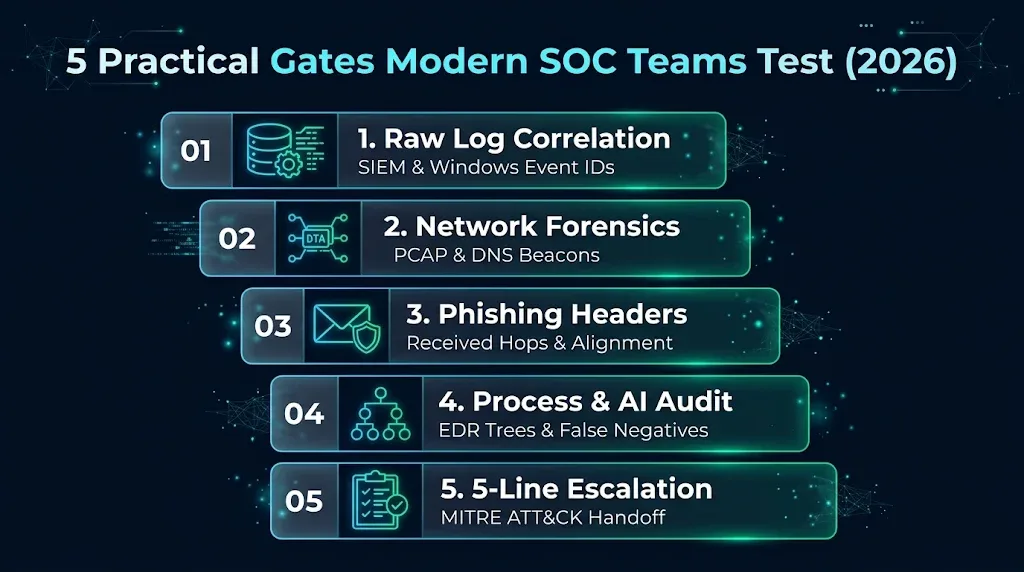
Because resumes and take-home essays are trivially easy to polish with generative tools, SOC teams across banking, SaaS, managed security providers, and enterprise IT have shifted the real filter into live, scenario-based technical screens. Across most Tier-1 and junior blue-team interviews in 2026, evaluations consistently center on five practical gates.
Gate 1: Raw Log Correlation and SIEM Query Reasoning
Interviewers rarely care whether you have memorized the exact button layout of their specific commercial SIEM. What they test is whether you understand what normal operating system and authentication telemetry looks like—and whether you can string events together into a coherent timeline.
In a typical live exercise, you are shown raw Windows Security logs, Sysmon telemetry, Linux authentication logs, or web server access logs and asked to trace what happened. Strong candidates recognize high-value event markers without guessing:
- Windows Authentication Context: Distinguishing a normal interactive sign-in (Event ID 4624, Logon Type 2) from a network logon (Logon Type 3) or a Remote Desktop session (Logon Type 10), and recognizing when repeated Event ID 4625 failures across forty different usernames from one IP point to password spraying rather than a single-account brute-force attempt.
- Process and Persistence Trails: Reading Event ID 4688 or Sysmon Event ID 1 process creation entries to check full command-line arguments, and spotting Event ID 4698 when an attacker quietly registers a scheduled task to survive a reboot.
- Query Logic Over Syntax Perfection: Explaining how you would filter out noisy service accounts, group failed attempts by source IP over a ten-minute window, and correlate an initial login anomaly with subsequent privilege changes using structured search logic (such as SPL or KQL).
Gate 2: Network Packet and Protocol Forensics
You do not need to be a senior network architect to pass a Tier-1 screen, but you cannot investigate alerts if TCP/IP feels like magic. Interviewers routinely hand candidates a small packet capture (PCAP) or summarized flow log and ask them to separate routine office traffic from suspicious command-and-control activity.
What separates passing candidates is methodical elimination. Can you verify whether a TCP three-way handshake actually completed, or was it just a blocked port scan? Do you notice an internal workstation sending unusually long, high-entropy DNS subdomain queries every sixty seconds—a classic sign of DNS tunneling or automated beaconing? Can you recognize when an endpoint initiates outbound HTTP traffic directly to a raw external IP address on a non-standard port rather than a legitimate domain over TLS?
Candidates who rush to shout "malware" at the first unfamiliar IP fail this gate. Analysts who inspect protocol behavior, check directionality, and verify whether traffic succeeded pass.
Gate 3: Raw Email Header and Phishing Forensics
Phishing remains one of the highest-volume queues in any SOC, and interviewers love raw .eml header tests because they quickly expose shallow knowledge. Many applicants assume phishing triage means checking if the sender passed SPF, DKIM, and DMARC—and marking the email safe if all three show pass.
That assumption fails immediately in modern environments. Attackers routinely register fresh lookalike domains, configure valid SPF records and DKIM keys on their own infrastructure, and send phishing lures that pass every authentication check cleanly.
During a live header walkthrough, SOC leads look for four habits:
- Reading received headers from bottom to top to find the true originating mail server IP rather than trusting the spoofed From display name.
- Checking alignment and reply paths, especially mismatches between the Return-Path, From, and Reply-To fields designed to capture credential replies.
- Inspecting URL structure safely—recognizing open redirects, URL shorteners, newly registered domains, and punycode spoofing without ever clicking live links directly.
- Scoping organizational impact, meaning your next step after confirming a phish is not just deleting one email, but searching mail gateway logs to see who else received it and whether any user actually clicked the link or entered credentials.
Gate 4: Endpoint Process Trees and Auditing AI Triage Summaries
Modern Endpoint Detection and Response (EDR) tools present attacks as parent-child process trees. A classic interview prompt shows a short process chain—for example, winword.exe spawning cmd.exe, which launches powershell.exe with a Base64-encoded command, or a benign system binary like certutil.exe or mshta.exe pulling a remote payload (known as living-off-the-land binaries, or LOLBins).
In 2026, however, a new twist has entered this game: auditing an AI-generated alert verdict.
Several SOC teams now show candidates both a short raw endpoint log and an AI assistant's pre-written conclusion—where the AI confidently dismisses the alert as "routine IT administrative scripting" based on a superficially normal filename or user role. The interviewer wants to see if you blindly accept the AI's polished summary or challenge it against the underlying process ancestry, parent image path, execution time, and network egress. Catching a plausible-sounding false negative from an automated tool has rapidly become one of the most valuable human skills on the SOC floor.
Gate 5: The Five-Line Escalation Ticket
Even if you accurately identify a real intrusion, a chaotic, rambling escalation note wastes precious response time for Tier-2 and Incident Response engineers. Writing is rarely emphasized in job descriptions, yet unclear documentation fails candidates every week.
Hiring managers look for crisp, structured escalation tickets—ideally mapped to MITRE ATT&CK tactics and techniques—that cover five exact elements without filler:
- Affected Scope: Exact hostname, username, IP address, and asset criticality (e.g., finance workstation vs. domain controller).
- Alert Trigger and Timeline: What fired, when it occurred in UTC, and what happened in the fifteen to thirty minutes before and after.
- Verified Indicators: Concrete artifacts—process names, parent processes, command lines, file hashes, external IPs, or HTTP status codes—that clearly distinguish confirmed facts from hypotheses.
- Immediate Status and Blast Radius: Whether the action succeeded, whether other hosts show the same indicator, and whether any automated containment (like host isolation or session revocation) has already occurred.
- Recommended Next Step: A direct, actionable handoff (for example, resetting user tokens, blocking an egress domain, or capturing volatile memory).
Legacy Resume Signals vs. 2026 SOC Verification Signals
The gap between how candidates still prepare and how SOC leads actually evaluate talent becomes unmistakable when placed side by side:
| Evaluation Area | Legacy Resume Signal (2021–2023) | Modern SOC Verification Signal (2026) |
|---|---|---|
| Tool Proficiency | Listing 20–30 SIEM, EDR, and scanning tools in a skills box | Deep fluency in 1–2 core tools with documented queries and workflow logic |
| Alert Triage | Explaining textbook definitions of phishing, DDoS, or SQL injection | Walking through raw logs or PCAPs to separate true positives from benign noise |
| AI & Automation | Treating manual IOC lookups as primary Tier-1 value | Validating AI triage summaries, spotting blind spots, and tuning noisy rules |
| Phishing Analysis | Checking only whether SPF/DKIM/DMARC show "Pass" | Tracing full Received hops, checking alignment/lookalikes, and scoping clicks |
| Certifications | Stacking multiple exams as the sole proof of readiness | Pairing a solid baseline certification with written lab investigation reports |
| Communication | Broad claims like "strong team communication skills" | Writing a structured 5-line Tier-2 escalation mapped to MITRE ATT&CK |
A Fair Counter-Argument: "Does This Mean Entry-Level Certifications Are Obsolete?"
Whenever hands-on testing takes center stage, a loud counter-narrative pops up online claiming that cybersecurity certifications no longer matter at all. That conclusion is just as flawed as relying on certificates alone.
In reality, hiring funnels still have two distinct doors. The first door is baseline screening—confirming that an applicant understands core security vocabulary, architectural fundamentals, cryptographic concepts, access controls, and risk principles well enough to collaborate with engineers and auditors without constant hand-holding. A respected vendor-neutral certification remains the cleanest, fastest signal to clear that initial filter.
Even the major certification bodies have adapted their blueprints directly around the 2026 SOC shift. Take CompTIA's Security+ V8 (SY0-801), launched in November 2026 (up to 90 multiple-choice and performance-based questions in 90 minutes, requiring a 750/900 passing score). Its domain weighting reflects where real operational hiring sits today:
- Security Operations is the single largest domain at 27%, explicitly testing log analysis, alert monitoring, vulnerability remediation, identity controls, incident response, automation, orchestration, and AI-assisted workflows.
- Threats, Vulnerabilities, and Attacks sits at 24%, adding dedicated coverage for artificial intelligence security risks, including model exposure, prompt attacks, and data leakage.
- Security Architecture (19%), General Security Concepts (16%), and Security Program Management and Oversight (14%) round out the foundational breadth.
The right mental model is simple: a certification proves you speak the language of security; documented lab investigations prove you can solve real problems in that language. Neither replaces the other, and candidates who combine both stand out instantly in a crowded applicant pool.
A Practical 6-Week Blueprint to Build Proof Hiring Managers Read
If your current resume still looks like a generic tool directory, you do not need another six months of passive video courses to fix it. Six focused weeks of artifact-driven practice can transform how technical interviewers perceive your readiness:
- Weeks 1–2: Lock Down Telemetry Baselines. Spend two weeks studying what normal looks like before hunting for attacks. Inspect standard Windows logon events, Sysmon process chains, Linux /var/log/auth.log entries, and clean Wireshark captures of DNS, HTTP, and TLS handshakes so anomalies jump out visually.
- Weeks 3–4: Go Deep on One SIEM and Write Three Case Reports. Pick a single SIEM platform, ingest realistic simulated attack data (such as brute-force attempts, encoded PowerShell execution, or suspicious web requests), and write three complete incident write-ups. Include the exact search queries you wrote, the indicators you validated, why you ruled out false positives, and how you mapped the activity to MITRE ATT&CK.
- Weeks 5–6: Drill Phishing, PCAPs, and Escalation Writing. Complete two raw .eml phishing analyses and two short PCAP investigations, publishing clean, sanitized walkthroughs in a structured portfolio repository. Then rewrite your resume from scratch: cut every tool you cannot defend for five minutes straight, and rewrite every remaining bullet so it names a log source, an investigative decision, and a concrete artifact.
The Takeaway: Evidence Beats Keywords
Getting your first security role in 2026 is not out of reach; hiring teams just stopped taking unverified claims at face value. When generative tools can polish any resume in ten seconds, managers rely on the one thing you cannot fake on a live call: how you reason through incomplete clues on a screen.
Looking at the patterns among learners preparing for certifications and junior blue-team roles, the real gap is rarely a missing tool name. It is hands-on familiarity with raw evidence. Earn one solid baseline credential to clear the early screen, spend real hours reading logs, packet captures, email headers, and process trees, and document your findings clearly enough that a teammate can act on them mid-shift. Walk into an interview with that proof ready, and the entire conversation shifts in your favor.