A shopper discovers a store through a glowing five-star review, places an order and earns a handful of points. Nobody reminds them the points exist, so they never return. Meanwhile, a different store has plenty of repeat buyers but only three reviews on its best-selling product. Each store is missing half the picture. A customer loyalty and reviews program connects both sides, so every order feeds the next one.
Key takeaways
- Loyalty and reviews each fix the other’s weak spot.
- Rewarding reviews grows social proof at low cost.
- Reviews give a loyalty program a reason to stay active.
- Reward honest reviews, never only positive ones.
- One connected program is easier to run than two apps.
What is a customer loyalty and reviews program?
A customer loyalty and reviews program is a single system that rewards shoppers for buying again and for sharing feedback. Customers earn points for orders, referrals and reviews, then redeem those points on future purchases. The store gets repeat sales and fresh social proof from the same program.
Most stores start with separate tools: one app for loyalty points and another for reviews. That setup works, but the two never talk to each other. Points don’t encourage reviews, and reviews don’t feed back into rewards. A combined program closes that gap, because the act of leaving a review becomes one more way to earn.
Why should a rewards program for ecommerce stores include reviews?
Because loyalty fatigue is real and reviews give shoppers a reason to engage between orders. A 2025 Bond Loyalty Report found the average consumer belongs to 17.4 loyalty programs, yet only 48% of Americans are “very satisfied” with them. A rewards program for ecommerce stores that only hands out points per dollar blends into that crowd.
Reviews change the picture in two ways. First, they help new shoppers decide. Northwestern University’s Spiegel Research Center found that a product with five reviews is about 270% more likely to be purchased than one with none (2017). Second, they give loyal customers something meaningful to do. Writing a review, adding a photo or referring a friend feels more personal than another purchase, and it keeps members connected to the brand.
Word of mouth matters too. Nielsen’s 2015 Global Trust in Advertising study found that 83% of people trust recommendations from friends and family. Reviews and referrals are the online version of that trust, and a loyalty program is the natural place to reward both.
How does a combined loyalty and reviews program work?
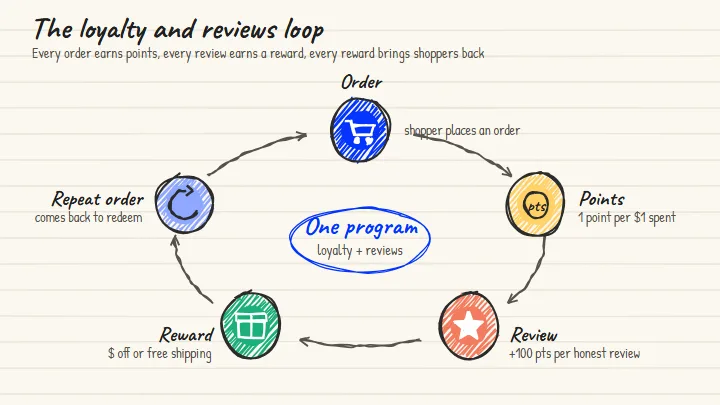
The program links each customer action to a reward and each reward to a business result. Shoppers earn points for orders, reviews and referrals, then redeem them on their next purchase. That redemption creates another order, which creates another chance to review, so the program keeps itself moving.
Here is a simple worked example, using a hypothetical store with 1,000 orders a month. If 10% of buyers leave a review for 100 points, the store gains 100 new reviews every month. At an assumed value of 100 points per $1, that costs $100 in future discounts, and that discount only gets spent when the customer comes back to buy again.
How can ecommerce stores set up a customer loyalty and reviews program?
Start small with three earning actions, reward honest feedback and time requests to delivery. Most stores can launch in a day by connecting points to orders, reviews and referrals, then adding tiers once the basics are working.
1. Pick three earning actions. Orders, reviews and referrals cover the core. Social follows and birthdays can wait until members are active.
2. Reward every honest review. Points should go to any genuine review, whatever the star rating. In the US, the FTC’s 2024 rule on consumer reviews bans incentives tied to positive sentiment. Mixed reviews also help sales: the same Spiegel study found purchase likelihood peaks at an average rating between 4.2 and 4.5 stars, not a perfect 5.0.
3. Ask at the right moment. Send review requests after delivery, not at checkout. Automated review collection emails with a reminder a few days later work well for most products.
4. Add tiers when members are engaged. Once repeat buyers are earning regularly, VIP tiers give them a goal to work toward, such as free shipping or early access at the next level.
One program, two growth engines
Loyalty brings shoppers back, and reviews persuade new ones to buy. Running them as one customer loyalty and reviews program means each order creates the next review and each review earns the next reward. Start with orders, reviews and referrals, then build from there.
Start free on Shopify and add points, review rewards and VIP tiers to a store in under 5 minutes.