Every business eventually hits this fork in the road. Buy something ready-made and adapt the business around it, or build something specific and wait longer for it to be ready. The right answer to this depends less on budget and more on how unique the underlying problem actually is, which is exactly what most comparisons of ai solutions get wrong by focusing on cost first without ever asking what problem is actually being solved.
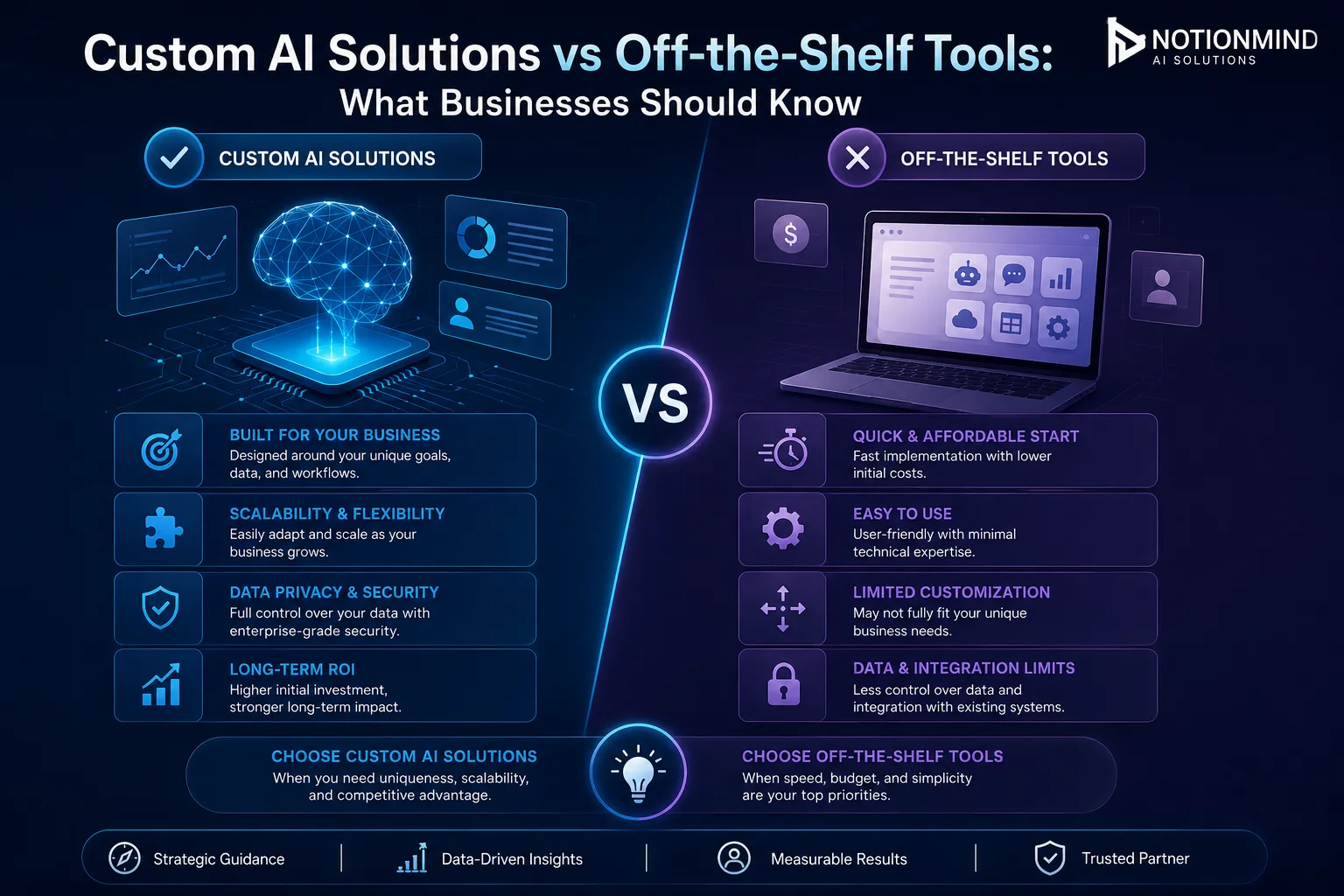
Off-the-shelf tools solve common problems quickly. Custom AI solutions solve specific problems precisely. Knowing which category a business actually has determines which path makes sense, and getting this classification wrong tends to be a more expensive mistake than most businesses initially expect.
Why Off-the-Shelf Tools Work for Common Problems
- Most businesses face problems that hundreds of other companies have already faced. Customer support automation, basic reporting, and standard workflow triggers all fall into this category, and treating them as if they require a fully custom build usually adds unnecessary time and cost without a proportional benefit.
- For these use cases, off-the-shelf ai solutions are usually the faster, cheaper, and lower-risk choice. The problem has already been solved by someone else, refined across many customers, and packaged into something ready to deploy within days rather than months.
Trying to custom-build a solution for a problem that already has a mature off-the-shelf answer usually wastes both time and budget without producing a meaningfully better result. The existing tool has typically already absorbed years of refinement across thousands of users, something a custom build starting from scratch simply can't match in the short term.
When a Problem Is Actually Unique Enough to Justify Custom Work
Not every business problem fits neatly into an existing product. Some workflows are shaped by industry-specific regulations, unusual data structures, or a competitive advantage the business doesn't want replicated by using the same tool as competitors.
In these cases, custom ai solutions become worth the additional time and cost, since an off-the-shelf tool would force the business to change its process to fit the software, rather than the other way around.
The clearest signal a problem needs custom work is when a business has already tried adapting an off-the-shelf tool and found the fit consistently awkward, requiring constant workarounds just to make it function. This pattern of repeated workarounds is usually a stronger indicator than any theoretical assessment of uniqueness, since it reflects what actually happens once real usage begins.
How to Tell the Difference Before Committing Budget
A short internal exercise helps clarify which category a specific need falls into before committing to either path. This kind of upfront clarity tends to save far more time than it costs, since it prevents the far more common mistake of discovering the wrong fit only after significant budget has already been spent.
Ask whether the underlying problem is common across many businesses or specific to this one. Ask whether speed to deployment matters more than precision of fit. Ask whether the workflow involves proprietary data or processes that a generic tool wasn't designed to handle well. A short, honest answer to each of these three questions is usually enough to point clearly toward one path over the other.
Businesses that skip this exercise often end up either overpaying for custom development on a problem that didn't need it, or wasting months forcing a generic tool to handle something it was never built for. Both mistakes are avoidable with a fairly short honest assessment done before any budget gets committed to either path.
Why Hybrid Approaches Are Increasingly Common
Many businesses no longer treat this as an all-or-nothing decision. A growing number combine off-the-shelf tools for common functions with custom-built components for the specific pieces that actually differentiate their operations, treating each function on its own merits rather than picking a single strategy for the entire technology stack.
This hybrid approach lets a business move quickly on the easy parts while investing custom development only where it genuinely matters, rather than spreading limited resources evenly across every part of the system regardless of how unique each piece actually is. Over time, this tends to produce a system where the common, low-value functions run on stable, well-tested off-the-shelf tools, while the differentiating parts of the business get the focused, custom attention they actually need.
What Businesses Often Get Wrong About Cost
The sticker price comparison between off-the-shelf and custom ai solutions is often misleading. Off-the-shelf tools look cheaper upfront, but ongoing subscription costs and the hidden cost of forcing a process to fit the tool add up over time, often more than businesses account for when making the initial decision.
Custom solutions look more expensive initially, but once built, they typically don't carry the same ongoing licensing costs and are shaped precisely around how the business actually operates, which can reduce inefficiency costs that don't show up on an initial price comparison. Over a multi-year timeline, this difference often narrows or reverses the apparent cost advantage that off-the-shelf tools seem to have at the outset.
Making the Right Call for Your Business
There isn't a universal answer here, only the answer that fits how unique a specific problem actually is within a specific business, and that answer can genuinely differ from one department to the next within the same company.
Businesses across India, the US, and Spain that have made this decision well typically start by honestly evaluating each individual workflow rather than applying one blanket decision across the entire organization, choosing off-the-shelf where it fits and custom development only where the fit genuinely doesn't exist. This workflow-by-workflow approach tends to produce far better long-term outcomes than committing an entire technology strategy to one side of this decision before actually understanding where the real differentiation lies within the business.
None of this needs to be decided all at once either. Businesses can start with a smaller pilot on one workflow, confirm the approach works, and then apply the same evaluation process to the next area as budget and priorities allow.