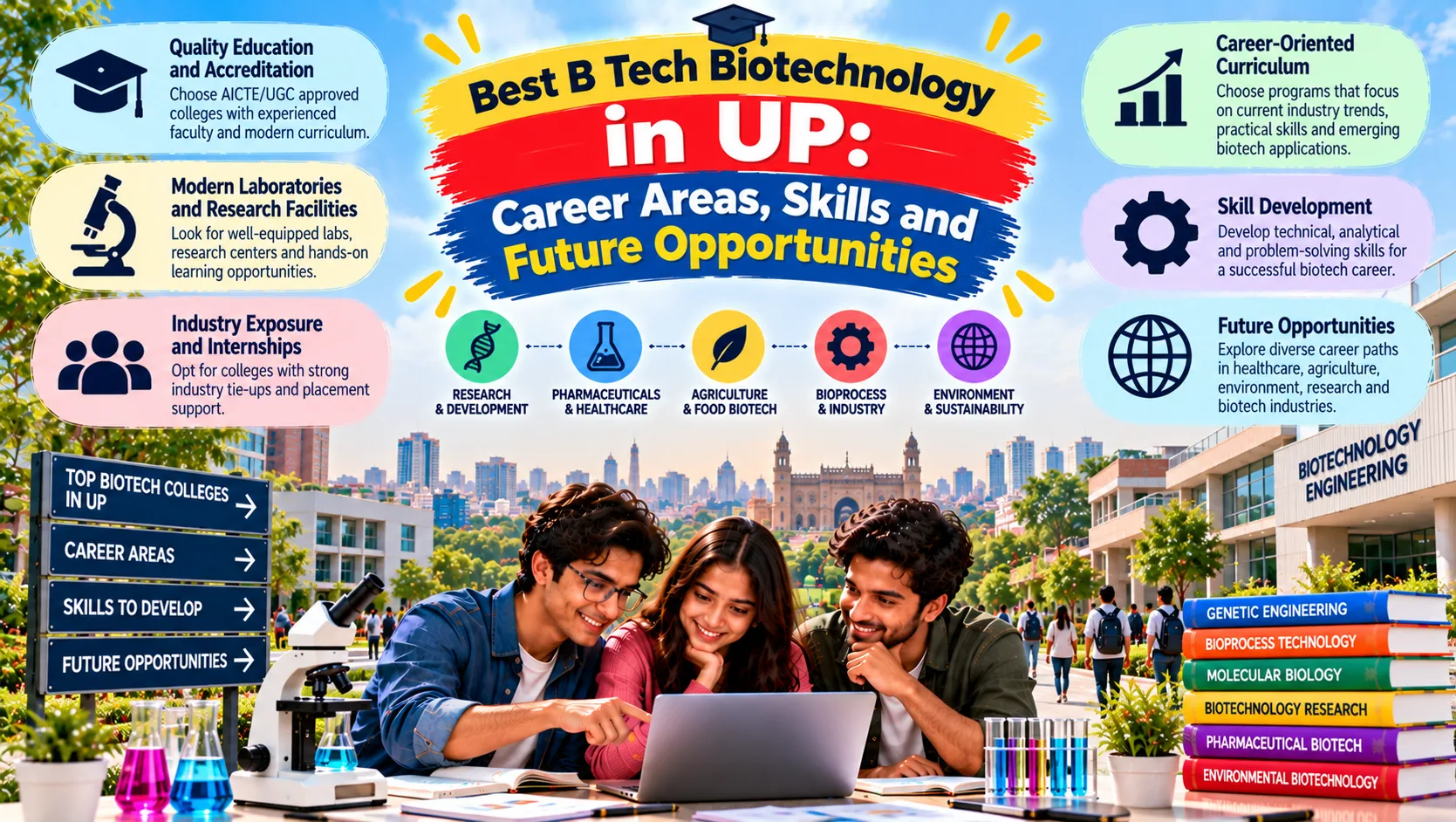
Choosing a B.Tech specialisation is one of the first major academic decisions students make after Class 12. With technology transforming almost every industry, students today have more options than traditional engineering branches. From Computer Science Engineering and Agricultural Engineering to Biomedical Engineering and Biotechnology, each discipline offers different learning opportunities, career paths and industry applications. Students researching the best university in UP should look beyond the popularity of a course and evaluate factors such as curriculum quality, practical learning, faculty expertise, infrastructure, internships and career support.
Computer Science Engineering connects engineering with software, artificial intelligence and digital technologies. Agricultural Engineering applies engineering principles to farming, irrigation, machinery and smart agriculture. Biomedical Engineering connects engineering with healthcare and medical technology, while Biotechnology combines biological sciences with technological and industrial applications.
All four fields have promising applications, but they suit different interests, academic strengths and career goals. The right choice depends on the subjects a student enjoys, the type of problems they want to solve, the skills they want to develop and the industries they see themselves working in.
Instead of asking which engineering branch is universally "best", students should ask a more useful question:
Which engineering discipline matches my interests, strengths and long-term career plans?
CSE: For Students Interested in Computing and Digital Technology
Computer Science Engineering remains one of the most technology-driven engineering disciplines.
Students typically build foundations in programming, algorithms, databases, operating systems, computer networks and software development. Modern programmes may also provide exposure to areas such as artificial intelligence, machine learning, cloud computing, cybersecurity and data science.
Who should consider CSE?
CSE can be a strong fit for students who:
- Enjoy mathematics and logical problem-solving
- Like computers and programming
- Want to build software or digital products
- Are interested in AI and emerging technologies
- Enjoy working with data
- Want flexibility to move across technology industries
Students comparing B.Tech Computer Science Engineering Colleges in UP should look beyond the number of computer labs. Curriculum quality, programming practice, project-based learning, internships and exposure to current technologies are equally important.
Agricultural Engineering: Where Engineering Meets Agriculture
Agricultural Engineering is different from conventional engineering branches because its applications are directly connected to agriculture and food systems.
The field can involve irrigation, farm machinery, agricultural structures, soil and water management, food processing, precision agriculture and smart farming technologies.
Modern agriculture increasingly uses sensors, drones, satellite imagery, automation and data-driven decision-making. This gives agricultural engineers opportunities to work at the intersection of engineering and emerging AgriTech.
Who should consider Agricultural Engineering?
This branch may suit students who:
- Are interested in agriculture and technology
- Want to work on real-world sustainability challenges
- Enjoy mechanical or engineering concepts
- Are interested in irrigation and water management
- Want to explore precision agriculture
- Are curious about drones, automation and smart farming
Students researching Agricultural Engineering Colleges in Delhi NCR can particularly benefit from examining whether programmes provide practical exposure to modern agricultural technologies rather than focusing only on traditional farming methods.
Biomedical Engineering: Engineering for Healthcare
Biomedical Engineering applies engineering and technology to healthcare.
It can involve medical devices, diagnostic equipment, biomaterials, rehabilitation technologies, medical imaging and wearable health technologies.
The field is becoming increasingly interdisciplinary as healthcare combines engineering, electronics, biology, data and artificial intelligence.
Who should consider Biomedical Engineering?
Biomedical Engineering may appeal to students who:
- Enjoy biology as well as engineering
- Are interested in healthcare technology
- Want to understand medical devices
- Like electronics, instrumentation or technology
- Are interested in medical research
- Want to work on technologies that support healthcare
Students exploring a Top Biomedical Engineering College in Delhi NCR should examine laboratory facilities, instrumentation, practical projects, faculty expertise and opportunities for interdisciplinary learning.
Biotechnology: Combining Biology With Technology
Biotechnology is another option for students who enjoy biological sciences but want to apply them using technological and engineering approaches.
The field covers areas such as molecular biology, genetics, microbiology, bioprocessing, bioinformatics and biological research.
Its applications extend into pharmaceuticals, diagnostics, agriculture, food technology, environmental biotechnology and genomics.
Who should consider Biotechnology?
Biotechnology could be suitable for students who:
- Enjoy biology and laboratory science
- Are interested in genetics and molecular biology
- Want to explore pharmaceutical or healthcare applications
- Are curious about genomics and bioinformatics
- Enjoy scientific research
- Want to combine biology with data or technology
Importantly, biotechnology careers are no longer limited to conventional laboratory positions. Computational biology, bioinformatics, diagnostics and bioprocessing are expanding the range of possible career directions.
How the Four Branches Differ
The biggest difference is the problem each discipline primarily tries to solve.
CSE focuses on computing, software, data and digital systems.
Agricultural Engineering focuses on improving agricultural processes, machinery, resources and production systems.
Biomedical Engineering focuses on healthcare-related technologies and medical applications.
Biotechnology focuses on biological systems and their applications in healthcare, agriculture, industry and research.
This distinction can make career planning much easier.
Which Branch Has the Most Emerging Technology?
All four disciplines are being influenced by emerging technologies, but in different ways.
CSE and Artificial Intelligence
AI is directly connected to CSE through machine learning, generative AI, data science and intelligent software systems.
Agricultural Engineering and Smart Farming
Agriculture is increasingly adopting sensors, drones, robotics, satellite technology and precision farming systems.
Biomedical Engineering and Digital Health
Healthcare technology is incorporating wearable devices, medical imaging, connected devices, robotics and AI-assisted systems.
Biotechnology and Computational Biology
Biotechnology is increasingly connected with bioinformatics, genomic data analysis, computational modelling and AI-assisted biological research.
The lesson is important: emerging technology is not exclusive to computer science.
Which Branch Requires More Programming?
CSE generally involves the most intensive programming education among these four options.
However, programming and computational skills are becoming useful in the other disciplines too.
A biotechnology student may use Python for biological data analysis. An agricultural engineering student may work with sensor data or automation systems. A biomedical student may encounter programming through medical imaging, instrumentation or data analysis.
Therefore, students do not necessarily have to choose CSE simply because they want exposure to technology.
Which Branch Is Best for Research?
Research opportunities exist across all four disciplines.
CSE research can involve AI, cybersecurity, computer vision, robotics and algorithms.
Agricultural Engineering research can address smart irrigation, farm automation, agricultural machinery and resource efficiency.
Biomedical research can focus on medical devices, biomaterials, diagnostics and healthcare technologies.
Biotechnology research can involve genetics, molecular biology, drug development, genomics and bioinformatics.
The better choice depends on the type of problems a student wants to investigate.
Think About Skills, Not Just Branch Names
A common mistake is choosing a branch only because it sounds popular.
Instead, students should consider the skills they will develop.
For example, a CSE student may graduate with programming, software development and data skills.
An Agricultural Engineering student may develop expertise in machinery, irrigation, agricultural systems and automation.
A Biomedical Engineering student may develop knowledge of engineering principles, medical technologies and biological systems.
A Biotechnology student may build laboratory, molecular biology, research and bioinformatics skills.
These skill combinations ultimately influence career options.
How to Choose Between the Four
A simple self-assessment can help.
Choose CSE if you enjoy:
Programming, computers, algorithms, mathematics, AI and digital products.
Consider Agricultural Engineering if you enjoy:
Agriculture, machinery, sustainability, water management, automation and smart farming.
Consider Biomedical Engineering if you enjoy:
Biology, engineering, medical technology, devices, healthcare and applied research.
Consider Biotechnology if you enjoy:
Biology, genetics, laboratory work, molecular science, pharmaceuticals and research.
You can also think about the kind of workplace you would prefer.
Would you rather build software, design agricultural systems, develop healthcare technology or work with biological systems?
There is no universally correct answer.
What Should You Check Before Choosing a College?
Once students have selected a preferred branch, the next step is comparing institutions carefully.
Students looking at the best engineering colleges in Delhi NCR should consider factors such as:
- Curriculum relevance
- Faculty expertise
- Laboratory infrastructure
- Industry interaction
- Internship opportunities
- Project-based learning
- Research exposure
- Student clubs and technical activities
- Placement transparency
- Higher education opportunities
- Campus environment
- Total cost of education
A college should be evaluated based on the actual learning experience it provides rather than a single ranking or advertisement.
Why Practical Learning Matters
Engineering is ultimately an applied discipline.
A student who studies programming should build software projects. An agricultural engineering student should understand how engineering concepts are applied to agricultural problems. Biomedical students should gain exposure to relevant equipment and technologies. Biotechnology students should receive meaningful laboratory and research experience.
This is why project-based learning and internships can be valuable parts of an engineering education.
Can Students Change Their Career Direction Later?
Yes, engineering careers are not always linear.
A CSE graduate can move into product management, analytics or entrepreneurship.
An agricultural engineer can move towards AgriTech, consulting or resource management.
A biomedical engineer can explore medical technology, healthcare operations or research.
A biotechnology graduate can move towards bioinformatics, pharmaceuticals, research or management.
Additional certifications, internships, postgraduate education and practical experience can also help students transition between related areas.
The Future Is Increasingly Interdisciplinary
One of the biggest changes in engineering education is the increasing overlap between disciplines.
Consider a smart healthcare device. It could involve biomedical engineering, electronics, software and AI.
A precision agriculture platform could combine agricultural engineering, satellite technology, sensors, data analytics and software.
A modern drug-discovery project could combine biotechnology, computational biology, AI and data science.
This means students should not think of engineering branches as completely isolated fields.
A Practical Decision Framework
Before finalising a B.Tech branch, ask yourself five questions:
1. What subjects do I genuinely enjoy?
Interest matters because engineering requires sustained learning.
2. What type of problems do I want to solve?
Think about software, agriculture, healthcare or biological systems.
3. What skills do I want to develop?
Identify whether you prefer coding, experimentation, engineering design, data analysis or laboratory research.
4. What kind of industries interest me?
Look beyond the degree title and explore actual industries and job roles.
5. Does the college support the learning style I need?
Check curriculum, faculty, laboratories, projects, internships and research opportunities.
Final Thoughts
CSE, Agricultural Engineering, Biomedical Engineering and Biotechnology can all lead to meaningful engineering careers, but they serve very different interests and industries.
The best decision is therefore not simply about choosing the branch with the highest perceived demand. It is about finding the combination of interest, aptitude, skills, learning opportunities and long-term career direction that fits you best.
Students comparing engineering programmes in 2026 should also remember that technology is transforming every branch. AI, automation, data analytics and digital systems are becoming relevant far beyond conventional computer science.
Whether you ultimately choose CSE, Agricultural Engineering, Biomedical Engineering or Biotechnology, a strong foundation combined with practical projects, internships and continuous skill development can make your B.Tech journey much more valuable.