
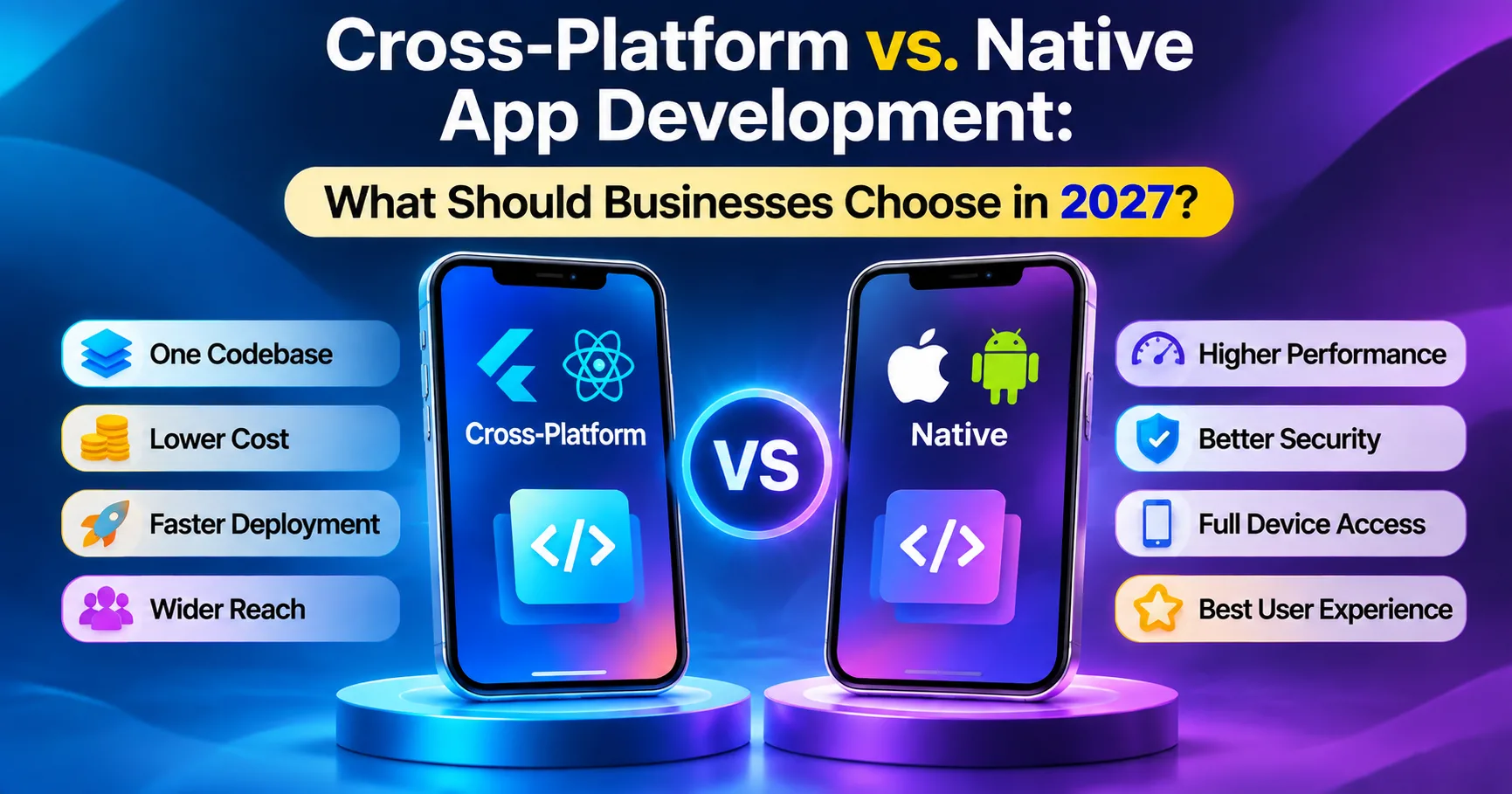
Choosing between native and cross-platform app development is an important decision for businesses planning to launch or expand their mobile products in 2027. The choice affects more than the initial development budget. It influences application performance, user experience, feature updates, maintenance requirements, and the ability to scale as business needs change.
Both approaches have evolved significantly. Cross-platform frameworks now offer more flexibility and stronger performance, while native development continues to provide direct access to platform capabilities. Therefore, the right decision depends on the application's purpose, technical requirements, available resources, and long-term product strategy.
Understanding Native App Development
Native app development involves building separate applications for specific operating systems. Developers generally use Swift or SwiftUI for iOS and Kotlin or Java for Android.
Because native applications are designed for their respective platforms, they can integrate directly with operating system features, device hardware, and platform-specific interface guidelines.
This approach is particularly useful for applications that require advanced camera functionality, complex animations, augmented reality, intensive graphics, or frequent interaction with device sensors.
However, developing separate applications means maintaining different codebases. Businesses may need dedicated iOS and Android developers, separate testing processes, and additional coordination when introducing new features. These requirements can increase development time and ongoing maintenance costs.
Understanding Cross-Platform App Development
Cross-platform development allows businesses to build applications for multiple operating systems using a shared codebase. Instead of creating every feature separately, developers can reuse application logic and, depending on the framework, interface components across platforms.
Popular technologies include Flutter, React Native, and Kotlin Multiplatform.
Flutter uses Dart and provides a shared approach to building application interfaces. React Native allows developers to build mobile applications using JavaScript or TypeScript and React. Kotlin Multiplatform takes a more flexible approach, allowing teams to share selected business logic while retaining native interfaces when required.
This model can reduce duplicated development work and make it easier to deliver updates across platforms. However, cross-platform development does not eliminate platform-specific requirements. Certain integrations, interface behaviours, and device features may still require native implementation.
Key Factors Businesses Should Consider in 2027
1. Application Performance
Performance should be evaluated according to the application's actual workload.
Native development offers direct access to platform APIs and is a strong option for applications involving intensive graphics, real-time processing, advanced animations, or hardware-heavy operations.
Modern cross-platform frameworks can also deliver responsive applications for many business use cases. However, performance depends on implementation quality, framework architecture, third-party dependencies, and device capabilities.
For a standard booking, retail, or business application, cross-platform development may provide sufficient performance. For a graphics-intensive or hardware-dependent product, native development may offer more control.
2. Development Cost and Time to Market
Budget and delivery timelines are important considerations, particularly for startups and businesses testing a new product idea.
Native development generally requires separate platform-specific implementation. This can increase development effort, especially when the same features must be delivered for both iOS and Android.
Cross-platform development can reduce duplicated work through code sharing. It may also simplify feature updates because shared components can be maintained in one place.
However, the lowest initial development cost does not always result in the lowest total cost. Businesses should also consider testing, platform-specific integrations, developer availability, maintenance, and future upgrades.
3. User Experience and Interface Consistency
Native applications can follow the design conventions of each operating system. This helps create familiar navigation, interactions, and interface behaviour for users.
Cross-platform applications can maintain a consistent design across devices, which may be useful for businesses that want a unified brand experience. Frameworks also provide options for platform-specific interface adjustments.
The important consideration is not simply whether the interface looks identical on both platforms. It should feel intuitive and function correctly on each device.
4. Maintenance and Scalability
Mobile applications require continuous improvements after launch. Operating system updates, security requirements, user feedback, and new business features can all influence the development roadmap.
A shared codebase can make cross-platform maintenance more manageable when features are common across platforms. Native applications provide greater freedom to implement platform-specific changes independently.
Businesses should evaluate how frequently the product will evolve, how many integrations it requires, and whether the development team can support the selected architecture over time.
How Modern Frameworks Are Changing the Decision
The native-versus-cross-platform discussion is no longer limited to choosing between two completely separate approaches.
Kotlin Multiplatform, for example, allows developers to share business logic while retaining native user interfaces. This gives teams the flexibility to reuse common functionality without requiring every part of the application to follow the same implementation.
Flutter and React Native also continue to provide options for building applications across iOS and Android from shared codebases.
For businesses planning a new product in 2027, this means architecture should be selected according to actual requirements rather than assumptions about a particular technology.
Which Approach Should Businesses Choose?
Cross-platform development can be a practical choice for startups, eCommerce platforms, booking applications, service-based products, and business applications that need to reach both Android and iOS users efficiently.
Native development may be more suitable for gaming applications, advanced financial tools, augmented reality products, and applications that depend heavily on platform-specific capabilities.
Some businesses may benefit from a hybrid architectural strategy: sharing selected business logic while implementing critical features natively. This can help balance development efficiency with platform-specific control.
Before making a decision, businesses should define their target users, required device features, expected performance, budget, release schedule, and long-term maintenance plans. Consulting an experienced Mobile app development company in USA can also help evaluate these requirements and select an architecture that supports the product's goals
Final Thoughts
There is no universal winner between native and cross-platform app development in 2027. Native development provides deeper platform control, while cross-platform development can improve code reuse and delivery efficiency.
The most effective choice is the one that supports the application's functionality, user expectations, and future growth. Businesses should focus on the product's technical requirements and long-term operating costs rather than choosing a development approach based only on popularity or initial budget.