
Introduction
Walk into any sales meeting across India right now, and you'll hear the same complaint. "We have so much customer data, but we can't find anything when we need it." Spreadsheets in one folder. WhatsApp chats on someone's personal phone. Follow-up reminders written on sticky notes that fall off the monitor.
This is the reality for thousands of businesses across Noida, Delhi NCR, and the wider region, even ones doing crores in revenue.
Customer expectations have changed. People want quick replies, personalised service, and businesses that remember their last conversation. A buyer in Sector 62 expects the same responsiveness as one dealing with a company in Singapore. Meeting that bar without a proper system is close to impossible once your team grows beyond a handful of people.
This is where CRM software comes in. A customer relationship management system gives a business one place to store customer information, track sales conversations, manage follow-ups, and see exactly where every deal stands.
Many companies start with an off-the-shelf CRM. It works fine at first. Then the business grows, processes change, and the software starts feeling like a straightjacket instead of a tool. Fields that don't match how your team actually sells. Reports that don't answer the questions your management asks. Integrations that simply don't exist for the other software you use.
That's usually the point where business owners start searching for a reliable CRM software development company in Noida. A custom-built CRM is designed around how your business actually works, not the other way around. In this guide, we'll walk through what custom CRM development really means, why it matters for businesses in Noida and the NCR region specifically, what it costs, and how to pick the right development partner.
What is Custom CRM Development?
A ready-made CRM, like a standard Salesforce or Zoho package, comes with a fixed set of features. You configure what's available and work within those boundaries. For a lot of small businesses, this is enough.
Custom CRM development is different. It means building (or heavily customising) a CRM platform specifically for your company's sales process, industry requirements, team structure, and existing software stack. Instead of adjusting your business to fit the software, the software is built to fit your business.
Think of it like the difference between buying a ready-made suit off the rack and getting one tailored. The ready-made one might fit reasonably well. The tailored one fits exactly, because it was measured for you.
Why Businesses in Noida Need Custom CRM
Noida's business environment, like much of the NCR, has its own texture. Deals often move through WhatsApp before they move through email. Field sales teams cover huge geographic areas across Delhi, Gurugram, Ghaziabad, and beyond. Many companies run on a mix of Excel, Tally, and personal phone contacts.
Here are the operational problems that push businesses in Noida toward custom CRM:
Manual, repetitive work. Sales teams spend hours updating spreadsheets, copying data between systems, and writing follow-up reminders by hand. That's time not spent talking to customers.
Inconsistent customer follow-ups. When follow-ups live in individual salespeople's heads or personal notebooks, leads get missed. A prospect who doesn't hear back in three days often moves to a competitor.
No real visibility into the sales pipeline. Business owners often don't know how many deals are in progress, which ones are stuck, or why. Decisions get made on gut feeling instead of actual numbers.
Data silos. Sales has one list. Marketing has another. Support has a third. Nobody has the full picture of a customer's journey.
Scaling pains. A CRM that worked fine for a 10-person team starts breaking down at 50 people. Custom CRM is built with growth already factored in.
These aren't small annoyances. They directly affect how fast a business grows and how much revenue slips through the cracks.
Top Benefits of Custom CRM Development
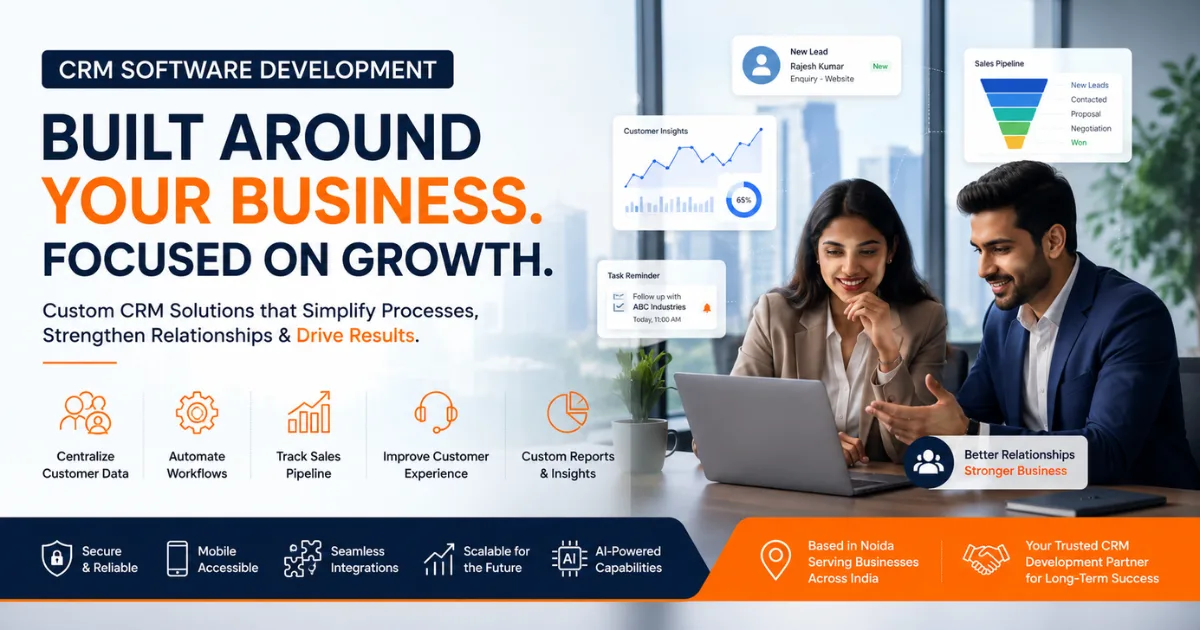
Centralized customer database: Every call, email, WhatsApp message, and meeting note lives in one place. Anyone on the team can pick up a customer conversation without starting from zero.
Automation of repetitive tasks: Follow-up reminders, welcome emails, lead assignment, and status updates happen automatically, so your team spends time selling instead of doing admin work.
Clear sales pipeline visibility: Management can see, at a glance, how many leads are at each stage, which deals are stuck, and where the bottlenecks are.
Better customer service: Support teams can see a customer's full history—past purchases, complaints, preferences—before they even pick up the phone.
Custom reporting: Instead of generic reports that don't match your business, you get dashboards built around the exact numbers your leadership team cares about.
Higher team productivity: Less time hunting for information means more time on actual selling and relationship-building.
Accurate lead tracking: Every lead is captured, assigned, and tracked from first contact to closed deal, so nothing falls through the cracks.
Mobile accessibility: Field sales teams can update customer information, log visits, and check details from their phone, right at the client's office.
Stronger data security: Custom CRM lets you control exactly who sees what data, with permissions built around your organization's structure.
Scalability: As your team and customer base grow, the system grows with you, without forcing you onto a more expensive plan or hitting arbitrary user limits.
AI-powered capabilities: Modern custom CRMs can include features like lead scoring, next-best-action suggestions, and automated data entry from conversations, which reduce manual effort significantly.
Industries That Benefit Most
Custom CRM isn't a one-size-fits-all product, and its value looks different depending on the industry.
Manufacturing — Managing dealer and distributor networks, tracking order cycles, and coordinating between sales and production planning.
Healthcare — Patient appointment management, follow-up care reminders, and referral tracking, all while respecting data privacy requirements.
Education—Managing student admissions pipelines, parent communication, and enquiry-to-enrolment conversion tracking.
Retail—Customer loyalty tracking, purchase history, and personalized offers based on buying patterns.
Real Estate — Site visit scheduling, lead-to-booking tracking, and post-sale customer communication across multiple projects.
Logistics — Client account management, shipment status visibility, and service-level tracking for repeat business clients.
Construction — Managing long sales cycles, project stakeholders, and vendor relationships across multiple ongoing projects.
Professional Services — Client relationship management, proposal tracking, and billing cycle visibility for consulting and legal firms.
Finance — Lead qualification, compliance-friendly documentation, and relationship tracking for high-value clients.
Automotive—Managing test drive bookings, service reminders, and dealership-level sales tracking.
If your business has a sales process that doesn't fit neatly into a generic template, that's usually a sign a custom approach will serve you better.
Must-Have Features in a Custom CRM
Not every business needs every feature, but here's what a well-built custom CRM typically includes:
- Lead Management — capturing, scoring, and assigning leads automatically
- Sales Automation—automated follow-ups, task creation, and deal stage movement
- Workflow Automation—custom rules that trigger actions based on customer behavior
- Email Integration — two-way sync with Gmail, Outlook, or your existing email system
- WhatsApp Integration—since so much of Indian B2B and B2C communication happens here
- Telephony Integration — click-to-call and automatic call logging
- Reporting & Analytics — dashboards tailored to what your leadership actually tracks
- Customer Support Module — ticketing, complaint tracking, and resolution timelines
- Role-Based Access Management — controlling exactly what each team member can see and edit
- Document Management — storing contracts, quotations, and proposals against each customer record
- Mobile App — for field teams who aren't sitting at a desk
- Smart Notifications — reminders that actually reach people, not just sit unread in an inbox
- Custom Dashboards — different views for sales reps, managers, and leadership
- API Integrations — connecting your CRM to other business software you already use
- AI Features — lead scoring, sentiment detection, and predictive insights where relevant
A good CRM partner won't just build all of these blindly. They'll help you figure out which ones actually matter for your business right now, and which can wait for a later phase.
CRM Development Process
A structured process is what separates a CRM that actually gets used from one that gets abandoned within six months. Here's how a proper custom CRM build typically unfolds:
- Discovery — Understanding your business, your sales process, and your pain points before writing a single line of code.
- Requirement Analysis — Mapping out exactly what the system needs to do, module by module.
- UI/UX Design — Designing screens that your team will actually find easy to use, since adoption depends heavily on this.
- System Architecture — Planning how the CRM will be built, hosted, and scaled.
- Development—Building the actual system in structured phases or sprints.
- Testing — Checking functionality, security, and performance before anything goes live.
- Deployment—Rolling out the system, often in phases to avoid disrupting daily operations.
- Training — Making sure your team actually knows how to use the system, not just that it exists.
- Support—Ongoing help for bugs, questions, and small adjustments after go-live.
- Optimization — Reviewing usage data over time and refining the system based on how your team actually works with it.
Skipping steps — especially discovery and training — is one of the biggest reasons CRM projects fail to deliver value.
CRM Integration Services
A CRM rarely works in isolation. Its real value comes from connecting to the other systems your business already runs on:
- ERP systems—for unified data between sales and operations
- Accounting software (like Tally) — for invoice and payment visibility
- WhatsApp Business API—for communication tracking at scale
- Payment Gateways — for tracking payment status directly in customer records
- Website & Landing Pages—for automatic lead capture
- Google Workspace — for calendar and email sync
- Microsoft 365 — for teams already working in the Microsoft ecosystem
- Power BI — for advanced business intelligence and reporting
- Marketing Automation Tools — for connecting campaigns to actual sales outcomes
- Inventory Systems — for real-time stock visibility during sales conversations
- HRMS — for connecting sales performance data with team management
Good integration planning during the initial discovery phase saves significant rework later.
CRM Development Cost in Noida
Every business owner asks about pricing early, and that's fair. But custom CRM pricing genuinely depends on several factors, so it's worth understanding what drives the cost rather than looking for a single number.
Business size and complexity—A CRM for a 15-person sales team looks very different from one supporting a 200-person, multi-branch organisation.
Number of modules — Basic lead and contact management costs less than a system with sales automation, support ticketing, and inventory visibility all built in.
Number of users — More users generally means more licensing, hosting, and support considerations.
Level of customization—Heavy customisation of workflows, fields, and business logic takes more development time than using standard templates.
Integrations required—Each integration (ERP, WhatsApp, payment gateway, etc.) adds development and testing effort.
Security requirements — Industries like healthcare and finance often need additional security layers and compliance considerations, which affects cost.
AI features — Adding capabilities like lead scoring or predictive analytics increases both development complexity and ongoing infrastructure needs.
Ongoing support — Post-launch support, maintenance, and future enhancements are usually priced separately from the initial build.
Hosting — Cloud hosting costs vary depending on data volume, user count, and performance requirements.
Scalability planning — Building a system that can grow without a complete rebuild later sometimes costs more upfront but saves money over time.
The honest answer is that CRM development cost for businesses in Noida and the NCR can range quite widely depending on these factors. The right approach is to have a proper discovery conversation with a local development partner who can scope your actual requirements, rather than relying on a generic price list that doesn't reflect your business.
How to Choose the Right CRM Development Company
Picking a CRM development partner is a decision that affects your business for years, not months. Here's what actually matters:
Industry experience — A partner who has built CRMs for businesses similar to yours will understand your challenges faster and avoid rookie mistakes.
Technology expertise — Look for genuine expertise in platforms like Microsoft Dynamics 365 and Odoo, along with custom development capability when off-the-shelf platforms aren't the right fit.
Portfolio of past work—Ask to see real examples of CRMs they've built, ideally in your industry or a similar one.
Support after launch — A CRM needs ongoing attention. Confirm what support looks like once the project goes live.
Data security practices — Ask directly how they handle data protection, access control, and backups.
Customization capability—Make sure they can genuinely build around your process, not just configure a template and call it custom.
Communication quality — During the sales process itself, notice how clearly they explain things and how well they listen to your actual problems.
Scalability thinking — A good partner designs for where your business is headed, not just where it is today.
Transparent pricing — You should understand exactly what you're paying for, with no vague line items.
Long-term partnership approach — The best CRM relationships aren't one-time projects. They're ongoing partnerships where the system keeps improving as your business evolves.
Common Mistakes Businesses Make
Even with good intentions, many CRM projects underdeliver. Here are the mistakes that come up again and again:
Choosing the cheapest option. A CRM that's priced far below market rate usually cuts corners somewhere — often in support, security, or actual customisation depth.
Ignoring user adoption. The best CRM in the world is useless if your sales team doesn't actually use it. Training and change management matter as much as the technology.
Skipping automation. Building a digital version of a spreadsheet, without automating follow-ups and workflows, wastes the biggest advantage of a CRM.
Poor integration planning. A CRM that doesn't talk to your accounting software, website, or WhatsApp ends up creating more data silos, not fewer.
Not budgeting for training. Teams need proper onboarding. A rushed, five-minute walkthrough almost guarantees low adoption.
Ignoring future scalability. Building only for today's team size often means an expensive rebuild in two or three years.
Choosing the wrong partner. A development company without genuine CRM and industry expertise often delivers something that looks fine in a demo but doesn't hold up in daily use.
Why Choose Cloudmonte Technologies
At Cloudmonte Technologies, CRM development isn't a side offering bolted onto a general software business — it's a core part of what we do every day. As a CRM software development company based in Noida, we work closely with businesses across the NCR region, using Microsoft Dynamics 365 CRM, Odoo CRM, and fully custom-built CRM platforms, depending on what genuinely fits a client's needs.
We start every engagement with a proper discovery process, understanding how a business actually sells, supports, and communicates with customers, before recommending any specific platform or feature set. This is deliberate. A CRM built without understanding the business first almost always underdelivers.
Our focus areas include:
- Custom CRM development built around your actual sales and service workflows
- Microsoft Dynamics 365 CRM implementation for businesses that need enterprise-grade capability
- Odoo CRM for businesses looking for flexible, cost-effective customisation
- AI-powered CRM features, including lead scoring and intelligent automation
- Business automation that removes repetitive manual work from your team's day
- Industry-focused implementations shaped around the specific workflows of manufacturing, healthcare, real estate, logistics, and other sectors
- CRM consulting for businesses that aren't sure yet whether they need custom development or a configured off-the-shelf solution
- Ongoing support, so the CRM keeps evolving as your business grows, rather than becoming outdated software within a year
We see CRM development as a long-term partnership, not a one-time delivery. If you're evaluating whether custom CRM is the right move for your business, we're happy to have that conversation with you directly, with no pressure and no generic sales pitch.
Conclusion
Customer relationships are the foundation of every growing business, and the systems used to manage those relationships matter more than most companies realise until something breaks down. Off-the-shelf CRM software works well for some businesses. For others, especially those with specific industry workflows or growing sales teams, custom CRM development is what closes the gap between the software you have and the software your business actually needs.
The right custom CRM doesn't just organise customer data. It removes manual work, gives leadership real visibility into the sales pipeline, and helps your team close more deals with less friction.
If you're considering custom CRM development for your business, Cloudmonte Technologies, a CRM software development company based in Noida, is happy to have a straightforward conversation about your specific requirements, whether that means a fully custom build, a Microsoft Dynamics 365 implementation, or an Odoo CRM setup. Reach out to us for a consultation, and let's figure out what actually makes sense for your business.