CRE Due Diligence Platforms vs. Manual Review: Comparing Costs and Efficiency
Commercial real estate due diligence is essential for evaluating property investments, assessing financial risks, and making informed lending decisions. Traditionally, this process has involved manually reviewing financial statements, rent rolls, operating reports, property records, and market data. While manual reviews allow analysts to examine individual documents closely, they often require substantial time and resources, particularly when managing complex transactions or large property portfolios.
AI-powered CRE due diligence platforms are changing this process by automating document extraction, financial reconciliation, and data validation. Instead of spending hours entering information into spreadsheets, analysts can use automated tools to identify inconsistencies, compare financial records, and concentrate on evaluating potential risks.
According to this comparison, the advantages of automated platforms extend beyond faster processing. They can also reduce operational costs, improve data accuracy, and increase the number of transactions a team can evaluate without expanding its workforce.
How Automated Due Diligence Reduces Costs and Processing Time
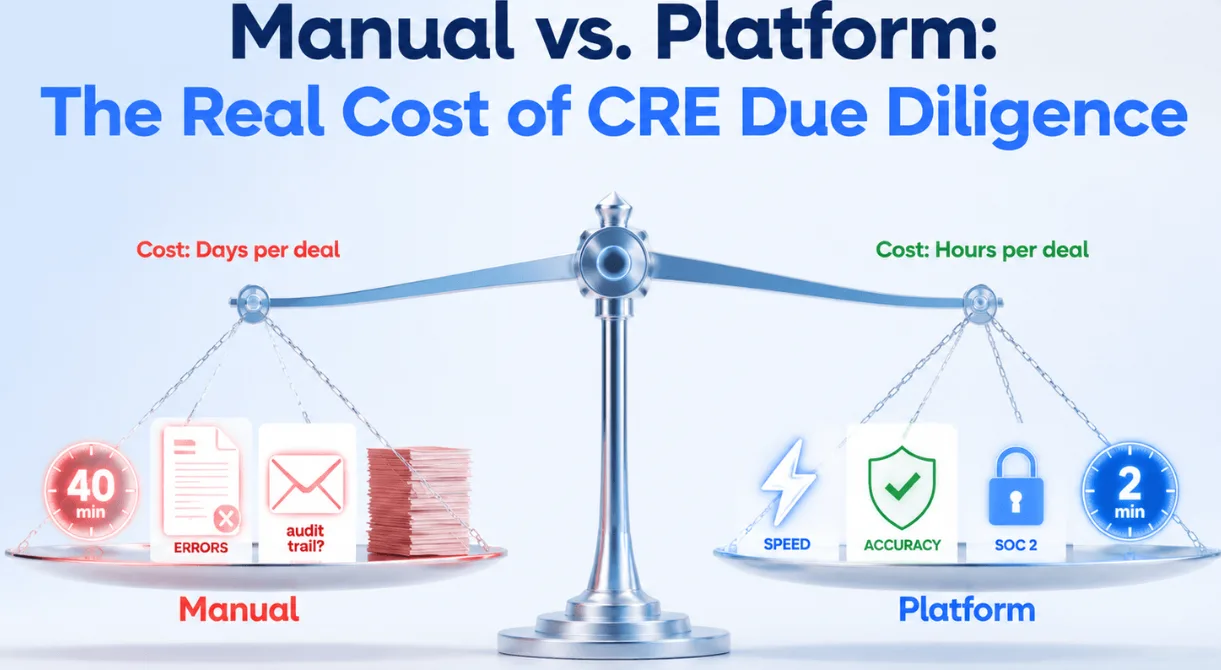
One of the biggest challenges with traditional CRE due diligence is the amount of time required to process financial documents. Reviewing a single financial statement or rent roll can take approximately 30–40 minutes. When a transaction includes dozens of documents, the workload can quickly increase to several days.
Automated platforms significantly reduce this burden by extracting relevant financial information and organizing it into structured formats within minutes. For example, the article highlights how JLL achieved a reported 30-fold productivity improvement in financial statement processing, reducing the time required per document from 30–40 minutes to approximately 1–3 minutes. KeyBank also reported a 40% reduction in loan model preparation time.
The benefits become particularly noticeable when comparing different transaction sizes:
- Small CRE transactions: Automated processing can reduce several hours of manual review to less than an hour of analyst time.
- Mid-market transactions: Tasks that traditionally require two or three working days may be completed within several hours.
- Large commercial property deals: Platforms can substantially shorten document review processes that would otherwise take an entire working week.
- Portfolio evaluations: Automated systems make it easier to analyze information across hundreds of loans without requiring proportional increases in staffing.
Beyond processing speed, AI-powered platforms can automatically compare rent rolls, trailing financial statements, and offering memorandums. This helps identify discrepancies in occupancy rates, rental income, expenses, and capital expenditure assumptions before they affect underwriting decisions.
Choosing the Right CRE Due Diligence Approach
Although automation offers significant operational advantages, selecting an appropriate platform requires careful evaluation. Financial institutions should consider several factors before transitioning from traditional reviews to automated solutions.
First, data accuracy should be tested using real transaction documents. Running an automated platform alongside an existing manual process can help determine whether the technology reliably extracts financial information and identifies meaningful discrepancies.
Second, integration capabilities are important. A platform should connect with existing loan origination, asset management, and portfolio monitoring systems to prevent duplicate data entry and maintain consistent information across workflows.
Security and regulatory compliance are equally important. Commercial real estate transactions involve sensitive financial information, making encryption, access controls, and transparent audit trails essential features.
Finally, organizations should evaluate the potential return on investment. The financial benefits depend on transaction volume, analyst costs, implementation expenses, and the amount of time saved through automation.
Ultimately, AI-powered CRE due diligence platforms are not intended to eliminate human expertise. Instead, they allow analysts to spend less time on repetitive administrative tasks and more time on financial analysis, risk assessment, and strategic decision-making. By combining automated data processing with professional oversight, lenders and investors can improve operational efficiency while maintaining the accuracy and reliability required for commercial real estate transactions.