AI chatbots are everywhere today—but here’s the truth: not all of them actually use artificial intelligence. Many still rely on rule-based systems that respond only to predefined commands, while others use advanced conversational AI capable of understanding intent, tone, and context.
While both aim to automate communication, the depth of interaction and intelligence they offer differs significantly—and understanding that difference is crucial to creating a great customer experience.
In this guide, we’ll uncover the key distinctions between traditional chatbots and conversational AI — exploring how each works, their strengths and limitations, and real-world examples to help you decide which one suits your business goals best.
What Is a Chatbot?
The chatbot is a computer program that can simulate conversation through either a set of preprogrammed responses or even workflows. Conventionally, a chatbot operates on a rule-based system, which, in strict terms, means following a set of preordained commands.
For instance, a customer may ask, "What are your working hours?" and they will receive an exact response from the database provided in the chatbot. They perform perfectly in the realm of repetitive queries, procedures, or immediate support that doesn't need the intervention of a human operator.
Key Features of a Chatbot
- Predefined rules and structured responses
- Works through button-based or menu-driven interfaces
- Ideal for simple customer service tasks
- Quick and cost-effective to implement
- Integrates easily with websites and social media platforms
While chatbots improve customer engagement and reduce workload, their main limitation is their lack of learning capabilities—they cannot interpret complex queries beyond their programming.
What Is Conversational AI?
Conversational AI is a broad term that encompasses technologies designed to enable computers to communicate naturally with humans. By leveraging Natural Language Processing (NLP) and Machine Learning (ML), conversational AI systems can interpret user intent, understand context, and deliver relevant, human-like responses—all while continuously improving through each interaction.
Although conversational AI has made remarkable advancements, it’s still an evolving technology. While it may never achieve true human-like consciousness, its capacity to analyze intent, learn from experience, and generate natural, context-aware responses is evolving at an unprecedented rate, making it a transformative tool for businesses worldwide.
Key Features of Conversational AI
- Uses NLP and ML for understanding complex user input
- Provides personalized and context-aware responses
- Continuously learns and improves through data
- Handles multiple languages and conversation flows
- Integrates across channels like voice assistants, chat, and messaging platforms
In essence, Conversational AI takes user engagement to a new level—transforming customer service, marketing automation, and sales support.
Why Businesses Are Moving Toward Conversational AI
Businesses across industries — from healthcare and eCommerce to finance and travel — are rapidly adopting AI-powered chatbot apps and Conversational AI platforms. Here’s why:
- Improved Customer Experience Conversational AI offers personalized interactions based on user behavior and preferences, creating a seamless and engaging customer experience.
- Cost-Effective Customer Support AI chatbots can handle thousands of customer queries simultaneously, reducing the need for large support teams while maintaining 24/7 availability.
- Scalability As your business grows, Conversational AI scales effortlessly — supporting more users, languages, and use cases without additional manpower.
- Automation with Intelligence AI-powered bots don’t just follow commands — they understand intent. For instance, they can detect when a user is frustrated and adjust responses accordingly.
- Data-Driven Insights Conversational AI collects valuable data on user preferences, helping businesses make informed decisions and improve products or services.
When to Choose a Chatbot
If your business primarily deals with straightforward customer interactions, such as FAQs, booking confirmations, or status checks, a chatbot might be the right fit.
Ideal Use Cases:
- Appointment scheduling
- Product information delivery
- Order status updates
- FAQs and basic troubleshooting
- Customer onboarding
Chatbots are affordable, easy to deploy, and efficient for handling repetitive tasks that don’t require deep understanding or personalization.
Read Also: Chatbots vs. Conversational AI: Which is Good for Your Business?
When to Choose Conversational AI
If your business focuses on personalized customer experiences and deals with complex, dynamic interactions, then Conversational AI is the smarter investment.
Ideal Use Cases:
- Personalized health or fitness coaching
- Banking or financial advisory
- Retail product recommendations
- Real-time multilingual support
- Intelligent voice assistants
With Conversational AI agents, businesses can provide human-like communication, build trust, and offer consistent support across multiple channels.
How AI-Powered Chatbot Apps Are Built
Developing a Conversational AI or chatbot app requires a well-planned approach that combines technical expertise and business understanding. Partnering with a reliable AI Development Company ensures your solution is scalable and aligned with user expectations.
Key Steps in AI Chatbot Development:
- Define the Use Case Identify your business goals — whether you need customer support automation, lead generation, or personalized shopping assistants.
- Choose the Right AI Framework Select from powerful AI frameworks such as TensorFlow, Dialogflow, Rasa, or IBM Watson for natural language understanding and processing.
- Design Conversation Flow Create intuitive dialogue flows to guide users naturally while ensuring a seamless experience.
- Integration and Testing Integrate with your CRM, website, or app and rigorously test for accuracy, tone, and user experience.
- Continuous Learning and Optimization Use real-world data to train your AI models,refine responses, and improve engagement quality.
For best results, collaborate with top AI software development companies that specialize in AI development services, ensuring end-to-end support from design to deployment.
Role of AI Development Companies
A trusted AI software development company provides customized solutions for building both chatbots and conversational AI systems. These experts bring the technical foundation and innovative mindset required to create AI-powered chatbot apps that align with your goals.
Key Services Offered:
- AI software development services
- Conversational AI development
- Custom chatbot creation
- AI integration for web and mobile platforms
- Ongoing maintenance and optimization
Whether you want a basic chatbot for your eCommerce website or a full-scale AI conversational platform, working with experienced AI development companies ensures long-term success.
Future of Conversational AI
The future of Conversational AI lies in greater context-awareness, emotion recognition, and multimodal communication. Businesses will soon use conversational agents that can process not only text and voice but also images, gestures, and emotions.
As AI technology advances, the line between human and AI interactions will blur — leading to a more natural and personalized experience for users worldwide.
Final Thoughts
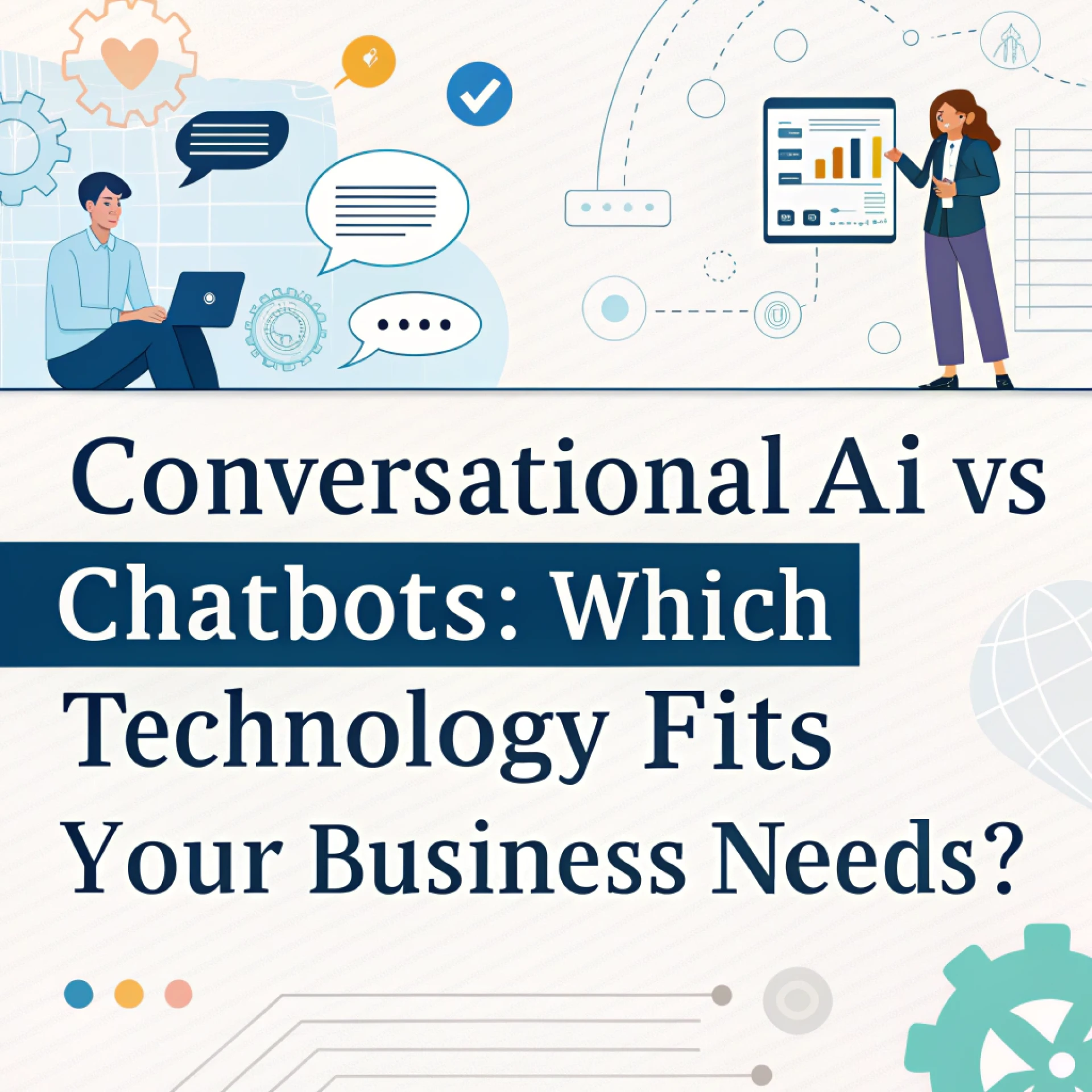
When comparing Chatbots vs. Conversational AI, the choice depends on your business needs, scale, and customer expectations.
If your goal is to automate simple tasks affordably, a chatbot is ideal. But if you want to deliver smarter, context-aware, and emotionally intelligent interactions, Conversational AI is the future.
By partnering with a leading AI Development Company offering top-notch AI Development Services, you can build intelligent solutions that enhance engagement, optimize processes, and future-proof your business communication.