Starting a factory or industrial business in India is not only about setting up machines and starting production. Businesses also need to follow environmental rules and obtain the required approvals. One important approval for many industries is Consent for Operation (CTO).
Consent for Operation allows an industry to legally operate after completing its setup and meeting the conditions set by the concerned State Pollution Control Board (SPCB). In simple words, it is like getting permission to run your factory while following pollution-control rules.
What Is Consent for Operation?
Consent for Operation, commonly called CTO, is an approval given by the State Pollution Control Board to industries that have completed their project setup and are ready to begin operations.
The approval is generally required under pollution-control laws, especially for industries that may produce air emissions, wastewater, hazardous waste, or other forms of pollution.
For example, if a manufacturing unit has installed its machinery and wants to start commercial production, it may need to obtain CTO before beginning operations.
Who Needs Consent for Operation?
Industries and businesses that can cause pollution usually need consent from the respective State Pollution Control Board.
This may include:
- Manufacturing industries
- Chemical and pharmaceutical units
- Food processing units
- Textile and dyeing industries
- Recycling and waste-processing units
- Mining and other industrial projects
- Industries generating wastewater or air emissions
The exact requirements depend on the type, size, location, and pollution potential of the business.
Consent for Operation vs Consent for Establishment
It is easy to confuse these two approvals.
Consent for Establishment (CTE) is generally obtained before setting up an industrial project. It confirms that the proposed unit can be established subject to certain conditions.
Consent for Operation (CTO) is obtained after the project has been established and is ready to start operations.
Think of it this way:
CTE = Permission to set up
CTO = Permission to operate
Both approvals can be important for industries covered under the applicable pollution-control requirements.
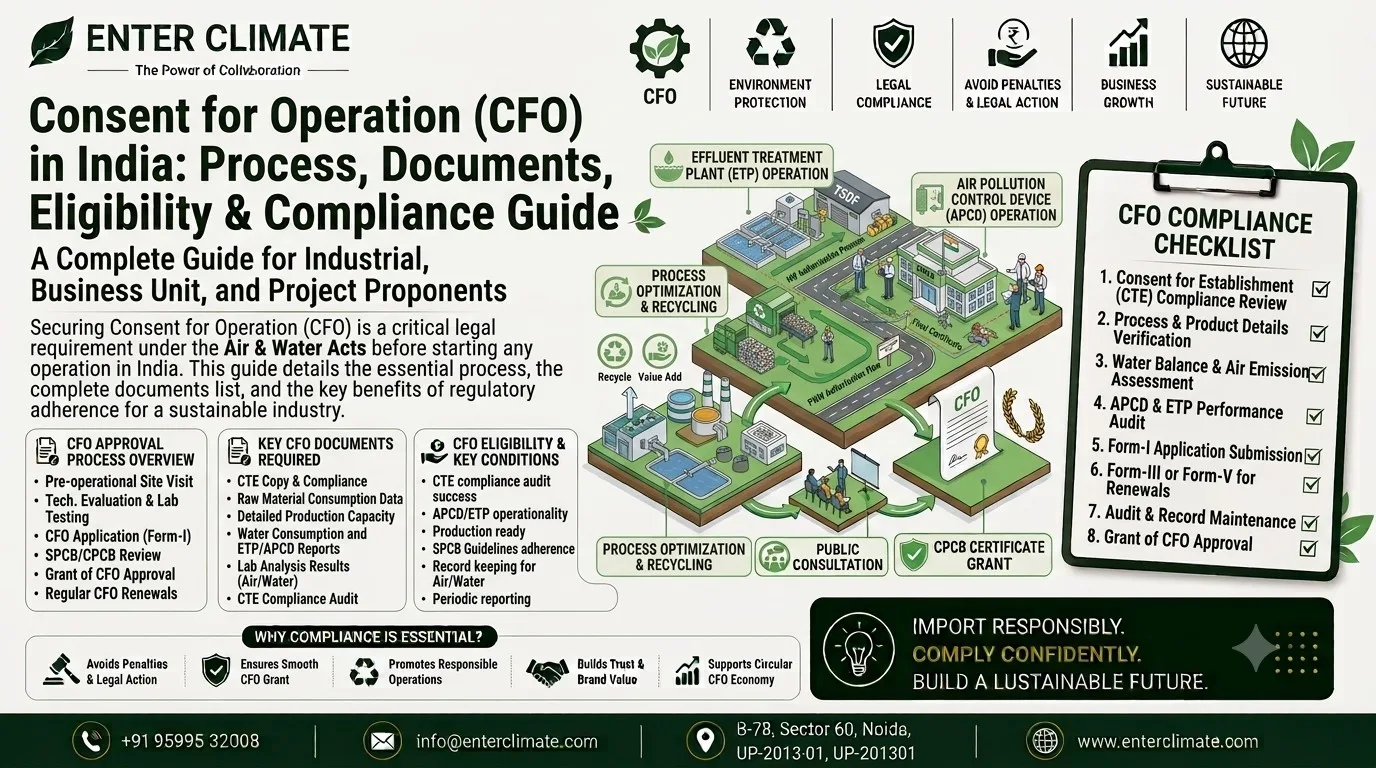
Consent for Operation Process in India
The CTO application process may vary from one state to another, but the general process is quite straightforward.
1. Identify the Applicable Category
First, the business needs to understand its industry category and pollution potential. The applicable category can affect the documents, fees, and conditions involved.
2. Prepare the Required Documents
The applicant should collect the required information about the factory, machinery, production capacity, pollution-control systems, waste generation, and other relevant details.
3. Submit the Online Application
The application is generally submitted through the online portal of the concerned State Pollution Control Board.
The applicant needs to provide correct information and upload the required documents.
4. Pay the Applicable Fee
The prescribed consent fee needs to be paid along with the application. The amount can depend on factors such as industry category, investment, and production capacity.
5. Inspection by the Board
In applicable cases, officials from the Pollution Control Board may inspect the industrial premises. They may check whether the unit has installed the required pollution-control equipment and is following the conditions mentioned in previous approvals.
6. Approval and CTO Issuance
If the application and site conditions meet the requirements, the authority may issue the Consent for Operation with specific conditions.
The industry must follow these conditions throughout its operation.
Documents Required for Consent for Operation
The exact document list differs between states and industries. Commonly requested documents may include:
- Application form
- Company or business registration documents
- PAN and identity/address proof
- Land ownership or lease documents
- Layout or site plan
- Details of manufacturing process
- Details of machinery and production capacity
- Previous Consent for Establishment, where applicable
- Details of raw materials and finished products
- Water consumption and wastewater details
- Air emission details
- Pollution-control equipment details
- Waste generation and disposal information
- Environmental management details
- Photographs of the industrial premises
- Other approvals required for the specific industry
Some businesses may also need additional permissions depending on their activities.
What About CPCB Certification and CPCB Approvals?
The Central Pollution Control Board (CPCB) plays an important role in India's pollution-control framework. However, CTO is generally handled by the concerned State Pollution Control Board or Pollution Control Committee.
People sometimes use the term CPCB Certification for different environmental approvals. In reality, the specific approval required depends on the business activity and applicable rules.
Similarly, CPCB Approvals may be required for certain activities, products, waste-management operations, or compliance requirements, while CTO is generally a state-level consent.
Therefore, businesses should identify the exact approval applicable to their activity instead of applying for an unrelated certificate.
Is Fire NOC Required?
A Fire NOC is another important approval that may apply to industrial and commercial premises. It is related to fire safety rather than pollution control.
Depending on the building, industry, location, and applicable local rules, a business may need to obtain a Fire NOC from the relevant fire authority.
A Fire NOC and Consent for Operation serve different purposes:
Fire NOC: Focuses on fire safety and emergency preparedness.
Consent for Operation: Focuses mainly on pollution-control and environmental requirements.
A business may need both approvals if they are applicable to its project.
Compliance After Getting CTO
Getting CTO is not the end of the process. The business must continue following the conditions mentioned in the consent order.
Regular compliance may include:
- Operating pollution-control equipment properly
- Maintaining environmental records
- Managing waste safely
- Monitoring emissions and wastewater
- Submitting required returns or reports
- Renewing consent within the applicable period
- Following SPCB inspection requirements
- Maintaining records of waste disposal and treatment
Failure to follow consent conditions can lead to notices, penalties, suspension, or other regulatory action.
How Can a Compliance Consultant Help?
Environmental approvals can sometimes feel confusing, especially for a new business owner. An Environmental Compliance Consultant can help identify applicable approvals, prepare documents, submit applications, coordinate compliance requirements, and guide businesses through the process.
Enterclimate helps businesses with environmental compliance and regulatory requirements, including pollution-control and waste-management related services.
Final Thoughts
Consent for Operation is an important environmental approval for eligible industries that want to operate legally and responsibly. Instead of treating it as just another government certificate, businesses should understand the conditions attached to it and maintain compliance throughout their operations.
The easiest approach is to identify the applicable requirements early, keep documents ready, install the necessary pollution-control systems, and submit accurate information to the concerned authority.
Author Profile
Upendra Sharma is an Environmental Compliance Consultant associated with Enterclimate. He writes about environmental approvals, pollution-control regulations, waste-management requirements, and business compliance in simple language to help entrepreneurs understand India's regulatory framework.