If you've owned a concrete pool for more than a decade, you've probably had a moment where you stood at the edge of it, looked at the surface, and thought "does this need work, or am I just being picky?
It's a fair question. Concrete pools are built to last, some for 40 years or more, but they don't stay maintenance-free the whole time. Somewhere around the 15 to 20 year mark, most BC pools start asking for attention. The tricky part is knowing whether what you're looking at is cosmetic, or a sign of something bigger going on underneath.
This guide walks through what actually causes concrete pools to age here in BC, the signs worth paying attention to, and what a renovation typically looks like from start to finish.
Why Concrete Pools Wear Differently in BC
Concrete pools don't age the same way everywhere. Climate plays a bigger role than most homeowners realize.
Coastal areas like Vancouver, Surrey, and the rest of the Lower Mainland get relatively mild winters, but they also get a lot of rain and damp ground for months at a time. That moisture works its way into hairline cracks and settles around the pool shell, which speeds up wear on plaster and rebar over time. Head out to the BC Interior and you get the opposite problem: bigger temperature swings and harder freezes, which stress the concrete through repeated expansion and contraction.
Did you know? A concrete pool shell itself can last 40+ years, but the surface finish (plaster, marcite, or aggregate) usually needs attention every 10 to 15 years. When people say a pool "needs renovating," they're almost always talking about the surface and systems, not the underlying structure.
That distinction matters, because it's usually the difference between a manageable renovation and a much bigger job.
6 Signs Your Concrete Pool Needs a Renovation
Here's what to actually look for, roughly in order of how common they are.
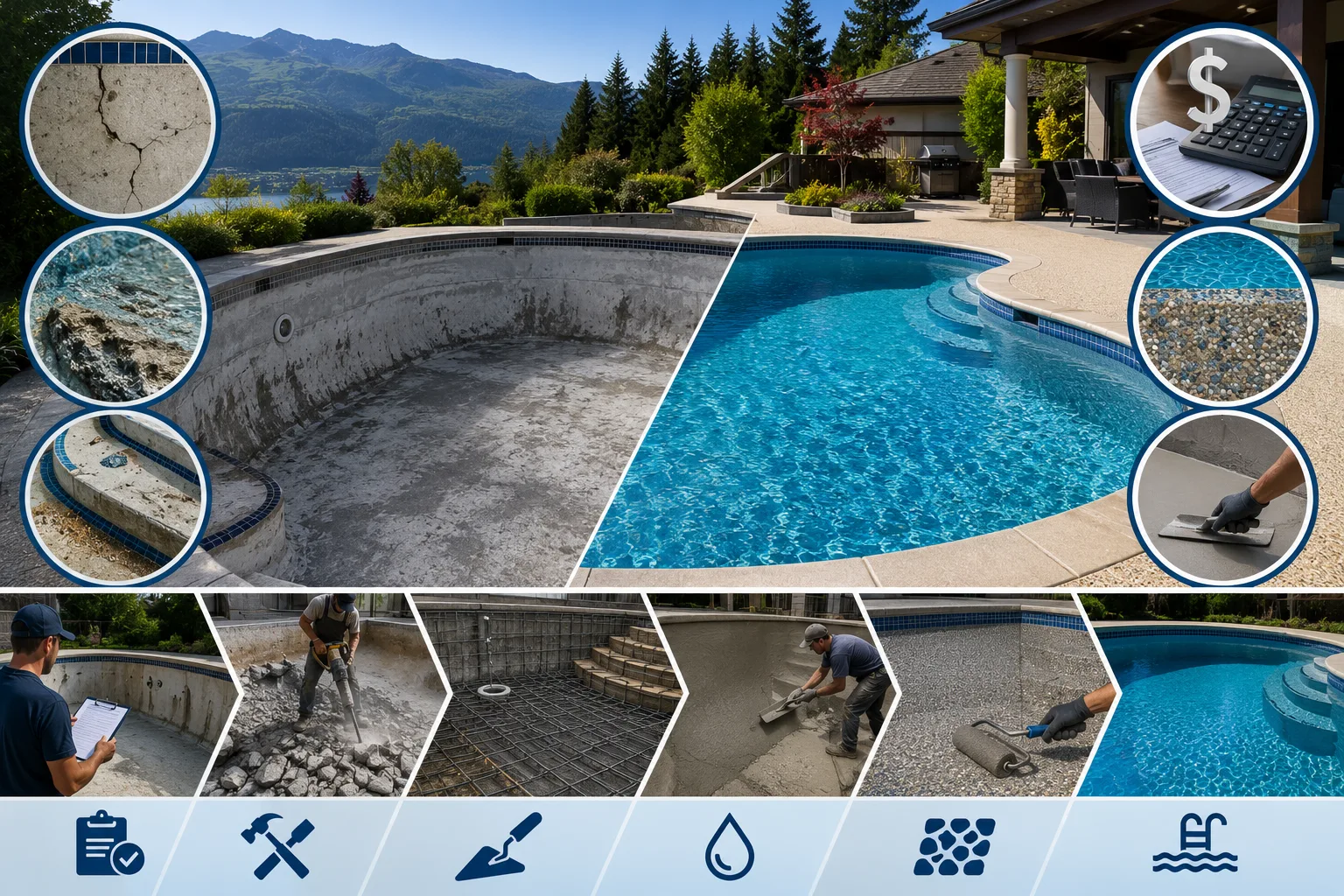
1. Rough or pitted surface texture If the pool floor or walls feel rough, chalky, or scratchy underfoot, the plaster is breaking down. This happens gradually, so it's easy to miss until a guest mentions it.
2. Visible cracks Small hairline cracks in the plaster are common and often cosmetic. Cracks that are wide, growing, or paired with water loss are a different story and usually point to structural movement.
3. Staining that won't come out Some staining is chemical and can be treated. Rust-colored staining that keeps returning, especially near the waterline, often means the rebar inside the shell has started corroding.
4. Water loss you can't explain Every pool loses some water to evaporation. If you're topping it up noticeably more than a neighbour with a similar-sized pool, or a bucket test shows loss beyond evaporation, that's worth investigating.
5. Dated tile, coping, or deck This one's purely cosmetic, but it's the most common reason people start a renovation conversation in the first place. Chipped coping, cracked deck concrete, or tile that hasn't been updated since the pool was built can make an otherwise healthy pool look tired.
6. Old, inefficient equipment Single-speed pumps, aging filters, and manual chlorine systems aren't dangerous, but they cost more to run and don't offer the automation most homeowners expect today. A renovation is often the natural point to upgrade all of it at once.
Pro tip: If you're only noticing one or two of these, it's likely a targeted repair. If you're nodding along to three or more, it's worth getting a proper assessment before deciding what route to take.
What a Concrete Pool Renovation Actually Involves
Renovation covers a wide range of work, and not every pool needs all of it. Depending on what an inspection turns up, a renovation can include:
Draining and prepping the shell
Chipping out and replacing old plaster, marcite, or aggregate finish
Repairing or sealing structural cracks
Replacing tile, coping, and deck concrete
Upgrading plumbing, skimmers, and drains
Installing new equipment: variable-speed pumps, updated filtration, heaters, or a switch to a saltwater system
Adding automation for water chemistry, lighting, and scheduling
Most renovations take anywhere from a couple of weeks to a couple of months, depending on scope, weather, and how much of the plumbing and equipment gets touched along the way.
Renovation or Rebuild? How to Decide
This is usually the real question underneath "does my pool need a renovation."
A renovation makes sense when the shell itself is sound and the issues are limited to surface finish, tile, equipment, or minor structural repairs. Most pools fall into this category, even ones that look pretty rough on the surface.
A rebuild becomes the more sensible option when there's significant structural movement, repeated plumbing failures throughout the shell, or when the pool's shape and size no longer fit how the family actually uses the space. In those cases, patching things up piece by piece often ends up costing more over a few years than starting fresh would have.
If a rebuild turns out to be the right call, it's worth working with a team that can handle both sides of that conversation honestly. TDG Pools works as custom pool builders in Vancouver and across BC, so whether the answer is "renovate what you have" or "let's design something new," it's the same team either way, not a renovation contractor telling you to call someone else for the rebuild.
What Does It Cost?
This is genuinely hard to answer with one number, because renovation scope varies so much from pool to pool. A resurfacing-only job with no structural work is on the lower end. Add in tile, coping, deck replacement, new equipment, or structural repairs, and the number climbs from there.
The honest answer is that the surface work alone, the equipment upgrades, and any structural repair each move the price independently, so two pools that look similar from the pool deck can land in very different budget ranges once you're underneath the surface. The only reliable way to get a real number is a site visit and assessment, since so much depends on the current condition of the shell and how much of the plumbing needs to come along with it.
Choosing the Right Team
A concrete pool renovation touches structural work, plumbing, finishing, and equipment, often all in the same project. Hiring separate trades for each piece can work, but it also means more handoffs, more scheduling coordination, and more room for something to fall through the cracks (sometimes literally).
A few things worth asking any contractor before you sign anything:
Do you handle design, structural repair, and finishing in-house, or subcontract most of it out?
What's included in the initial assessment, and is it free?
Can you show recent BC renovation projects, not just new builds?
How do you handle unexpected issues once the old surface is chipped away?
That last one matters more than people expect. Once the old plaster comes off, you sometimes find out things about the shell that weren't visible before. A contractor who's upfront about that possibility, instead of pretending every job goes exactly to plan, is usually the one worth hiring.
FAQ
How long does a concrete pool renovation take in BC?
Most renovations take two to eight weeks depending on scope. A resurfacing-only project moves faster than one that includes structural repair, tile, deck work, and equipment upgrades.
Can I renovate a concrete pool myself to save money?
Surface prep and finish work require specific techniques and curing conditions to hold up long-term. DIY resurfacing is possible but the failure rate is high, and a failed finish usually costs more to fix than hiring it out properly the first time.
Is it better to renovate in a specific season?
Late fall through early spring is often the preferred window in BC, since the pool would be closed for swimming season anyway. It also tends to be easier to schedule than peak summer.
Will renovating fix a leaking pool?
Sometimes. If the leak is coming from a crack, plumbing fitting, or the skimmer area, renovation work usually resolves it. If it's a deeper structural issue, that needs to be addressed as its own repair before any cosmetic work goes on top.
Should I switch to saltwater during a renovation?
It's a common upgrade to make while the pool is already drained and being worked on, since adding a salt chlorine generator later means less disruption than doing it as a standalone project.
How do I know if I need a renovation or a full rebuild?
If the shell is structurally sound and the issues are limited to surface, tile, or equipment, renovation is usually the right call. If there's significant structural movement or the layout no longer works for your space, a rebuild is often more cost-effective long term. A proper assessment is the only way to know for sure.