
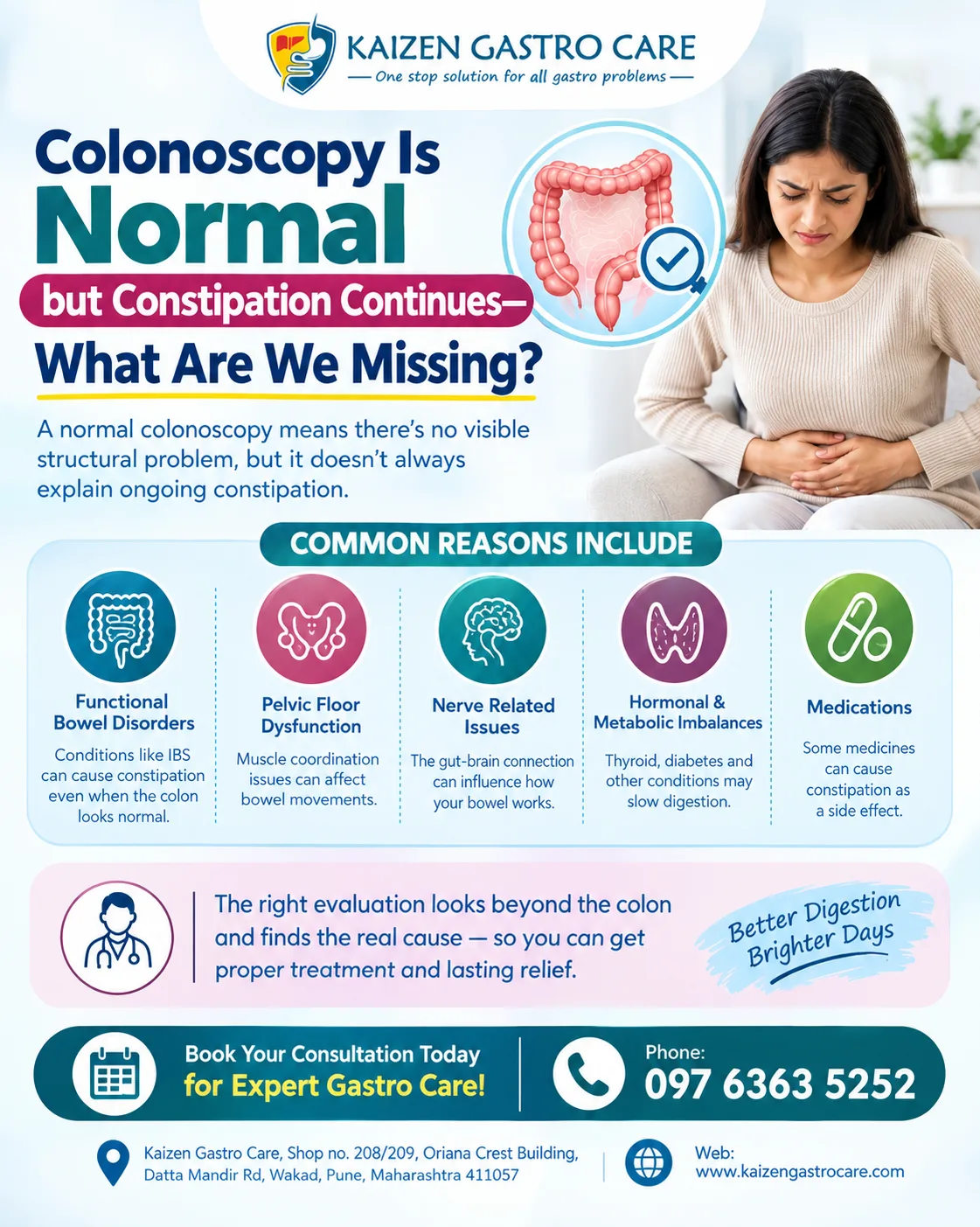
Your colonoscopy report says "normal," but your constipation has not improved at all. This is more common than you think. Many patients face this exact confusion every single day. The real problem often lies not in the colon's structure, but in how the colon and pelvic floor muscles work together during motion. This is exactly where a Gastrophysiologist in Pune can help you find real answers.
Understanding the Confusion: Normal Report, Real Problem
When your colonoscopy comes back clear, it feels reassuring at first. No cancer. No polyps. No inflammation. But then the confusion sets in. If nothing is wrong, why does constipation continue?
This is one of the most common questions patients ask. The answer lies in understanding what a colonoscopy actually tests, and what it does not.
A colonoscopy is a visual and structural test. It looks at the inside lining of your colon. It can detect ulcers, tumours, polyps, and inflammation. But it cannot tell you how well your colon muscles are working. It also cannot tell you whether your pelvic floor muscles are coordinating properly during a bowel movement.
Constipation is often a functional problem, not a structural one. This means the plumbing looks fine, but the way it works is not fine.
Why a Normal Colonoscopy Doesn't Mean Everything Is Fine
Two common functional issues cause most chronic constipation cases:
1. Slow Colon TransitIn this condition, stool moves too slowly through the colon. The colon muscles are not contracting with enough strength or rhythm to push stool forward at a normal pace. Patients with slow transit often feel bloated, have infrequent bowel movements, and feel a general heaviness in the abdomen.
2. Dyssynergic DefecationThis is a coordination problem. When you try to pass stool, your pelvic floor muscles are supposed to relax. But in dyssynergic defecation, these muscles tighten instead of relaxing. This creates a kind of internal resistance, making it very hard to pass stool even when there is an urge.
Neither slow transit nor dyssynergic defecation shows up on a colonoscopy screen. They need special motility tests to be diagnosed correctly. Without these tests, patients often keep trying different laxatives, diets, and home remedies without any real improvement.
The Missing Piece: Functional GI Testing
This is where functional gastrointestinal testing becomes important. These tests do not look at the structure of the colon. Instead, they measure how well the colon and pelvic floor muscles are functioning.
1. Colon Transit StudyThis test checks how long it takes for stool to move through your colon. Patients swallow small markers, usually in the form of a capsule, and X-rays are taken over a few days to track how these markers move through the digestive system.
This test helps doctors understand two important things. First, whether the constipation is due to slow-moving stool throughout the colon. Second, whether it is due to an outlet problem, meaning the stool reaches the rectum normally but struggles to exit. This distinction is very important because the treatment approach is completely different for each type.
2. High-Resolution Anorectal ManometryThis is one of the most advanced tests available for diagnosing constipation. It measures the pressure and coordination of your anal sphincter and rectal muscles using a thin, flexible catheter.
The test shows whether your pelvic floor muscles relax properly during a bowel movement, or whether they tighten incorrectly. As mentioned earlier, this incorrect tightening is called dyssynergic defecation. It is one of the most common yet under-diagnosed causes of chronic constipation, especially in patients who have already had a normal colonoscopy.
Anorectal manometry also helps assess sphincter strength, which is useful for diagnosing other pelvic floor conditions as well.
3. Balloon Expulsion TestThis is a simple, quick test. A small balloon is placed in the rectum and filled with a little water or air. The patient is then asked to push it out, just like passing a normal stool.
Difficulty in expelling the balloon often points towards a pelvic floor coordination problem. This test is usually done along with anorectal manometry for a complete picture.
4. Biofeedback TherapyOnce a coordination problem is confirmed through testing, biofeedback therapy is the most effective, non-surgical treatment available. During biofeedback sessions, patients are shown real-time feedback about their pelvic floor muscle activity on a screen.
This helps them learn how to relax and contract these muscles correctly during a bowel movement. Over multiple sessions, most patients see a significant improvement in their symptoms. This therapy has strong scientific backing and excellent long-term success rates for chronic constipation caused by muscle coordination issues.
When Constipation Is Linked to Other Pelvic Floor Problems
Chronic constipation rarely exists in isolation. Many patients who suffer from long-standing constipation also develop other pelvic floor issues over time, often due to years of excessive straining.
Some patients experience involuntary leakage of stool or gas. This can feel embarrassing, and many people hesitate to discuss it even with their doctors. However, it is a real medical condition with effective treatment options, and proper evaluation through anorectal manometry can identify the exact cause.
Other patients notice a feeling of something slipping out or bulging during motion, especially after years of straining due to constipation. This can be an early sign of a prolapse-related issue and needs timely medical attention before it worsens.
Both these conditions are closely connected to constipation, and both need proper physiological evaluation. A colonoscopy alone cannot detect either of them.
Why You Need a Specialist, Not Just a Scope
A colonoscopy is performed by a gastroenterologist to check the structure of your gut. But functional testing, like manometry, transit studies, and biofeedback, needs a doctor trained specifically in gut motility and pelvic floor function. This specialised field is called Gastrophysiology.
This is exactly the gap Dr. Rupali Bandgar-Jankar fills for patients in Pune. She is a Consultant Gastrophysiologist and Biofeedback Specialist with over 8 years of experience in advanced gastrointestinal physiology and GI motility studies. She is recognised as the first dedicated Consultant Gastrophysiologist and Biofeedback Specialist practicing in Pune, Maharashtra.
Dr. Rupali Bandgar-Jankar completed her MBBS from Grant Medical College, Mumbai, and her MD in Physiology from Government Medical College, Latur. She trained further in Gastrophysiology at the Asian Institute of Gastroenterology, Hyderabad, one of the most respected centres for GI motility studies in India.
She currently heads the GI Motility Department at Kaizen Gastro Care, Pune, where she is widely noted for introducing advanced diagnostic procedures like high-resolution manometry and non-invasive biofeedback therapies to the region. She has treated more than 3,000 patients for conditions related to constipation, GERD, achalasia, and pelvic floor disorders.
What to Expect at Your Consultation
At Kaizen Gastro Care, the approach is simple, thorough, and patient-friendly. Here is what usually happens during a consultation:
- A detailed discussion about your bowel habits, symptoms, and medical history
- Review of your existing colonoscopy and other test reports
- Recommendation of relevant functional tests, based on your specific symptoms
- Clear explanation of each test before it is performed, so you understand exactly why it is needed
- A personalised treatment plan, which may include biofeedback therapy, dietary guidance, or medical management
This step-by-step approach ensures that no important detail is missed, and that treatment is based on accurate diagnosis rather than guesswork.
Don't Ignore Persistent Constipation
If your colonoscopy is normal but your constipation continues, please do not assume it is "just stress" or "just diet." There is likely an underlying functional cause that a routine scope simply cannot catch.
Ignoring persistent constipation for too long can also lead to other complications over time, including pelvic floor weakness and related issues. Early diagnosis always leads to easier and more effective treatment.
With proper constipation treatment in Pune, the right tests, and correct diagnosis using a Colon Transit Study in Pune, most chronic cases can be treated effectively without surgery. If leakage or slipping symptoms are also troubling you, timely fecal incontinence treatment in Pune and rectal prolapse treatment in Pune can bring lasting relief and improve your quality of life significantly.
Book Your Consultation Today
For expert evaluation and advanced GI motility testing, visit:
Dr. Rupali Bandgar-Jankar
Kaizen Gastro Care
Shop no. 208/209, Oriana Crest Building, Datta Mandir Road, Wakad, Pune, Maharashtra 411057
📞 097636 35252
📧 [email protected]
🌐 www.drrupalibandgar.com
🕒 Mon to Sat: 8 am–3 pm, 4–9 pm
Don't let unexplained constipation affect your daily life. Get the right diagnosis with proper functional GI testing today.