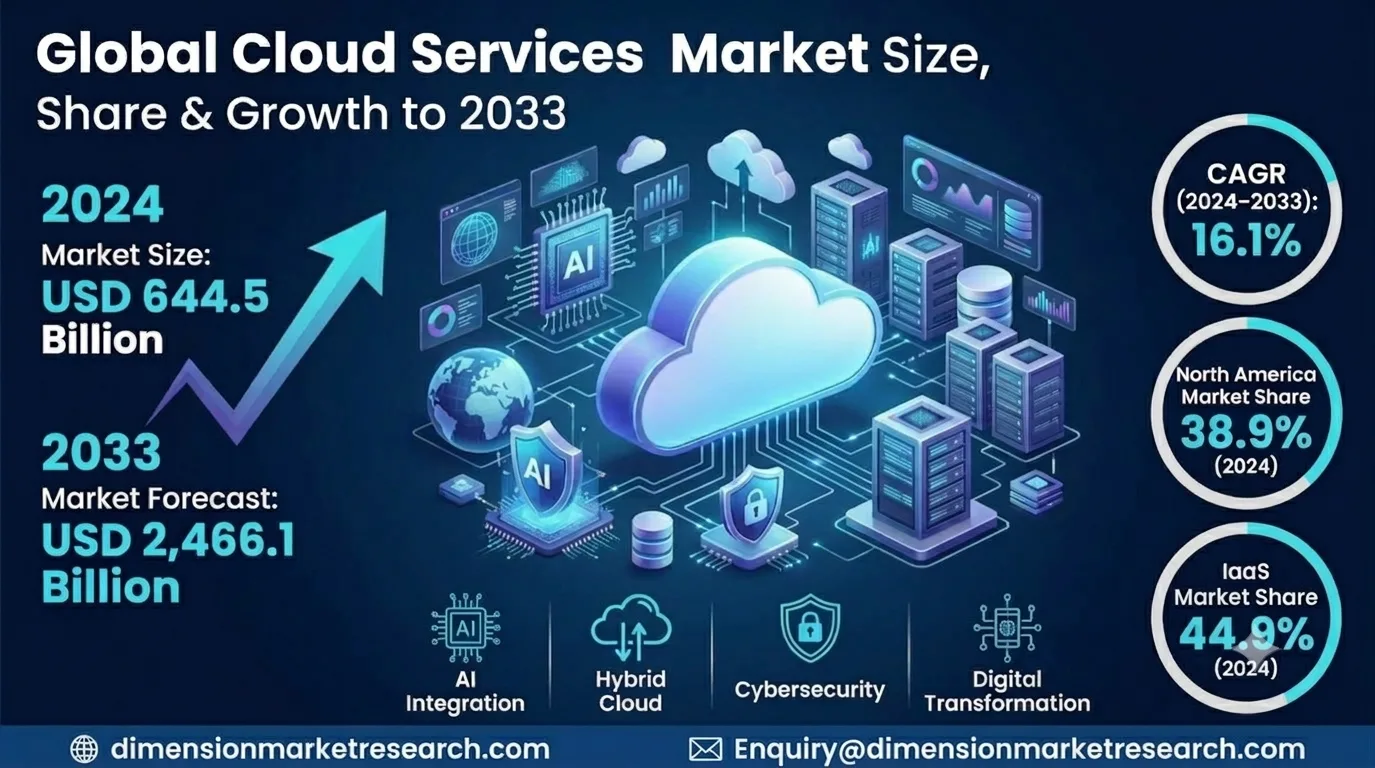
The Global Cloud Services Market is experiencing substantial expansion as enterprises accelerate digital transformation, adopt artificial intelligence, and modernize IT infrastructure. According to Dimension Market Research, the global market was valued at USD 644.5 billion in 2024 and is projected to reach USD 2,466.1 billion by 2033, expanding at a CAGR of 16.1%. Increasing demand for scalable computing, cloud-based applications, and secure digital infrastructure continues to transform enterprise technology investments.
Cloud computing has become essential for organizations seeking operational flexibility, cost optimization, and improved business performance. Enterprises across banking, healthcare, manufacturing, retail, and telecommunications increasingly rely on cloud platforms for data storage, application management, analytics, and business continuity. The transition from traditional on-premise infrastructure to cloud environments enables businesses to access computing resources without significant upfront hardware investments.
Advancements in generative AI, machine learning, edge computing, and cloud-native application development are creating additional opportunities for cloud service providers. Organizations are also adopting hybrid and multi-cloud strategies to improve workload distribution, strengthen disaster recovery, and meet changing regulatory requirements. These developments are positioning cloud services as critical infrastructure for the global digital economy.
📄 Looking for Specific Data? Get a Free Customized Sample:
https://dimensionmarketresearch.com/request-sample/cloud-services-market/
Cloud Services Market Overview
The Cloud Services Market encompasses internet-delivered computing solutions, including infrastructure, software applications, development platforms, networking, databases, and storage. These services allow organizations to access technology resources on demand while reducing dependence on internally managed physical infrastructure.
Cloud platforms typically operate through subscription-based, consumption-based, or pay-as-you-go pricing models. This flexibility enables businesses to adjust computing capacity according to operational requirements, improve resource utilization, and accelerate application deployment.
The global market's projected increase from USD 644.5 billion in 2024 to USD 2,466.1 billion by 2033 represents an expansion of approximately 3.8 times its 2024 value. This growth reflects sustained demand for enterprise modernization, automated IT operations, and advanced digital services.
Key Findings of the Global Cloud Services Market
● Global market valuation reached USD 644.5 billion in 2024.
● Market revenue is projected at USD 2,466.1 billion by 2033.
● The forecast CAGR is 16.1%.
● North America held a projected 38.9% revenue share in 2024.
● IaaS represented an estimated 44.9% service share in 2024.
● Asset management led applications with a 34.1% share in 2024.
● The U.S. market was estimated at USD 210.8 billion in 2024.
● The U.S. market is projected to reach USD 747.9 billion by 2033.
Cloud Services Market Dynamics
The global cloud computing landscape is influenced by digital infrastructure modernization, enterprise IT investment, data protection requirements, and advances in software development. Organizations increasingly view cloud adoption as a long-term strategic investment rather than simply a replacement for conventional servers.
Cloud technologies enable enterprises to implement advanced analytics, improve workforce collaboration, and deploy digital products across multiple geographic locations. However, escalating infrastructure complexity, cybersecurity risks, and integration challenges continue to influence purchasing decisions.
Key Growth Drivers
Rising Demand for Scalable IT InfrastructureScalability remains a fundamental driver of cloud services adoption. Organizations experiencing fluctuating workloads require infrastructure that adjusts computing resources without lengthy procurement cycles or significant capital expenditure.
Cloud environments support seasonal business demand, transaction processing, digital commerce, and enterprise applications. For example, online retailers can increase computing capacity during promotional campaigns and reduce consumption afterward.
This operational flexibility strengthens the commercial appeal of Infrastructure as a Service, particularly among growing enterprises and digitally intensive industries.
Accelerating Digital TransformationDigital transformation initiatives are encouraging enterprises to migrate legacy applications, modernize databases, and integrate automation technologies.
Cloud solutions provide the foundation for implementing AI, machine learning, data analytics, and Internet of Things applications. These capabilities help organizations improve business intelligence, streamline internal processes, and deliver more personalized customer experiences.
Key growth drivers include:
● Increasing adoption of AI-enabled enterprise applications.
● Rising demand for cloud storage and backup solutions.
● Expansion of remote and distributed work environments.
● Growing enterprise investment in digital modernization.
● Demand for flexible and consumption-based IT infrastructure.
Emerging Cloud Services Market Trends
Growth of Hybrid and Multi-Cloud Environments
Hybrid and multi-cloud adoption is reshaping enterprise infrastructure strategies. Businesses increasingly combine public cloud platforms, private infrastructure, and multiple service providers to balance security, flexibility, and performance.
Multi-cloud environments allow organizations to select platforms according to workload requirements while reducing dependence on a single technology ecosystem.
However, managing multiple environments also creates challenges involving interoperability, security policies, application portability, and operational visibility.
Integration of Artificial Intelligence and Automation
Artificial intelligence is emerging as an important catalyst for cloud infrastructure demand. Generative AI applications require substantial computing power, advanced data processing, and specialized infrastructure to support model development and deployment.
Cloud providers are expanding AI-ready infrastructure, managed machine learning platforms, and automated development environments to meet these requirements.
AI-enabled cloud management can also improve resource allocation, identify performance anomalies, and support predictive infrastructure maintenance.
Expansion of Edge and Cloud-Native Computing
Edge computing is gaining relevance as connected devices generate increasing volumes of information requiring rapid processing.
Combining edge infrastructure with centralized cloud platforms enables organizations to process time-sensitive information closer to its source while maintaining centralized analytics and management capabilities.
Cloud-native technologies, including containers, microservices, and orchestration platforms, are also improving application scalability and software development flexibility.
Major Technology Trends
● Growing deployment of generative AI infrastructure.
● Increasing adoption of hybrid and multi-cloud platforms.
● Expansion of cloud-native software architectures.
● Rising demand for edge computing integration.
● Greater emphasis on cloud cost optimization and automation.
Cloud Services Market Challenges and Restraints
Cybersecurity and Data Privacy Concerns
Security remains a significant challenge for organizations transitioning critical workloads to cloud environments. Unauthorized access, identity misconfiguration, ransomware, and inadequate access controls can expose sensitive corporate information.
Industries handling confidential financial, healthcare, and personal data face additional requirements concerning compliance, auditability, and information governance.
Businesses must therefore invest in encryption, identity management, continuous monitoring, and appropriate shared-responsibility security controls.
Migration Complexity and Vendor Dependence
Legacy IT infrastructure can create technical and financial obstacles during cloud migration. Organizations operating highly customized applications may require extensive modernization before transferring workloads.
Furthermore, proprietary platforms and specialized cloud services can increase switching costs and complicate migration between providers.
Unexpected data transfer charges, inefficient resource allocation, and insufficient cloud management capabilities may also weaken anticipated cost benefits.
Principal market challenges include:
● Increasing complexity of cloud cybersecurity management.
● High costs associated with legacy application migration.
● Potential vendor lock-in and limited interoperability.
● Unpredictable consumption and data transfer expenses.
● Complex data residency and regulatory requirements.
Cloud Services Market Segmentation Overview
The Cloud Services Market is categorized by service model, deployment, organization size, application, and industry vertical. These segments reveal important differences in enterprise technology spending, infrastructure requirements, and cloud adoption strategies.
By Service Model
Infrastructure as a Service (IaaS) represented approximately 44.9% of the global market in 2024, making it the leading service segment within the report's classification.
IaaS enables organizations to access virtual servers, storage, networking, and computing infrastructure without directly maintaining physical hardware.
Platform as a Service (PaaS) supports application development, testing, integration, and deployment, while Software as a Service (SaaS) provides ready-to-use business applications through cloud-based delivery models.
The primary service categories include:
● IaaS: Virtual computing, storage, networking, and backup.
● PaaS: Application development, testing, and data integration.
● SaaS: Enterprise software, CRM, collaboration, and productivity.
By Deployment Model
Public cloud deployment holds a leading position because of its scalability, service accessibility, and relatively low initial infrastructure requirements.
Private cloud environments remain important for organizations requiring dedicated infrastructure and greater control over sensitive workloads.
Hybrid deployment combines these approaches, allowing enterprises to distribute applications across environments based on performance, security, and compliance needs.
By Organization Size and Application
Large enterprises represent a leading customer segment because of their substantial computing requirements, complex operations, and extensive application portfolios.
Small and medium-sized enterprises also present significant opportunities as subscription-based cloud solutions reduce the need for large initial technology investments.
By application, asset management captured approximately 34.1% of the market in 2024. Cloud-based asset management enables organizations to monitor equipment, manage resources, and analyze operational performance across multiple locations.
Other major application categories include customer relationship management, enterprise resource planning, supply chain management, project management, and business intelligence.
By Industry Vertical
The banking, financial services, and insurance sector represents a leading industry vertical due to its requirements for secure transaction processing, data analytics, digital banking, and regulatory compliance.
Healthcare organizations increasingly use cloud platforms for information management, clinical collaboration, and digital health applications. Meanwhile, manufacturing companies deploy cloud-connected platforms for production monitoring, predictive maintenance, and supply chain visibility.
Retail, telecommunications, government, and technology businesses further contribute to market expansion through digital service delivery and application modernization.
📄 Purchase the Report for Comprehensive Details:
https://dimensionmarketresearch.com/checkout/cloud-services-market/
Cloud Services Market Regional Analysis
North America Cloud Services Market
North America held a projected 38.9% share of global cloud services revenue in 2024, positioning it as the leading regional market.
The region benefits from established cloud infrastructure, advanced enterprise technology adoption, and the presence of major providers, including Amazon Web Services, Microsoft Azure, and Google Cloud.
The United States represents a major contributor, with its cloud services market estimated at USD 210.8 billion in 2024 and projected to reach USD 747.9 billion by 2033, reflecting a CAGR of 15.1%.
Continued investment in AI infrastructure, cybersecurity, and enterprise modernization supports regional demand.
Europe Cloud Services Market
Europe represents an important market supported by digital transformation initiatives, enterprise software modernization, and demand for secure cloud infrastructure.
Data protection obligations and digital sovereignty considerations influence cloud procurement strategies. Organizations increasingly evaluate regional data hosting, encryption capabilities, and regulatory compliance when selecting cloud platforms.
Demand for hybrid cloud solutions is particularly relevant among financial institutions, industrial enterprises, and public-sector organizations.
Asia-Pacific Cloud Services Market
Asia-Pacific presents substantial growth opportunities as businesses expand digital operations and governments support digital infrastructure development.
China, India, Japan, South Korea, and Southeast Asian economies are contributing to demand for cloud computing, digital payments, enterprise applications, and AI infrastructure.
Expansion of e-commerce, connected manufacturing, and technology-enabled services further supports regional adoption.
Latin America and Middle East & Africa
Latin America is experiencing increasing interest in cloud-based enterprise systems, digital financial services, and scalable technology infrastructure.
Brazil and Mexico represent important markets supported by enterprise modernization and growing digital business activity.
Across the Middle East and Africa, cloud demand is developing alongside smart-city initiatives, government digitalization, telecommunications modernization, and investments in regional data infrastructure.
Competitive Landscape of the Cloud Services Market
The global cloud services industry features intense competition among hyperscale infrastructure providers, enterprise software vendors, and specialized technology companies.
Leading participants compete through infrastructure capacity, AI capabilities, cybersecurity solutions, global availability, pricing structures, and enterprise partnerships.
Major companies operating in the market include:
● Amazon Web Services (AWS)
● Microsoft Corporation
● Google Cloud
● Alibaba Cloud
● Oracle Corporation
● IBM Corporation
● Cisco Systems, Inc.
● Dell Technologies Inc.
● Salesforce, Inc.
● SAP SE
Amazon Web Services, Microsoft Azure, and Google Cloud maintain influential positions in hyperscale cloud infrastructure. Other companies strengthen the competitive landscape through enterprise applications, hybrid infrastructure, database technologies, and industry-specific cloud solutions.
Strategic partnerships, data center expansion, product innovation, and AI platform integration remain important competitive strategies.
Future Market Outlook: Cloud Services Market Through 2033
The Cloud Services Market is expected to undergo continued transformation as cloud computing becomes increasingly integrated into enterprise operations.
The projected market value of USD 2,466.1 billion by 2033 highlights the long-term commercial potential of cloud infrastructure, application platforms, and digital services.
Future investment opportunities are expected to emerge across AI-enabled cloud platforms, advanced cybersecurity, sovereign cloud infrastructure, managed services, and cloud-native software development.
Organizations will increasingly prioritize workload optimization, operational resilience, and measurable returns from cloud investment rather than migration alone.
Strategic Opportunities Through 2033
● AI-ready cloud infrastructure and accelerated computing.
● Industry-specific cloud platforms and managed applications.
● Secure and compliant regional cloud environments.
● Advanced cloud automation and cost management.
● Cloud-native application modernization services.
Frequently Asked Questions About the Cloud Services Market
1. What is the global Cloud Services Market size?
The global Cloud Services Market was valued at USD 644.5 billion in 2024 and is projected to reach USD 2,466.1 billion by 2033, registering a CAGR of 16.1%. Growth is supported by digital transformation, scalable infrastructure demand, and increasing adoption of advanced cloud technologies.
2. Which region leads the global Cloud Services Market?
North America leads the global market with a projected revenue share of 38.9% in 2024. Its leadership is supported by advanced technology infrastructure, substantial enterprise cloud investment, and the presence of major cloud service providers.
3. Which service segment holds the largest market share?
Infrastructure as a Service leads the service segment with an estimated 44.9% share in 2024. Its position reflects demand for scalable computing resources, virtualized infrastructure, cloud storage, and flexible consumption-based pricing.
4. What are the primary factors driving cloud services market growth?
Major growth drivers include enterprise digital transformation, increasing AI adoption, demand for scalable IT infrastructure, cloud-native application development, and growing requirements for secure storage, analytics, and business continuity.
5. What opportunities will shape the Cloud Services Market by 2033?
Key opportunities include generative AI infrastructure, hybrid and multi-cloud adoption, industry-specific cloud services, cybersecurity modernization, edge computing, and expansion into emerging digital economies.
Summary of Key Insights
The Global Cloud Services Market is entering a significant phase of expansion as organizations increasingly depend on cloud infrastructure for operational efficiency, digital innovation, and enterprise growth.
With revenue projected to increase from USD 644.5 billion in 2024 to USD 2,466.1 billion by 2033, the market offers substantial opportunities across infrastructure services, application development, enterprise software, and emerging AI technologies.
North America's 38.9% regional share, IaaS leadership at 44.9%, and the growing importance of cloud-enabled asset management demonstrate the market's diverse commercial potential.
Looking ahead, AI integration, cybersecurity, hybrid deployment, and cloud-native innovation will remain central to competitive differentiation. Companies capable of delivering secure, scalable, efficient, and industry-focused solutions will be better positioned to capture opportunities in the evolving global cloud services ecosystem.
Related Reports:
https://dimensionmarketresearch.com/report/kingdom-of-saudi-arabia-cloud-services-market/
https://dimensionmarketresearch.com/report/cloud-computing-market/
https://dimensionmarketresearch.com/report/cloud-infrastructure-services-market/