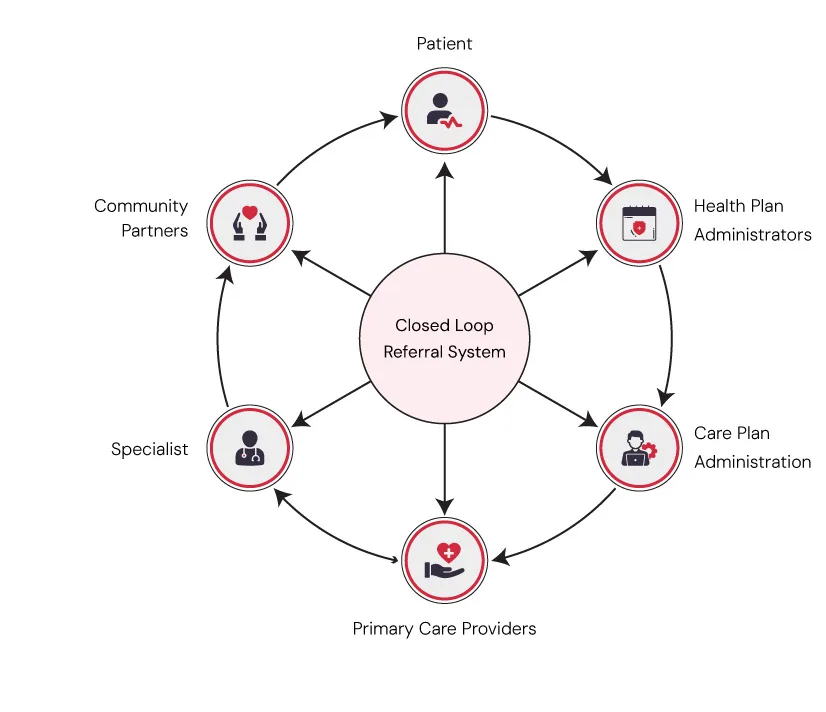
Modern healthcare is increasingly about connections. A patient may begin with a primary-care provider, continue with a specialist, require assistance from a community organization, and depend on a payer or care coordinator to keep everything moving. When communication breaks between these participants, even a well-intentioned referral can lose momentum. A Closed Loop Referral System creates a more connected pathway by allowing referrals to be tracked from the original request through confirmed resolution. Rather than treating a referral as the end of a provider's responsibility, this approach makes it part of a measurable and coordinated care journey.
The Referral Problem Hidden in Plain Sight
Healthcare organizations create referrals every day.
A physician may refer someone to a cardiologist. A care coordinator may connect a patient with transportation assistance. A health plan may identify a need for food support. A community organization may need to coordinate with a medical team before a service can be completed.
Each referral represents an intended action.
But creating the referral does not necessarily mean the action occurs.
The patient might never schedule the appointment. The receiving organization might not have sufficient information. A message might remain unanswered. Staff members may not know whether another team has already contacted the patient.
Without visibility, the original organization may assume everything is progressing normally.
That uncertainty is precisely where closed-loop referral management becomes valuable.
From Sending Information to Following Outcomes
Traditional referral processes often emphasize transmission.
A provider sends a referral, and the next organization takes responsibility.
A closed-loop model emphasizes what happens afterward.
The referral continues through defined stages until there is confirmation that the intended service has been delivered or the need has otherwise been addressed.
SocialRoots.ai describes GridSocial as a verified two-way referral network that connects patients with healthcare and community services. The platform tracks referrals in real time and is designed to continue monitoring them until confirmed resolution.
This creates a fundamental shift in thinking.
Instead of asking whether the referral was sent, organizations can ask whether it produced the intended result.
Why Two-Way Communication Matters
Communication in healthcare cannot always be one-directional.
The referring provider needs information from the receiving organization. At the same time, the receiving organization may need clarification, additional information, or coordination from the referring team.
Two-way communication creates a feedback loop.
Imagine a patient referred for a specialist consultation. The referral is accepted, but scheduling becomes difficult. If there is no mechanism for communicating the delay, the original provider may remain unaware.
With greater referral visibility, the delay can become an actionable event instead of an invisible problem.
The same principle applies to social services.
A patient may be referred for transportation, food assistance, housing support, or another community resource. Knowing whether the connection actually occurred can help care teams determine what should happen next.
Connecting Medical and Community Resources
Healthcare does not operate inside a single building.
Many factors influencing a person's ability to maintain health exist outside the traditional clinical setting.
Transportation difficulties can interfere with appointments. Food insecurity can affect nutrition. Housing instability can complicate recovery. Medication-related gaps can affect continuity of treatment.
These challenges may require assistance from organizations that operate outside the healthcare provider's immediate environment.
SocialRoots.ai positions GridSocial as a platform for connecting patients with both clinical and non-clinical services. Its referral model can therefore bring healthcare providers and community partners into a more coordinated workflow.
The advantage is not simply having more organizations involved.
The advantage is making their involvement more visible and coordinated.
Turning Community Investment Into Outcomes
Community programs often receive funding because organizations believe they can improve people's lives.
But investment alone does not demonstrate impact.
Leaders, funders, and other stakeholders increasingly want evidence that resources are reaching the people who need them.
A connected referral process can help organizations understand what happens after someone is directed to a community resource.
SocialRoots.ai highlights measurable outcomes such as completed referrals and needs addressed, giving donors and organizations information they can use when communicating impact.
This can change the conversation around community investment.
Instead of reporting only how much money was allocated or how many referrals were generated, organizations can focus on what those activities accomplished.
Helping Payers Think Beyond Claims
Health plans have another reason to care about unresolved referrals.
When clinical and social needs remain unaddressed, problems can continue or become more difficult to manage.
A missed follow-up can leave a patient without appropriate ongoing care. A medication gap can create another challenge. Transportation or food barriers can interfere with a broader care plan.
SocialRoots.ai describes GridSocial as a tool that can help payers address missed follow-ups, medication gaps, housing, food, and transportation barriers earlier.
The broader concept is proactive coordination.
Rather than waiting for an unresolved need to contribute to another costly healthcare interaction, organizations can work toward identifying and addressing gaps earlier.
Making Referral Management Less Dependent on Memory
Human attention is valuable, but healthcare teams manage large volumes of information.
When referral tracking depends heavily on individual employees remembering to check spreadsheets, emails, messages, or separate systems, important tasks can be overlooked.
Automation can help.
According to SocialRoots.ai, GridSocial sends automated reminders and flags overdue referrals when staff do not update referral statuses.
This provides a practical safety net.
Instead of requiring supervisors to repeatedly ask whether outstanding referrals have been addressed, the system can bring overdue items back into view.
The goal is not to replace people.
It is to help people focus their attention where it is most needed.
A Better View of the Referral Lifecycle
A referral has a lifecycle.
It begins with identifying a need.
Then comes the referral.
After that, the receiving organization must respond, the patient may need to participate, and the service must ultimately be delivered.
Every stage can introduce friction.
A closed-loop system makes the lifecycle easier to observe.
This visibility can help organizations discover where problems occur most frequently.
For example, a healthcare organization may discover that referrals are regularly accepted but rarely completed. Another may identify delays between referral creation and initial contact. A community network might notice that certain services receive more requests than they can handle.
These insights can lead to better operational decisions.
Supporting Better Care Coordination
Care coordination is difficult when every participant sees only part of the picture.
A physician may know the clinical situation.
A care coordinator may understand the patient's broader needs.
A community organization may know which resources are currently available.
A payer may have another perspective based on member needs and utilization.
A shared referral workflow can help connect these perspectives.
SocialRoots.ai states that GridSocial provides centralized workflow and shared visibility, allowing authorized staff to collaborate, reassign referrals, and continue coordination when additional support is necessary.
That flexibility is important because real-world referrals rarely follow perfectly predictable paths.
When Referrals Need Reassignment
A referral is not always successful on its first attempt.
Perhaps the receiving organization cannot provide the service. Maybe the patient's circumstances change. The original destination might not have capacity.
A rigid system can turn these situations into dead ends.
A coordinated workflow can instead allow authorized staff to intervene.
Reassignment becomes part of the process rather than an exception that requires starting over.
This helps preserve continuity.
The objective remains the same: connect the patient with the appropriate resource and maintain visibility until the need is addressed.
Working Alongside Existing EHR Environments
Healthcare organizations already depend heavily on electronic health records.
Adding another technology layer can create concerns about duplicate data entry and fragmented workflows.
Integration therefore becomes an important consideration.
SocialRoots.ai states that GridSocial can work with multiple EHRs and can read from and write back to them. The company also states that full implementation, including EHR integration, workflow configuration, and staff training, typically takes 9–10 weeks.
For organizations using standalone deployment without EHR integration, the company describes a shorter 3–4-week implementation for smaller networks.
The underlying principle is straightforward: referral management should complement existing healthcare operations rather than create another isolated information silo.
Making Technology Accessible to Frontline Teams
Sophisticated technology is not automatically useful.
If frontline workers find a platform difficult to understand, adoption can suffer.
SocialRoots.ai says GridSocial is designed for everyday frontline use and does not require care coordinators to be highly tech-savvy. The company also includes staff training as part of its implementation approach.
This is especially relevant for referral management because the people updating referral information are often busy with multiple responsibilities.
A system should reduce unnecessary complexity.
The more naturally referral tracking fits into daily work, the easier it becomes to maintain reliable information.
Preparing for Larger Care Networks
Referral networks can grow quickly.
A healthcare organization may add new clinics, specialists, community organizations, programs, or geographic locations.
That growth can create another challenge: maintaining consistency.
SocialRoots.ai describes GridSocial as using a multi-tenant architecture designed to scale across sites, programs, and geographies.
Scalability can therefore be important for organizations that expect their coordination requirements to expand over time.
The objective is to build a referral infrastructure capable of supporting today's workflow while remaining useful as the network becomes more complex.
Measuring What Actually Happened
One of the most important advantages of closed-loop referral management is the ability to move from assumptions to measurable activity.
Organizations can examine:
- Referral completion rates
- Unresolved referrals
- Overdue cases
- Types of services requested
- Referral destinations
- Areas where reassignment occurs
- Patterns in clinical and social needs
- Outcomes associated with community connections
These measurements can reveal operational patterns that are difficult to identify through disconnected communication.
A high number of referrals may sound positive, but volume alone does not demonstrate effectiveness.
Completion and resolution provide a more meaningful perspective.
Closing the Gap Between Intention and Action
Healthcare professionals generally make referrals because they want something to happen.
A specialist should see the patient.
A transportation provider should help remove an access barrier.
A community organization should connect someone with an appropriate resource.
A follow-up should occur.
The referral represents intention.
The closed-loop process focuses on execution.
That distinction makes referral management more than an administrative function. It turns it into an important component of coordinated care.
The Future Is More Connected
Healthcare organizations increasingly operate as networks rather than isolated institutions.
Doctors collaborate with specialists. Health plans coordinate with providers. Community organizations support patients beyond clinical settings. Care teams connect multiple services around individual needs.
The technology supporting these relationships must therefore provide more than simple referral transmission.
It needs to support communication, visibility, accountability, and measurable resolution.
That is the direction represented by closed-loop referral management.
SocialRoots.ai's GridSocial combines referral tracking with a two-way workflow designed to keep organizations informed from service request through confirmed resolution.
For organizations seeking to strengthen care coordination, this approach can provide a clearer way to understand what happens after the referral leaves the originating provider.
Conclusion: Make Every Referral Count
A referral should be more than a message sent into another system.
It should be the beginning of a coordinated process with a visible outcome.
A Closed Loop Referral System can help organizations make that transition by connecting referral creation, communication, tracking, follow-up, and resolution within a more unified workflow.
For providers, this can mean better visibility into patient support. For community organizations, it can mean clearer evidence of completed services. For payers, it can provide a way to identify and address clinical and social needs earlier.
Most importantly, closed-loop coordination changes the definition of success.
Success is not simply generating a referral.
Success is knowing what happened next.
When healthcare organizations can follow that journey, identify obstacles, coordinate across organizations, and confirm resolution, every referral has a greater opportunity to become meaningful action.
And when more referrals turn into completed connections, healthcare networks can move one step closer to delivering truly connected care.