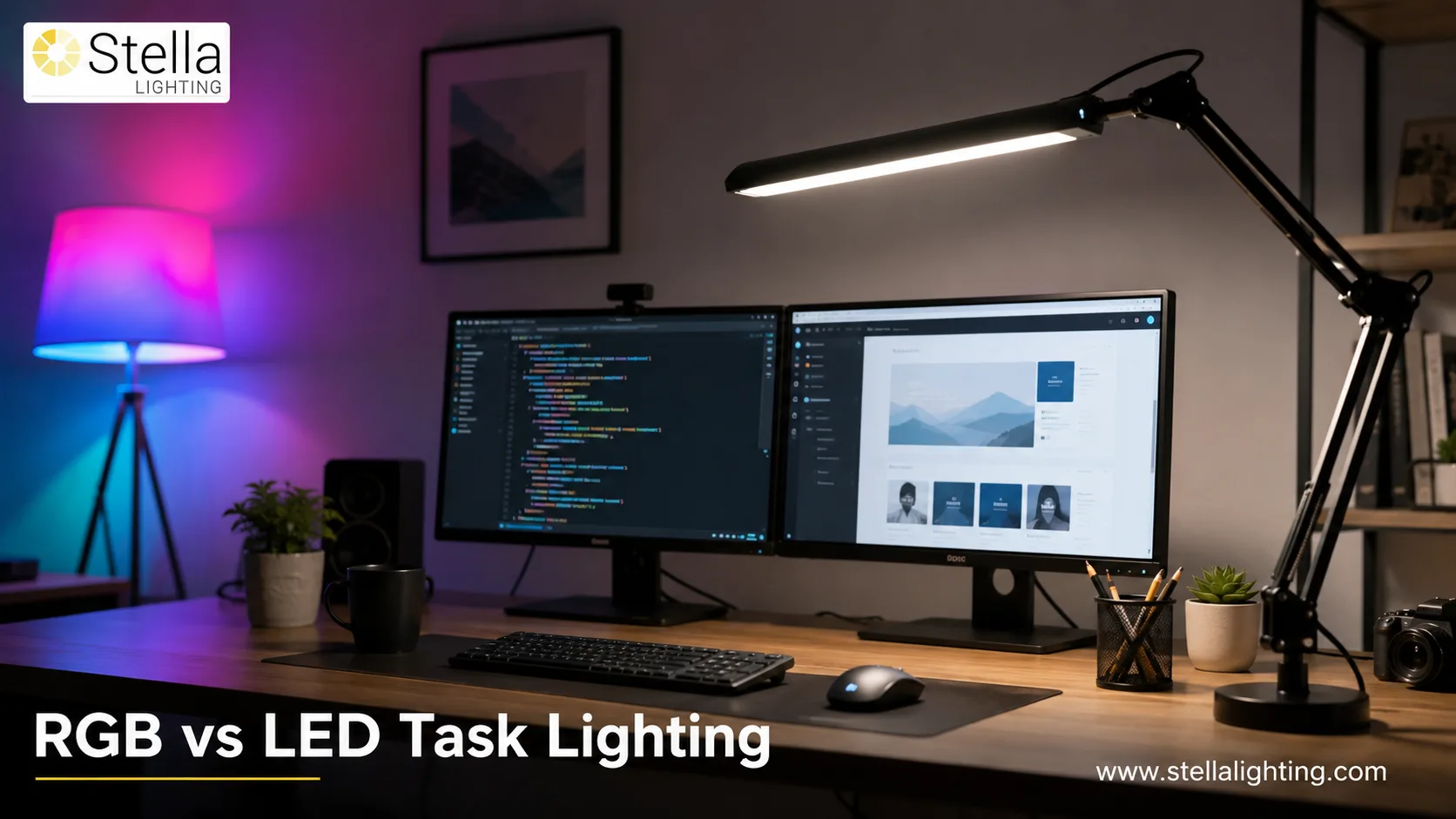
For digital architects spending hours managing Elementor navigation headers, resolving page rendering errors, and updating custom code structures, the workstation is an environment of intense, sustained visual focus. Operating under substandard lighting introduces severe optical friction, directly causing macular fatigue, tension migraines, and chronic postural degradation. While a trendy rgb desk lamp might enhance a studio's aesthetic backdrop, it fundamentally fails to provide the clinical optical clarity required for heavy cognitive workloads. To permanently eliminate these physiological bottlenecks, professionals must upgrade their environment with an engineered, medical-grade LED task lamp. At Stella Lighting, our optical instruments are designed to eradicate shadow interference, halt micro-flicker fatigue, and protect your long-term vision.
The Biological Cost of the RGB Illusion
The human visual system is biologically engineered for distance viewing under full-spectrum natural daylight. Sustained near-field focus—such as auditing dense lines of code or matching exact hex colors for a client website—places unnatural mechanical tension on the ciliary muscles within the eye. Relying on an rgb desk lamp as your primary workstation illumination introduces severe optical stressors:
- Pulse Width Modulation (PWM) Strobe: Generic consumer RGB fixtures regulate dimming via PWM, rapidly cycling the diodes on and off thousands of times per second. This invisible high-frequency micro-flicker forces the optic nerve into continuous adjustments, acting as the primary biological trigger for severe tension headaches.
- Chromatic Distortion (Sub-80 CRI): Retail lighting typically registers between 70 and 80 on the Color Rendering Index (CRI). This deficient rating casts a muddy, artificial tint over your workstation, flattening visual micro-contrast and washing out true colors.
- Inadequate Task Lux: Most RGB setups prioritize colorful ambient glow over direct, high-intensity surface illumination, forcing the eyes to overexert themselves to resolve fine details on the desk.
Core Engineering Specifications for Clinical Illumination
To actively combat visual fatigue and secure true color fidelity, an LED task lamp must meet stringent clinical engineering parameters that consumer fixtures simply cannot match.
1. 95+ Color Rendering Index (CRI)
A premium task fixture mandates a 95+ CRI rating to synthetically mimic pure, natural daylight. This clinical standard ensures absolute color fidelity, allowing digital professionals to execute complex color grading and design audits without cognitive strain or visual guesswork.
2. Tri-Spectrum Temperature Tuning
Because ambient environmental lighting shifts throughout the day, static color temperatures are ergonomically inadequate. Advanced fixtures dynamically adapt to the physical environment:
- Cool White (5500K): Simulates intense, high-contrast mid-day sunlight. Mandatory for resolving microscopic details and reading dense documentation.
- Natural White (4000K): A balanced spectrum optimal for dual-monitor computer work, bridging the harsh contrast between glowing digital screens and the surrounding physical room.
- Warm White (2800K): An amber-toned spectrum engineered for late-night server deployments or code updates. It strips out high-frequency blue light, allowing the optic muscles to relax.
3. Constant-Current LED Drivers & Zero Heat
To entirely eradicate PWM micro-flicker, medical-grade lamps utilize constant-current power delivery. This ensures a smooth, uninterrupted beam of light. Furthermore, high-efficiency LEDs generate zero radiant heat, allowing the operator to position the light head mere inches from their hands or hardware without thermal discomfort.
Step-by-Step Ergonomic Deployment Protocols
To extract the maximum physiological benefit and extend your creative stamina, adhere to these physical deployment protocols when installing Stella Lighting hardware:
- Dominant-Hand Offsetting: Mount the base or clamp on the side opposite your dominant hand. This permanently prevents your arm from casting moving shadows over your active workspace.
- Optimize Proximity: Capitalize on the zero-heat output of clinical LEDs. Lower the articulating neck to bring the light head as close to the desk as physically comfortable to exponentially increase surface clarity.
- Balance Ambient Contrast: Never execute high-focus tasks in a pitch-black room illuminated solely by your task light. Maintain a soft baseline of ambient background lighting to prevent ocular shock when looking away from the illuminated zone.
Conclusion
Protecting your long-term visual health and maximizing professional output requires a total departure from inadequate, flickering retail fixtures. Elevating your environment with engineered optical technology permanently eliminates chromatic distortion and macular fatigue. By demanding 95+ CRI true daylight accuracy, Tri-Spectrum adaptability, and zero-flicker performance, you secure uncompromising precision. Leave the ambient glow to the background; an engineered Stella Lighting LED task lamp delivers the medical-grade clarity necessary to ensure every hour you work is highly accurate, hyper-focused, and completely fatigue-free.