When families begin exploring therapy options for autism, one of the most common questions they face is whether to choose a structured clinical setting or therapy at home. Both approaches offer valuable benefits, but the right choice depends on your child’s needs, learning style, and family environment.
At Adapt For Life - AFL Autism Services, the focus is always on delivering meaningful, individualized care that supports long-term progress. Understanding how each therapy model works can help you make a more confident and informed decision.
Understanding ABA Therapy and Its Purpose
Applied Behavior Analysis (ABA) is a research-based approach designed to improve specific behaviors such as communication, social skills, and daily living activities. It works by breaking down complex skills into smaller, manageable steps and reinforcing positive behaviors.
ABA therapy can be delivered in different settings, most commonly in a clinic or at home. Each environment influences how a child learns, practices, and generalizes new skills.
What Is Clinic Based ABA Therapy?
Clinic Based ABA Therapy is delivered in a structured, professionally supervised environment where trained therapists work directly with children using individualized treatment plans.
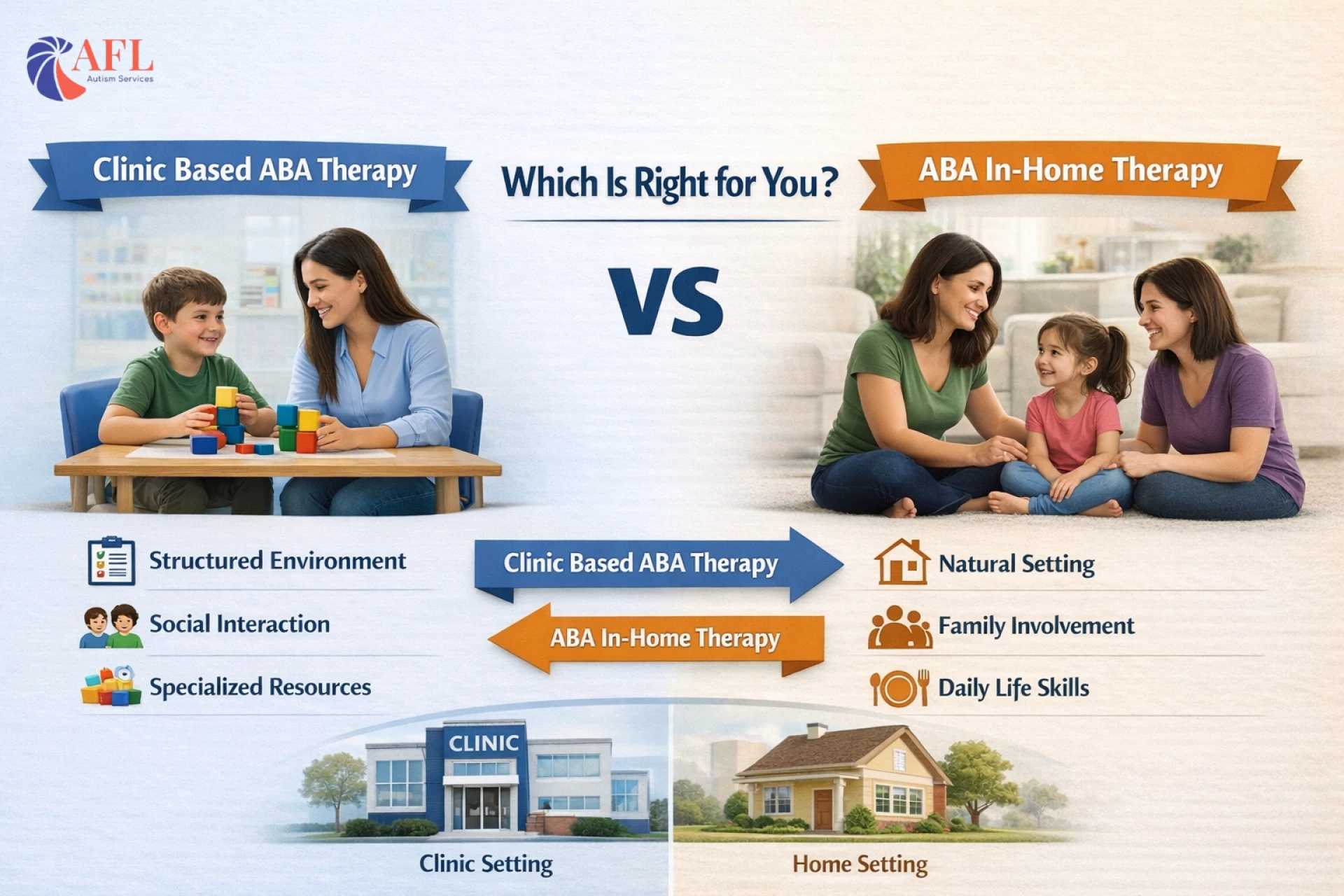
In this setting, children have access to specialized tools, controlled learning environments, and opportunities for peer interaction. Sessions are typically more intensive and follow a consistent routine, which helps reinforce learning patterns effectively.
Key Benefits of Clinic Based ABA Therapy
A clinical environment offers several advantages that can accelerate a child’s progress.
First, the structured setup minimizes distractions, allowing therapists to focus on targeted skill development. This controlled environment is particularly helpful for children who need consistency and routine to learn effectively.
Second, access to trained professionals and supervision ensures that therapy techniques are implemented correctly and adjusted as needed. This leads to more accurate tracking of progress.
Third, clinic settings often include opportunities for social interaction with other children. This helps develop essential communication and group participation skills in a natural yet guided way.
Finally, specialized resources such as therapy rooms, sensory tools, and learning materials enhance the overall effectiveness of sessions.
What Is In-Home Therapy?
aba in home therapy involves delivering ABA sessions in a child’s natural environment, typically their home. This approach focuses on teaching skills within everyday routines and familiar surroundings.
Therapists work with the child and often involve family members to reinforce learning throughout daily activities.
Key Benefits of aba in home therapy
One of the biggest advantages of in-home therapy is its ability to integrate learning into real-life situations. Children can practice skills such as communication, following instructions, or self-care within their natural environment.
This approach also encourages family involvement. Parents and caregivers learn techniques they can apply consistently, which strengthens long-term outcomes.
Additionally, children who struggle with transitions or unfamiliar environments may feel more comfortable and engaged when therapy takes place at home.
Clinic Based ABA Therapy vs In-Home Therapy: Core Differences
1. Learning Environment
Clinic Based ABA Therapy provides a structured and distraction-free setting designed specifically for focused learning. In contrast, in-home therapy takes place in a familiar but less controlled environment, which may include interruptions or distractions.
2. Social Interaction Opportunities
In a clinic, children often interact with peers, which helps develop social skills like sharing, turn-taking, and communication. At home, these opportunities may be limited unless structured intentionally.
3. Skill Generalization
While Clinic Based ABA Therapy is effective for teaching new skills, transferring those skills to real-world situations may require additional practice. In-home therapy naturally supports generalization because learning occurs in the same environment where skills are used daily.
4. Level of Structure
Clinic sessions follow a consistent routine with clearly defined goals. In-home sessions tend to be more flexible and integrated into daily life, which can be beneficial for practical learning but less intensive for skill-building.
5. Family Involvement
Although both approaches encourage caregiver participation, in-home therapy naturally involves more direct family engagement during sessions.
Which Option Is Right for Your Child?
Choosing between Clinic Based ABA Therapy and in-home therapy depends on several factors.
If your child benefits from structure, routine, and a distraction-free environment, a clinic setting may be more effective. It is especially useful for children who need intensive skill development or struggle with focus.
On the other hand, if your child learns best in familiar surroundings and needs support applying skills in real-life situations, aba in home therapy may be a better fit.
Some families also choose a hybrid approach, combining both methods to maximize benefits. This allows children to learn new skills in a clinic and practice them at home.
How Adapt For Life - AFL Autism Services Supports Your Decision
At Adapt For Life - AFL Autism Services, therapy plans are not one-size-fits-all. Each child receives a personalized assessment to determine the most effective approach.
The team focuses on understanding your child’s strengths, challenges, and goals before recommending a therapy model. Whether it involves Clinic Based ABA Therapy, in-home sessions, or a combination of both, the priority is always meaningful progress.
Therapists also work closely with families to ensure consistency, providing guidance and support that extends beyond therapy sessions.
Why Many Families Choose Clinic Based ABA Therapy
Many parents prefer Clinic Based ABA Therapy because of the level of structure and professional supervision it provides. The environment is designed specifically for learning, which often leads to faster progress in key developmental areas.
Additionally, children benefit from exposure to new situations and peer interactions, which can improve social confidence over time.
However, it is important to remember that the best choice is not about what works for others, but what works for your child.
Final Thoughts
Both Clinic Based ABA Therapy and in-home therapy offer unique advantages. The decision should be based on your child’s individual needs, comfort level, and learning style.
A structured clinical environment can provide focused, intensive support, while home-based therapy allows for real-world application and family involvement. In many cases, a balanced approach delivers the best results.
If you are unsure which option is right for your family, professional guidance can make the process much easier.
For personalized support and expert recommendations, contact us to learn how Adapt For Life - AFL Autism Services can help your child thrive.
FAQs
1. What is Clinic Based ABA Therapy best suited for?
Clinic-based therapy is ideal for children who benefit from structured environments, consistent routines, and focused skill development.
2. Is in-home therapy as effective as clinic-based therapy?
Yes, aba in home therapy can be very effective, especially for teaching practical, everyday skills in a familiar environment.
3. Can my child receive both types of therapy?
Yes, many families choose a combination of clinic and home therapy to balance structured learning and real-life application.
4. How do I decide which therapy option is right?
The decision depends on your child’s needs, behavior patterns, and comfort level. A professional assessment can help guide you.
5. How soon can we see results from ABA therapy?
Progress varies for each child, but consistent therapy and family involvement typically lead to noticeable improvements over time.