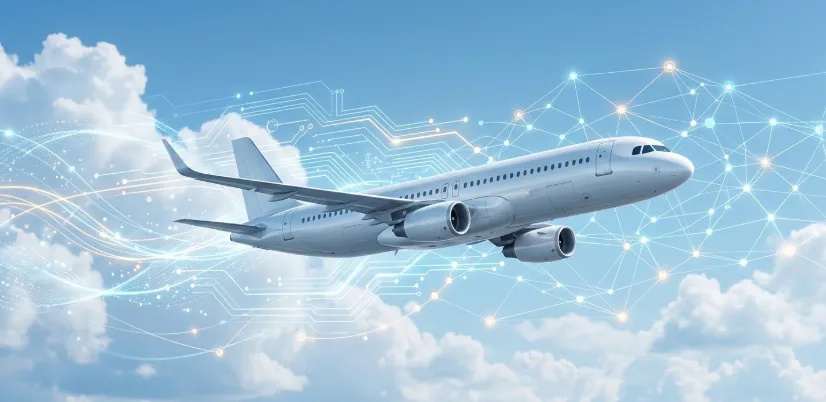
The aircraft rises because physics permits it, yet the desire to rise belongs to poetry. Between those two conditions is an industry governed by schedules, weather, machinery, judgment, and the occasional passenger who believes a delayed suitcase constitutes a personal betrayal by civilization.
Enter AI, which has, naturally, entered this sector just like every other. And AI has, as everyone knows, an appetite for patterns, probabilities, and preemptive decisions. Obviously, the change is massive, but for the common passenger, it remains invisible… until something goes wrong.
The chief question is, therefore: how to ensure nothing ever goes wrong?
Machines Speak Before They Fail
To begin with, AI should be used for foresight, not final decisions. Making the machine replace human judgment is simply unnatural and, thankfully, many industries are beginning to realize this fact.
AI can be helpful with some practices that traditionally rely on fixed intervals, such as aircraft maintenance. Historically, engineering expertise, recorded defects, and the disciplined suspicion that every machine eventually develops a secret have produced remarkable safety. However, it has also led to unnecessary part replacements, sudden disruptions, and expensive aircraft downtime.
Modern AI systems can study sensor readings, maintenance logs, component histories, environmental exposure, and past failure patterns to identify signs that a problem is developing. It is disciplined probability, which changes the timing of attention.
The benefits of predictive maintenance are especially clear across large fleets. A single aircraft produces a vast quantity of operational data, and a fleet produces enough information to exhaust even the most diligent analyst. Thankfully, AI can compare thousands of flights and discover the subtle relationships difficult to detect through ordinary review.
There is also a financial reality, because noble machines still require budgets. Unplanned maintenance can disrupt crews, gates, passenger connections, catering, and airport slots. One technical defect can create a chain of consequences stretching across several cities. Thus, AI for aviation gives businesses a better chance to intervene before a minor irregularity becomes a costly public drama.
Smarter Decisions Above the Clouds
Flight operations comprise a constant exchange between planning and changing conditions. Weather moves, airspace closes, traffic builds, crews approach duty limits, and fuel calculations respond to circumstances that refuse to remain polite. Dispatchers and pilots already work with sophisticated systems, but AI can process larger amounts of information at greater speed. It can compare routes, forecast congestion, assess weather conditions, and recommend adjustments that reduce delays or fuel consumption while respecting safety requirements.
Still, a recommendation needs to be explainable, relevant, and available at the proper moment. Pilots and operational teams need to understand why a route change has been suggested, which data influenced the proposal, and what uncertainty remains. A mysterious answer delivered with digital confidence has limited value in a field where accountability is written into every procedure. The system needs to show its reasoning in practical terms and leave final authority with qualified professionals.
Lastly, operational control centers can also use AI to respond to disruption. When storms affect a major hub, aircraft, crews, gates, and connecting passengers all need revised plans. AI can test all possible recovery scenarios and show which choices may restore the schedule with the least damage.
Airports Can Read the Rhythm of Crowds
Airports resemble cities that have replaced permanent residents with anxious temporary citizens carrying liquids in transparent bags. Their operations depend upon timing, movement, and the management of queues that can form with impressive speed. AI can analyze passenger flows, security demand, gate activity, baggage volumes, and transport patterns to predict where pressure will develop. Staffing and space can then be adjusted before congestion becomes visible across the terminal.
Security screening can benefit from improved image analysis, although the work requires strict oversight and careful testing. AI can help identify objects or patterns that deserve closer inspection, but the technology needs to be assessed for reliability, false alarms, and uneven performance across different conditions.
Baggage handling can also benefit from AI. The suitcase is, essentially, an ordinary object, but its journey can be more complicated than the passenger’s, especially when several airports and narrow connection times are involved. Bags disappear less often through mystery than through missed timing, incorrect routing, damaged tags, and complex transfer chains. AI can predict which bags face a higher risk of missing a connection and prompt staff to intervene.
Finally, AI can help with passenger movement. E.g., if a large number of travelers are expected at one checkpoint, staff can be reassigned early, or if a gate change will cause congestion, signage and notifications can be adjusted. These changes may appear small, yet a clear sign, a shorter queue, and a bag that arrives with its owner can inspire more gratitude than any marble floor.
A More Considerate Passenger Journey
Air travel often asks passengers to surrender control while pretending that control remains available through an app. Delays, missed connections, gate changes, and baggage problems can leave people dependent upon information that arrives late or in fragments. AI can improve communication by combining operational data with individual itineraries. E.g., a passenger affected by disruption can receive a revised connection, boarding guidance, baggage information, and available alternatives without repeating the same explanation to several departments.
It is exactly in this aspect that personalization proves particularly useful. However, it needs to remain respectful, as too much on literally every person out there is already readily available to anyone who cares to look for it. Aviation already collects significant amounts of personal information, and any intelligent system handling that data needs strong privacy protections, limited access, and clear rules.
When used properly, AI can help airlines use travel history and stated preferences to provide relevant offers, accessibility support, meal choices, or service updates. For the reason mentioned above, the purpose needs to be convenience rather than intrusion.
Cleared for a More Intelligent Future
The future of aviation is likely to arrive without a single dramatic announcement. Rather, it will appear through fewer technical delays, better recovery after storms, more accurate arrival times, improved fuel use, faster baggage transfers, and decisions supported by deeper evidence. Passengers may notice only that the journey feels less exhausting.
However, AI will not make flight simple: it has never been simple! What it can do is make complexity more visible and manageable. After all, aviation has spent more than a century proving that humanity can rise above the ground. Its next achievement may be learning how to do so with greater foresight, discipline, and grace.