Animation gives businesses a way to show what words and static images sometimes cannot. A product can be explored from different angles, a technical process can be visualized, and an abstract idea can become a story that is easier to follow.
But choosing an animation style is not simply a question of which one looks better. 2D and 3D animation serve different creative and communication needs. The right choice depends on what you are trying to explain, who needs to understand it, where the animation will be used, and the resources available for production.
For businesses considering an animation project, understanding those differences before production begins can make the creative process much more focused.
2D vs. 3D Animation: What’s the Difference?
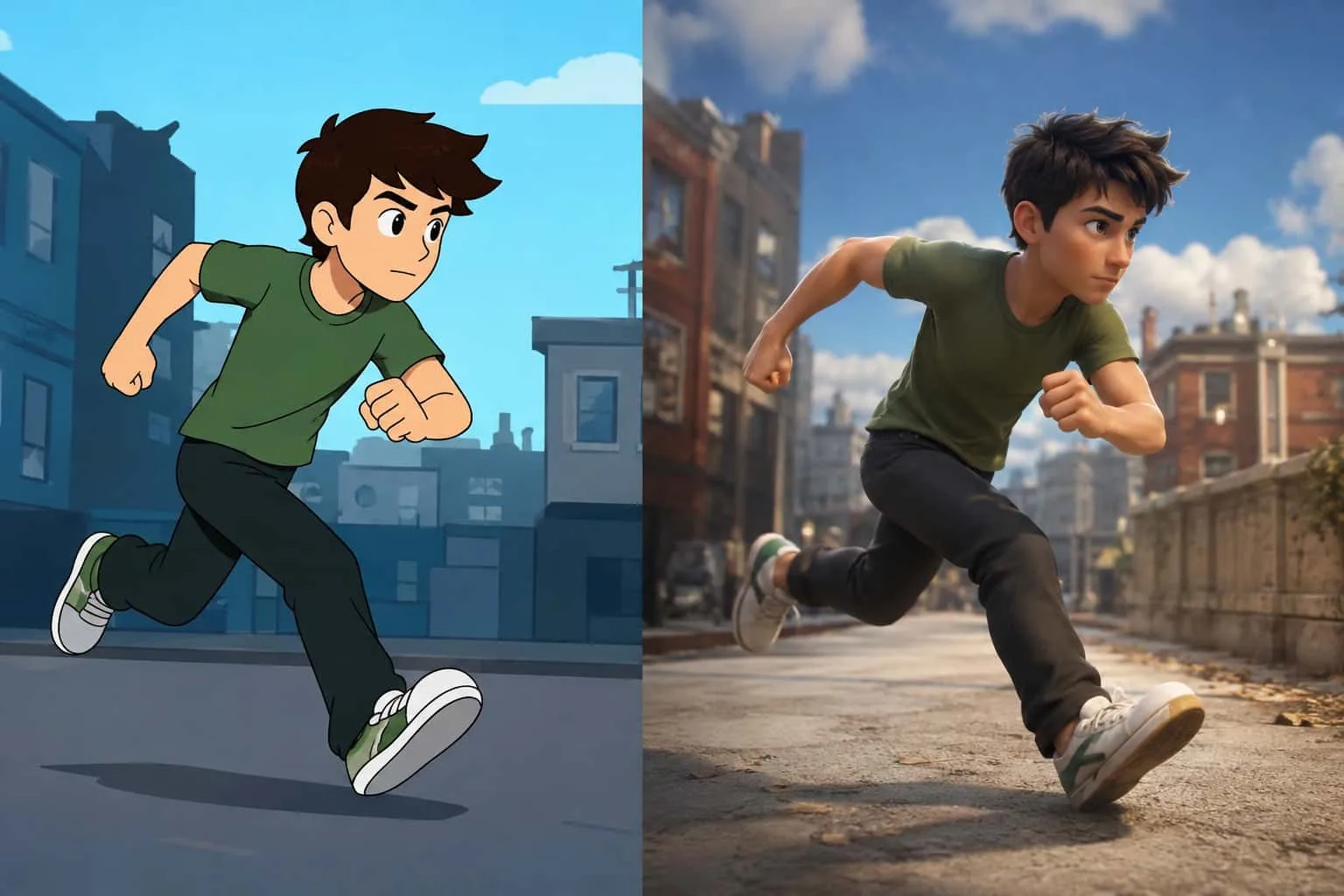
At the most basic level, 2D animation creates movement within a two-dimensional space, while 3D animation works with digital objects and environments that have depth.
That difference affects how artists design, animate, light, and present the final work.
What Is 2D Animation?
2D animation creates the appearance of movement using flat, two-dimensional artwork. It can be traditionally drawn or produced digitally, with artists creating characters, objects, backgrounds, and other visual elements.
Modern 2D animation can take many forms, including:
- Character-based animation
- Illustrated storytelling
- Digital 2D animation
- Explainer videos
- Motion graphics and animated graphic elements
One of its strengths is creative flexibility. A business can use a deliberately simple visual style or develop artwork closely around its existing brand identity.
2D animation is particularly useful when the message itself is more important than realistic depth or physical representation. Adobe notes that 2D animation is commonly suited to areas such as explainer and educational content where clarity and consistency are important.
What Is 3D Animation?
3D animation creates moving visuals within a three-dimensional digital environment. Objects and characters can be modeled with depth, textured, lit, positioned, and animated from different viewpoints.
A typical 3D animation pipeline can include:
- Concept development and storyboarding
- 3D modeling
- Texturing and materials
- Rigging
- Animation
- Lighting
- Rendering
- Editing and post-production
This additional production process gives 3D animation its ability to represent realistic products, environments, characters, and physical interactions. Autodesk describes the 3D pipeline in terms of modeling, rigging, animation, lighting, and rendering.
2D and 3D Animation Compared at a Glance
There is no universal winner between the two. Their differences are more useful when viewed in terms of the project itself.
Consideration2D Animation3D AnimationVisual styleFlat, illustrated or graphicDepth, volume and perspectiveRealismUsually stylizedCan range from stylized to photorealisticProductionGenerally fewer 3D-specific stagesOften includes modeling, rigging, lighting and renderingProduct visualizationUseful for concepts and explanationsParticularly strong for detailed productsCharacter storytellingHighly flexibleAllows movement through a 3D environmentRevisionOften straightforward for graphic elementsChanges may involve models, materials, lighting or rendersBest suited toExplainers, education, storytelling and graphic communicationProducts, environments, technical visualization and immersive storytellingProduction time and cost vary considerably by project. A simple 3D animation can be less demanding than a highly detailed 2D production, so it is better to evaluate the actual scope rather than assume one format will always be cheaper or faster. Adobe notes that 3D generally requires additional time, resources, and specialized skills because of its production pipeline.
The Key Benefits of 2D Animation for Businesses
2D animation can be a strong choice when a business wants to explain something clearly without needing a realistic three-dimensional representation.
Simple and Effective Visual Storytelling
A carefully designed 2D animation can break information into a sequence that viewers can follow naturally.
It can be used to:
- Explain a service or process
- Introduce an idea
- Tell a brand story
- Present educational information
- Turn written concepts into visual sequences
This makes 2D particularly useful when the subject is conceptual rather than physical.
Flexible Creative Styles
Because the visual language can be built around illustrations, typography, shapes, characters, and graphic elements, 2D animation offers considerable stylistic freedom.
A project might use:
- Hand-drawn artwork
- Clean vector illustrations
- Character animation
- Graphic animation
- A combination of typography and motion
The visual style can therefore be developed around the tone of the brand instead of trying to reproduce physical reality.
When Is 2D Animation a Good Choice?
2D animation can make sense when:
- The story is the main focus
- The subject is conceptual or abstract
- You want an illustrated visual identity
- The animation needs to explain information clearly
- Characters or graphic storytelling are central to the idea
- The project is primarily educational or explanatory
The important point is that choosing 2D does not mean choosing something less sophisticated. A well-designed 2D production can be highly detailed, expressive, and visually distinctive.
Why Businesses Choose 3D Animation
3D animation becomes particularly useful when depth, physical appearance, movement, or spatial relationships are important to the story.
Create Realistic and Immersive Visuals
3D allows artists to control a virtual camera and digital objects inside a three-dimensional environment. Materials, textures, lighting, reflections, shadows, and perspective can be used to create a realistic or deliberately stylized result.
That makes 3D useful for showing things that would otherwise be difficult or expensive to film.
For example:
- A product can be shown from multiple angles.
- Internal components can be revealed.
- A proposed environment can be visualized before it exists.
- A complex mechanism can be shown in motion.
- A concept can be presented in a controlled digital environment.
Make Products Easier to Understand
Product visualization is one of the practical applications of 3D.
Autodesk describes 3D product visualization as a way to create detailed digital representations that can be rendered from different angles and used across marketing, sales, and e-commerce applications.
For businesses, this can be useful when:
- The physical product is difficult to film
- A product is still in development
- Multiple configurations need to be shown
- Internal features need to be explained
- A product needs to be presented from precise viewpoints
A digital model can also become a reusable visual asset for different types of content.
Where Does 3D Animation Work Best?
3D animation has applications across a wide range of industries.
These include:
- Product marketing and visualization
- Architecture and real estate
- Manufacturing and engineering
- Automotive and aerospace
- Advertising
- Film and entertainment
- Education and training
- Scientific and technical visualization
Autodesk identifies applications ranging from architectural walkthroughs and product design to healthcare, aerospace, marketing, VR, and AR.
2D or 3D Animation: Which Is Better for Your Business?
The better question is not “Which animation is better?”
It is:
“Which animation communicates this particular idea better?”
Choose 2D Animation When You Need Simplicity and Speed
2D can be a practical option when the project depends on clear graphic communication rather than physical realism.
It may be suitable for:
- Explainer videos
- Educational content
- Character-led stories
- Social media campaigns
- Brand storytelling
- Presentations
For straightforward concepts, adding realistic 3D detail may not improve the message. Sometimes a clear illustration is the more effective solution.
Choose 3D Animation When Realism Matters
3D is worth considering when the viewer needs to understand what something looks like, how it works, or how it exists in space.
It can be especially useful for:
- Product visualization
- Technical demonstrations
- Architectural visualization
- Engineering concepts
- Realistic advertising
- Complex physical products
3D visualization can also allow teams to explore designs digitally before committing to physical prototypes or models. Autodesk identifies early design evaluation, collaboration, and visualization as important applications of 3D visualization.
Consider Your Audience and Marketing Goals
Before deciding on an animation style, ask:
- What exactly does the audience need to understand?
- Is the subject physical or conceptual?
- Does realism add value?
- Where will the animation appear?
- Is the goal to explain, demonstrate, promote, or tell a story?
- Does the visual style need to match an existing brand identity?
Starting with these questions usually produces a better creative decision than choosing a style based only on appearance.
2D vs. 3D Animation: Cost, Time, and Production
Budget is naturally part of the decision, but there is no reliable universal price difference between 2D and 3D.
The scope of the project matters more.
Is 3D Animation More Expensive Than 2D?
A detailed 3D production can require several stages that are not present in a simple 2D project, including modeling, texturing, rigging, lighting, and rendering. This can increase production requirements.
However, cost depends on factors such as:
- Animation length
- Number of scenes
- Level of detail
- Character complexity
- Number of assets
- Required realism
- Simulation and visual effects
- Voiceover and sound design
- Revision requirements
A simple 2D animation and a cinematic 3D animation are not meaningful cost comparisons simply because they belong to different categories.
How Long Does 2D and 3D Animation Take to Produce?
Both formats require planning before animation begins.
A production can involve:
- Concept development
- Scriptwriting
- Storyboarding
- Visual development
- Asset creation
- Animation
- Editing
- Sound and finishing
For 3D, additional work may include modeling, rigging, materials, lighting, and rendering.
The more detailed the project, the more production time it is likely to require.
What Determines the Final Animation Budget?
Instead of asking only whether 2D or 3D is cheaper, businesses should define the scope first.
Important considerations include:
- What needs to be created from scratch?
- How many characters or products are involved?
- How realistic should the visuals be?
- How many scenes are required?
- Is the animation using existing assets?
- How much sound design is required?
- How many versions or revisions are expected?
A clear brief makes it easier for an animation team to provide a realistic production plan.
2D vs. 3D Animation for Marketing and Brand Storytelling
Animation is not limited to entertainment. Businesses use animation to explain products, communicate ideas, demonstrate processes, and create marketing content.
Using 2D Animation for Marketing
2D can work particularly well for marketing messages that depend on clarity and visual storytelling.
Examples include:
- Explainer videos
- Social content
- Educational campaigns
- Brand stories
- Service explanations
- Animated presentations
Its graphic nature can also make it easier to build a visual language around a brand.
Using 3D Animation for Marketing
3D is particularly valuable when the product or physical experience needs to be the focus.
A business might use 3D animation for:
- Product launches
- Product demonstrations
- Advertising
- Product visualization
- Architectural presentations
- Technical marketing
3D product imagery can also provide consistent views and visual variations without requiring a physical product to be photographed for every scene. Autodesk highlights photorealistic product rendering and configurable product visualization as applications of 3D commerce.
How Animation Can Strengthen Your Brand
The strongest animation is not simply the one with the most visual effects.
It should make the message easier to understand.
Good animation can help a brand:
- Explain a complicated idea visually
- Demonstrate a product
- Build a consistent visual identity
- Present a concept before physical production
- Tell a story in a controlled visual environment
Storytelling remains an important part of animation because technical production alone does not determine whether the audience understands the message. Autodesk specifically identifies storytelling as an important part of 3D animation and visualization.
How to Choose Between 2D and 3D Animation
There is no need to decide based on trends alone. Start with the communication problem.
Start With the Story You Want to Tell
Write down the simplest version of the message.
If the story is about an idea, process, or concept, 2D may provide enough visual language.
If the story depends on a physical object, environment, movement, or spatial relationship, 3D may offer more possibilities.
Define Your Project Goals and Audience
Think about the person watching the animation.
Are they:
- Learning about a product?
- Comparing options?
- Understanding a technical process?
- Seeing a concept for the first time?
- Being introduced to a brand?
The answer should influence the visual approach.
Consider Your Budget and Timeline
Be realistic about the amount of production involved.
A project requiring multiple detailed 3D environments will have different production requirements from a short 2D explainer using simple graphics.
Defining the scope early helps prevent unnecessary production work later.
Think About Where the Animation Will Be Used
The final destination matters.
An animation designed for:
- A website
- Social media
- A trade show
- A product launch
- A presentation
- Television advertising
- E-commerce
may require different dimensions, durations, versions, or visual approaches.
Choose the Style That Best Communicates Your Message
The visual style should support the message rather than compete with it.
If realism helps the audience understand the subject, 3D may be the better choice.
If simplicity makes the message clearer, 2D may be the better choice.
And sometimes, the strongest answer is not choosing one exclusively.
Can 2D and 3D Animation Work Together?
Yes. 2D and 3D elements can be combined within the same visual production.
Combining 2D and 3D for More Creative Possibilities
A project can use 3D models and environments alongside graphic elements, typography, illustrations, or other 2D components.
This can allow a business to combine:
- Realistic product visuals with graphic explanations
- 3D environments with 2D information
- 3D objects with animated typography
- 3D scenes with illustrated elements
The exact approach depends on the creative direction and production requirements.
When a Hybrid Animation Approach Makes Sense
A hybrid approach can be useful when different parts of the message need different visual treatments.
For example, a product could be presented using a 3D model while supporting information appears through 2D graphics.
This is not about using more techniques simply for the sake of complexity. Each visual element should have a purpose.
Examples of 2D and 3D Working Together
A product video might use:
- 3D animation to demonstrate the physical product
- 2D graphics to identify features
- Animated text to highlight specifications
- 2D diagrams to explain a process
Combining techniques can therefore create a single visual story without forcing every part of the message into the same style.
Making the Right Animation Choice for Your Project
Choosing between 2D and 3D animation becomes much easier when the decision starts with the message rather than the medium.
There Is No One-Size-Fits-All Animation Style
A short educational explainer may benefit from the simplicity of 2D.
A product launch may need the depth and realism of 3D.
A larger campaign may use both.
The right choice depends on what the audience needs to see and understand.
Focus on Communication, Not Just Visual Style
A beautiful animation still needs to communicate something.
Before production begins, establish:
- The central message
- The intended audience
- The purpose of the animation
- The visual style
- The distribution channels
- The production scope
This gives the creative team a clear foundation to work from.
Work With an Animation Team That Understands Your Goals
At MovingStone Digital, the focus should begin with the idea behind the animation—not simply whether a project should be 2D or 3D.
A strong production process connects the concept, story, visuals, animation, and final delivery into one coherent piece.
Whether the project calls for the clarity of 2D animation, the depth of 3D animation, or a combination of both, the goal remains the same: create visuals that help people understand, remember, and connect with the idea.
Frequently Asked Questions About 2D and 3D Animation
What Is the Difference Between 2D and 3D Animation?2D animation creates movement in a two-dimensional space, while 3D animation uses digitally modeled objects and environments with depth. 3D production can also incorporate lighting, materials, cameras, rigging, and rendering to create realistic or stylized three-dimensional visuals.
Is 2D or 3D Animation Better for Business?Neither is automatically better. 2D can be effective for illustrated storytelling, explainers, and conceptual communication, while 3D is particularly useful for products, environments, technical subjects, and situations where depth and realism matter.
Is 3D Animation More Expensive Than 2D?It can be, particularly when the project requires detailed modeling, texturing, rigging, lighting, and rendering. However, the final cost depends on the project's scope, complexity, duration, and creative requirements rather than the animation type alone.
Should I Choose 2D or 3D Animation for Product Marketing?If the product's physical appearance, materials, mechanisms, or dimensions are important to the message, 3D can be especially useful. 2D can work well when the campaign is more focused on explanation, graphic storytelling, or brand communication.
Which Takes Longer to Produce, 2D or 3D Animation?There is no fixed production time for either format. A detailed 3D project can involve additional stages such as modeling, rigging, lighting, and rendering, while complex 2D productions can also require substantial artwork and animation work.
Can 2D and 3D Animation Be Used Together?Yes. 2D graphic elements, typography, illustrations, and other design elements can be combined with 3D models and environments when the creative direction calls for it.
How Do I Choose the Right Animation Style for My Project?Start with the message, audience, purpose, distribution channel, budget, and timeline. Then determine whether 2D, 3D, or a hybrid approach communicates the idea most effectively.