Choosing an Australian university has never been just about rankings, tuition fees or campus life. For international students applying in 2026, visa processing conditions have become another factor worth considering.
Australia’s September 2026 evidence level review is drawing attention because recent visa refusal rates have changed the risk profile of some institutions. The research paper behind this discussion reports that one in three student visa applications to Australian universities was refused in February 2026.
That does not mean every university has suddenly become difficult to access. It does mean students need to look beyond the university brochure before making an application.
The evidence level attached to an institution can influence the amount of documentation required and the scrutiny an applicant receives. Understanding that system can help students make a more informed decision.
Why University Choice Now Has a Visa Dimension
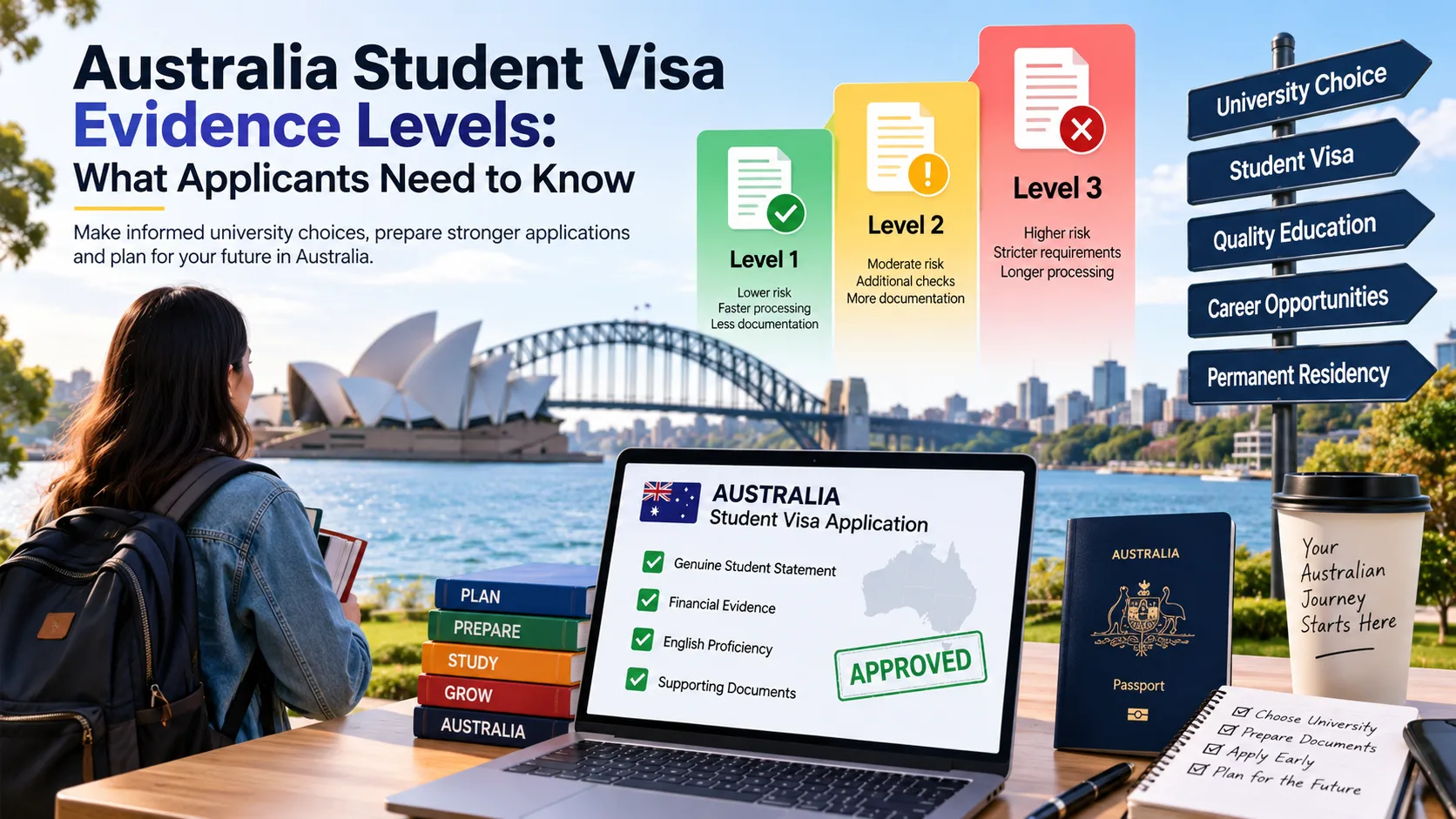
Australia’s student visa framework uses evidence levels to assess education providers and source countries. Providers can fall into Level 1, Level 2 or Level 3 categories, with higher levels generally associated with greater documentation requirements and closer scrutiny.
The important point is that an evidence level is not a university quality rating. A highly respected institution can have a stricter classification because of the visa outcomes associated with its applicant population.
The research paper highlights why this distinction matters in 2026. Chinese student demand dropped sharply, while Australian universities relied more heavily on South Asian markets. The paper reports refusal rates of 65% for Nepal, 51% for Bangladesh, 40% for India, 38% for Sri Lanka and 36% for Bhutan.
Those figures can influence institutional risk calculations even when an individual university has not changed its recruitment practices.
Imagine two universities offering the same business degree. One attracts students mainly from lower-refusal markets, while the other has recently enrolled more students from markets experiencing higher refusal rates. Their courses could be equally strong, yet their visa-related risk profiles may differ.
That is why students should avoid treating a risk classification as a simple academic ranking.
Stronger Applications Matter More Than Guessing the Tier
Students cannot control how the wider visa system calculates institutional risk. They can control the quality of their own application.
A clear Genuine Student explanation should connect the proposed course with the student's previous education, career direction and reasons for studying in Australia. Financial evidence should also be complete and easy to understand.
The research suggests that applicants should prepare carefully even when applying to an institution they believe has a lower-risk classification. Country-level risk can still affect the evidence expected from an applicant.
Timing matters as well. A change following the September review could lead some institutions to request additional documentation. That may increase processing times, creating problems for students working toward a fixed course commencement date.
The safest approach is to prepare documents before they are requested rather than waiting for additional scrutiny to appear.
Students also need to manage their academic responsibilities during this period. University applications often involve statements, research, written assignments and other academic work. Those who need subject-specific assistance can consider resources such as Expertsmind.com’s dissertation writing support when managing demanding academic preparation.
Academic support does not replace visa advice, but it can help students keep their coursework and preparation organised while dealing with a complicated application process.
Look Beyond the Visa Application
A university decision should also make sense several years into the future.
International students often begin by asking a simple question: “Which university will give me the best chance of getting a visa?” That is too narrow. A better question is whether the university, course and career pathway make sense together.
Course content, employment prospects, location, tuition costs and post-study opportunities all deserve attention. Students who hope to remain in Australia after completing their studies should understand how their education fits into their longer-term plans.
This is where the distinction between a student visa and permanent residency becomes important. Studying in Australia does not automatically result in permanent residency, so students should research possible pathways before committing to a course. The guide on moving from a student visa to permanent residency in Australia offers useful context for students thinking beyond graduation.
That long-term view can change the university decision. A course that looks attractive because of its location may be less suitable if it does not support the student's professional goals. Likewise, a university with a stricter evidence level should not automatically be dismissed if its course offers a strong academic and career fit.
The September review also raises a broader question about Australia's visa system. When refusal rates change rapidly because student markets shift, universities can face consequences that do not necessarily reflect the quality of their teaching or recruitment.
The International Education Association of Australia has called for a freeze on evidence-level changes, while Universities Australia has advocated greater access to refusal data. Their concern is that institutions need enough information to identify problems before a temporary shift becomes a long-term disadvantage.
For applicants, the lesson is straightforward. Do not choose a university solely because you think its visa risk is lower. Choose a course that makes sense academically and professionally, then build the strongest possible application around that decision.
The Australian university admissions process may change as evidence levels are reviewed, but students still have significant control over their preparation. Clear documentation, convincing study intentions and realistic financial evidence remain the foundation of a strong application.
A changing visa system makes university selection more complicated, not impossible. The smartest applicant is not the one who tries to predict every policy change. It is the one who chooses carefully, prepares early and makes sure the application tells one consistent story from study plans to future goals.