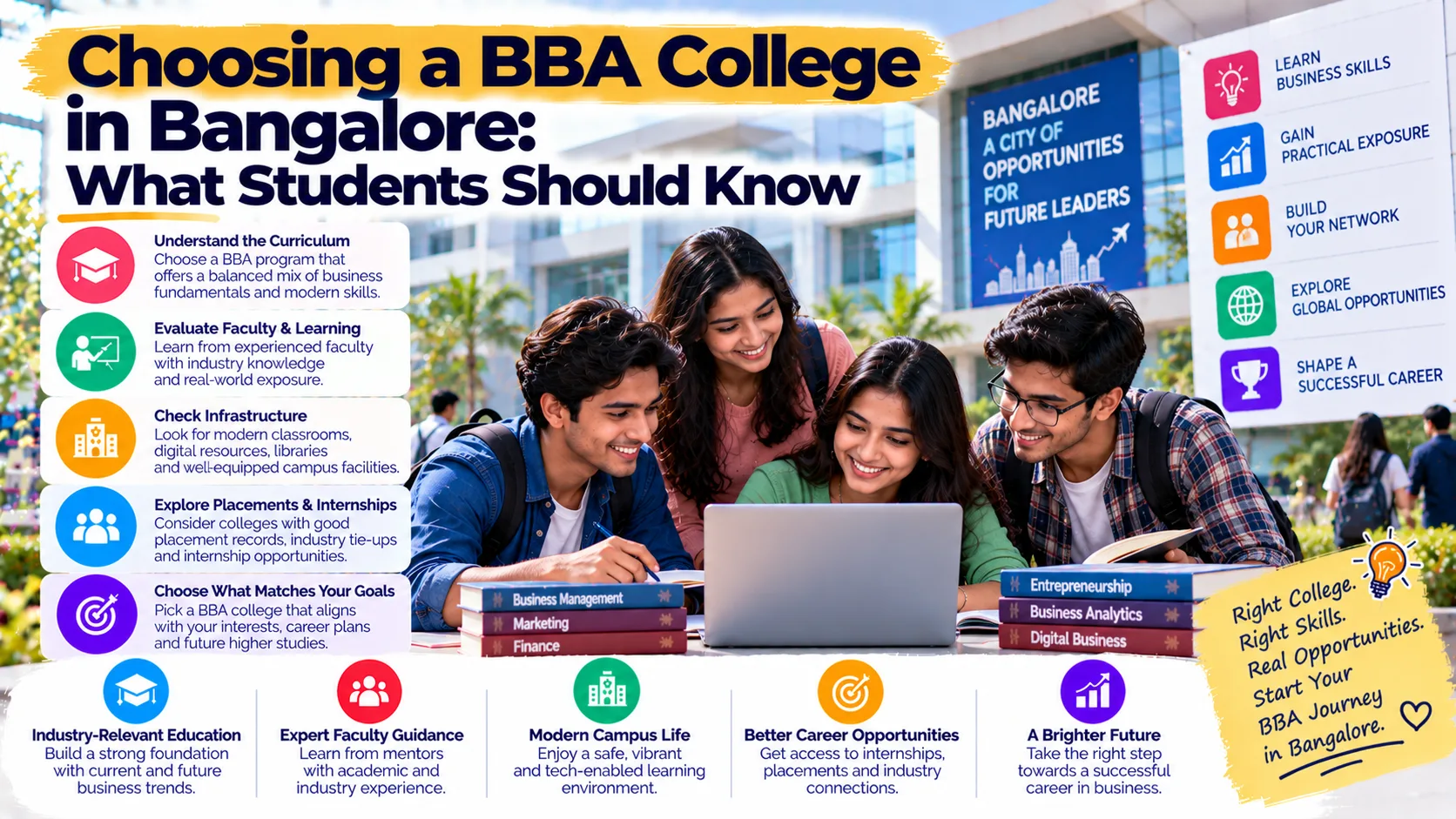
Students interested in business do not always want to wait until postgraduate studies to understand how organisations work. A Bachelor of Business Administration introduces learners to management, marketing, finance, operations and other areas that influence business decisions.
When researching a BBA college in Bangalore, students should look beyond the course name and investigate what they will actually learn. The curriculum, teaching methods, practical assignments, industry exposure and opportunities to develop professional skills can all influence the value of the learning experience.
Bangalore's broad business environment also makes it useful for students to understand how companies operate across different sectors. However, the college and programme should be selected based on verified information and personal goals, not location alone.
1. Understand the Subjects Covered in BBA
A BBA programme generally introduces students to the basic functions of business and management. Depending on the institution, subjects may include principles of management, marketing, accounting, economics, human resource management, business communication, organisational behaviour and operations.
These subjects help students understand how different departments contribute to an organisation. Marketing focuses on customers and market needs, finance examines the use of money and resources, and human resources explores employee management and development.
Before applying, review the semester-wise syllabus. Check whether the subjects match your interests and whether the course gives you opportunities to explore different areas before choosing a specialisation, if one is available.
Do not assume that every programme has the same curriculum. Compare the official course documents and ask the admissions team about any subjects or learning components that are important to you.
2. Look for Practical Business Learning
Understanding business concepts is important, but applying them is equally useful. Case studies, presentations, group projects, business simulations and assignments can help students explore how organisations respond to real challenges.
For example, a marketing assignment might ask students to identify a target audience and develop a campaign idea. A finance project could involve preparing a basic budget, while an operations assignment might examine how a business manages time and resources.
When comparing colleges, ask how practical assignments are included in the programme. Find out whether students receive feedback and whether they are expected to explain their reasoning rather than simply submit answers.
Practical learning can help students become more comfortable with problem-solving and decision-making.
3. Evaluate Communication and Leadership Development
Business graduates often need to explain ideas, work with teams, prepare reports and communicate with different stakeholders. These skills take practice, so students should consider whether a programme gives them opportunities to develop them.
Presentations can help build confidence in speaking. Group assignments can teach students how to divide responsibilities, resolve disagreements and work toward a shared deadline. Student clubs and event activities may offer additional opportunities to organise tasks and coordinate with others.
When researching a BBA college in Bangalore, ask about classroom participation, presentations, group work and student activities. These details can reveal how students practise professional skills during the course.
Leadership does not mean being in charge of every situation. It can also involve listening carefully, supporting a team and taking responsibility for completing assigned work.
4. Understand the Role of Internships and Industry Exposure
Internships can help students see how classroom concepts are used in professional settings. They may provide exposure to customer interactions, business processes, research tasks, reporting or project coordination.
Before selecting a college, ask whether internships are part of the programme, optional or arranged independently by students. Check what career guidance is available and whether students receive support in preparing CVs and practising interviews.
Industry talks, company visits and project-based assignments can also help learners understand different business roles. However, these opportunities vary by institution, so confirm the details rather than assuming they are guaranteed.
Students can also build experience through independent projects, volunteering and campus activities. The goal is to learn how to work responsibly and explain what each experience taught you.
5. Explore Career Paths After BBA
A BBA can provide a foundation for entry-level roles in business administration, sales support, marketing coordination, customer relations, operations assistance and related areas. The opportunities available to an individual depend on the employer, practical skills, experience and job requirements.
Some students continue with an MBA or another postgraduate programme. Others develop specialised skills through certifications or practical experience. Before choosing a path, explore job descriptions and identify the qualifications employers expect.
For example, students interested in marketing can learn about customer research, digital communication and campaign measurement. Those interested in finance may build spreadsheet skills and financial literacy. Students drawn to operations can learn about process improvement, reporting and coordination.
Exploring these options during college can help you make more informed decisions after graduation.
6. Compare Fees, Facilities and Academic Support
Course fees are only one part of the total cost of education. Students should also consider transport, learning materials, accommodation where relevant and other expenses.
Compare the resources offered by each college, including libraries, computer facilities, mentoring, academic support and career guidance. Ask how students can access help if they struggle with a subject or need advice about further studies.
Speak with current students or alumni when possible. Their experiences may help you identify useful questions, but verify important details through official information.
AIMS IBS Business School is one institution prospective students can research while exploring business and management education in Bangalore. Review its current official programme details and admission requirements to assess whether its offerings fit your interests.
7. Build a Clear College Shortlist
Instead of comparing colleges based on one advertisement, create a shortlist using consistent criteria. Include curriculum, practical learning, internships, faculty information, fees, student support and career preparation.
Assign greater importance to the factors that matter most to you. If you want to pursue marketing, for example, investigate the subjects and projects that help develop customer and communication skills. If you are interested in entrepreneurship, look for learning opportunities related to business planning and problem-solving.
Keep notes on each college and verify details before making a final decision.
Conclusion
Selecting a BBA college in Bangalore is an opportunity to begin building your business knowledge and professional skills. A thoughtful decision considers the course structure, practical learning, industry exposure, communication development, fees and future study options.
Take time to compare programmes and understand what each institution actually offers. A clear match between your interests, learning preferences and career goals can help you make better use of your undergraduate years.
FAQs
1. What should I check before joining a BBA college in Bangalore?
Review the curriculum, practical assignments, faculty information, internship opportunities, fees and student support.
2. What skills can BBA students develop?
Students can develop business awareness, communication, teamwork, problem-solving, presentation and organisational skills.
3. Can I pursue an MBA after BBA?
Yes, many MBA programmes accept eligible BBA graduates. Check the admission and entrance requirements of each institution.
4. Are internships necessary during BBA?
Internships can provide useful workplace exposure, but their availability and requirements vary by programme.
5. What jobs can BBA graduates explore?
Depending on their experience and skills, graduates may explore roles in sales support, marketing coordination, business administration, customer relations and operations assistance.