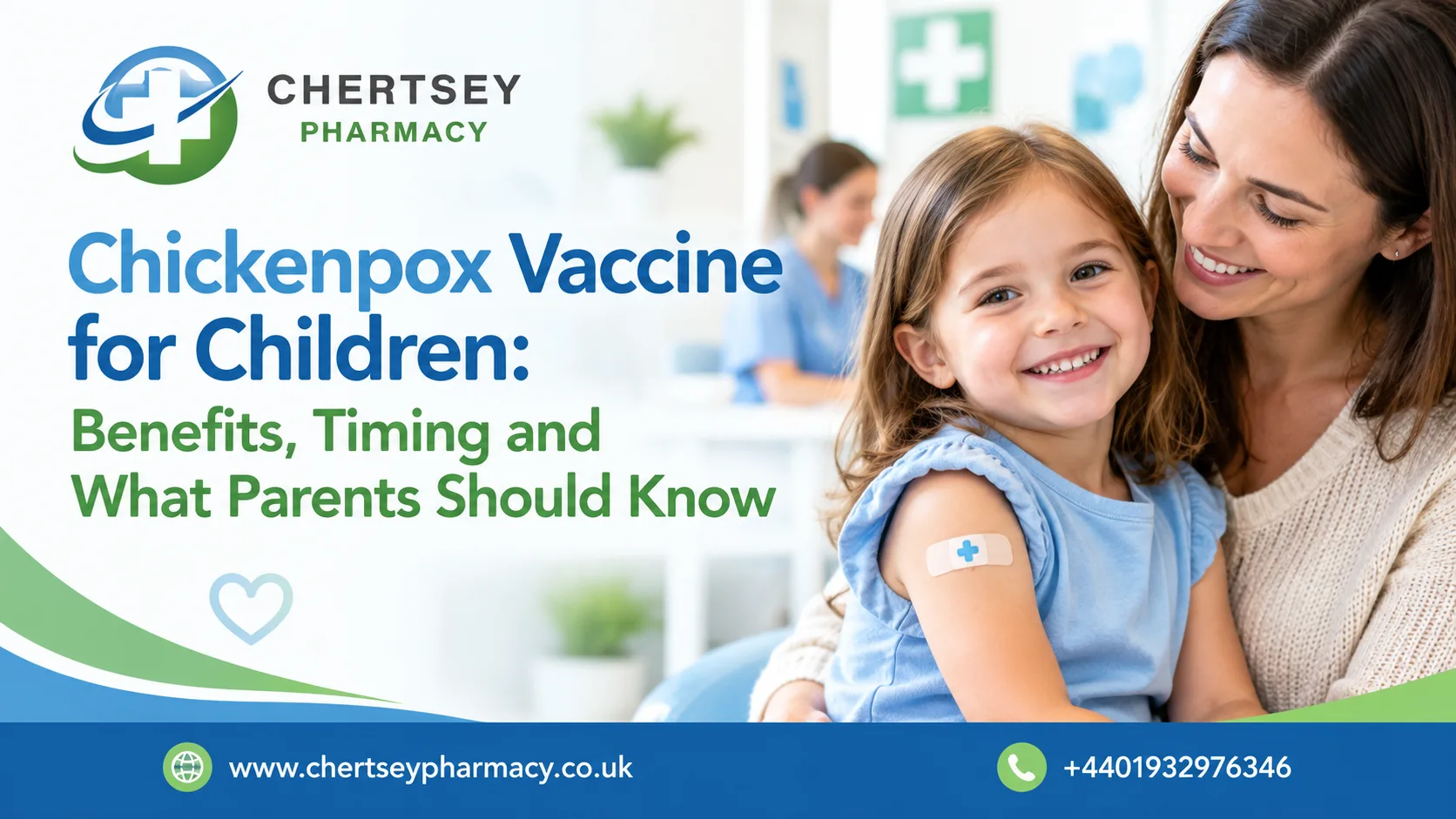
If you have ever watched a child cope with itchy spots, a high temperature and several days off nursery or school, you already know why the chickenpox vaccine for children matters to so many families. Since 1 January 2026, chickenpox protection has been part of the routine NHS childhood schedule in the UK. That is a major change, and it has left many parents asking the same questions. Which children are eligible? When are the doses given? What if my child is too old for the NHS programme?
This guide answers those questions in plain language. It covers how the vaccine works, the current UK timings, the benefits, the safety picture, and how NHS and private options compare. It is written for parents, carers and grandparents who want clear, trustworthy information before making a decision.
This article is for general information and does not replace advice from a GP, health visitor or pharmacist who knows your child’s medical history.
Chickenpox, also called varicella, is a highly contagious infection caused by the varicella-zoster virus. It spreads through coughs, sneezes and direct contact with the blisters. A child can pass it on from a day or two before the rash appears until every spot has crusted over.
For many children, it is a miserable but short illness. The typical picture is:
- A fever and general tiredness at the start
- An itchy rash that moves from red spots to fluid-filled blisters, then scabs
- Several days of discomfort, disrupted sleep and time away from school or childcare
How the Chickenpox Vaccine for Children Works
The chickenpox vaccine contains a weakened (live attenuated) form of the varicella-zoster virus. It is too weak to cause full chickenpox in a healthy child, but strong enough to teach the immune system to recognise the real virus. If your child meets chickenpox later, the body is ready to respond quickly.
In the UK, there are two routes to getting the vaccine:
- The combined vaccine on the NHS. Children on the routine schedule receive a combined measles, mumps, rubella and varicella (MMRV) vaccine, so protection against four illnesses comes in one injection.
- A standalone chickenpox vaccine, available privately. This is used for children and adults who fall outside NHS eligibility, and it is given as a course of two doses.
Chickenpox immunisation for children works best when the full course is completed. One dose offers good protection, but two doses give stronger and longer-lasting immunity, which is why the schedule always includes a second dose.
Benefits of the Chickenpox Vaccine for Children
Parents often ask whether the chickenpox vaccine for children is really worth it. Here are the main benefits, explained in practical terms.
1. Lower Risk of Catching ChickenpoxThe vaccine greatly reduces the chance that your child will catch chickenpox. Two doses give the strongest protection.
2. Milder Illness if Infection Still HappensA small number of vaccinated children can still get chickenpox. When they do, the illness is usually much milder, with fewer spots, a lower fever and a quicker recovery.
3. Fewer Serious ComplicationsBy lowering the chance of infection, the vaccine also lowers the chance of hospital admission, skin infections and other serious problems.
4. Fewer Missed School and Work DaysChickenpox typically keeps children away from school or nursery until all the spots have crusted over. For working parents, that can mean a week of disrupted childcare. Preventing the illness protects routines as well as health.
5. Protection for Vulnerable People Around Your ChildWhen more children are vaccinated, the virus has fewer chances to spread. That helps protect babies too young to be immunised, pregnant women and people with weakened immunity.
6. A Lower Chance of Shingles Later in LifeOnce someone has had natural chickenpox, the virus stays dormant in the body and can reappear decades later as shingles. Vaccine-strain virus is less likely to reactivate than the natural virus. Adults in your family who want to understand their own protection may find our page on the shingles vaccine helpful.
Chickenpox Vaccine Schedule for Children in the UK
The chickenpox vaccine schedule for children depends on your child’s date of birth. The NHS programme began on 1 January 2026, and the arrangements differ slightly for different age groups.
Who Should Consider Chickenpox Vaccination in the UK? (Use Cases)
Chickenpox vaccination in the UK suits several real-life situations. Here are the most common ones families ask about.
1. Your child was born before 2020.
They fall outside the NHS programme, so private vaccination is the route to protection.
2. Your child missed the NHS catch-up.
If your child is in the eligible 2020 to mid-2022 group but you would prefer not to wait for an invitation, the pharmacy route may be quicker. Check first that your child has not already received the NHS dose, so it is not duplicated.
3. There is a newborn, pregnant relative or immunosuppressed family member at home.
Vaccinating older siblings reduces the chance of bringing the virus into the household. Always discuss the specifics with a healthcare professional first.
4. Your child has never had chickenpox and is nearing secondary school.
Chickenpox tends to be more severe in older children and adults, so many parents prefer not to leave it to chance.
5. Your family is moving abroad or travelling for a long stay.
Some countries and schools ask for proof of varicella protection, so it is worth checking requirements well before you go.
6. Your child is starting a new nursery, school or sports club.
Group settings are where chickenpox spreads fastest, and protection beforehand helps avoid outbreaks and exclusions.
Is the Chickenpox Vaccine for Children Safe?
The chickenpox vaccine for children has been used safely in many countries for decades, and it is now part of the UK’s routine schedule. Most children have no problems at all.
Common, Mild Side Effects- A sore, red or slightly swollen arm or thigh where the injection was given
- A mild temperature
- Feeling tired or a little grumpy for a day or two
- Occasionally, a few mild spots appearing one to three weeks later
Serious allergic reactions are very rare. Staff who administer vaccines are trained to recognise and manage them, which is one reason to choose a registered, regulated provider.
Who Should Not Have the Vaccine, or Should WaitBecause it is a live vaccine, it is not suitable for everyone. Tell the vaccinator beforehand if your child:
- Has a weakened immune system, or is taking treatment that suppresses immunity
- Has had a severe allergic reaction to a previous vaccine or any ingredient
- Is unwell with a high temperature on the day (the appointment may simply be rearranged)
- Has recently had another live vaccine or an immunoglobulin treatment, as timing may need adjusting
If a teenager or adult in your family is pregnant or planning pregnancy, the live vaccine is not given during pregnancy, and pregnancy should usually be avoided for a short period after vaccination. Ask a clinician for the exact guidance.
Best Practices for Parents
A few simple habits make the vaccination experience smoother and safer.
- Check the NHS Red Book and your child’s records first. Know which vaccines your child has already received so nothing is duplicated or missed.
- Confirm eligibility early. Use your child’s date of birth to see whether the NHS schedule applies before looking at private options.
- Complete both doses where two are advised. Protection is strongest after the full course, so keep the second appointment in your diary.
- Share the full health picture. Mention allergies, illnesses, medical treatments and recent vaccinations at the appointment.
- Mind the live vaccine spacing. If different live vaccines are not given on the same day, they generally need a gap of about four weeks. A professional will plan this for you.
- Prepare your child. Explain what will happen in simple, calm words, and bring a favourite toy or book for comfort.
- Stay for a few minutes afterwards. Remaining on site briefly after any vaccination is a sensible precaution.
- Keep a record. Ask for written confirmation of the date and batch so it can be added to your child’s health record.
If your child develops symptoms of chickenpox in the meantime, keep them home, avoid contact with newborns, pregnant women and anyone with a weak immune system, and seek advice if they seem very unwell. Many pharmacies, including those with walk-in services, can give practical guidance on managing symptoms and knowing when to see a doctor.
Common Mistakes to Avoid
Even well-informed parents can slip up. Here are the mistakes we see most often when families think about the chickenpox vaccine for children.
- Waiting for natural infection (“chickenpox parties”). Deliberately exposing a child to the virus is risky because complications cannot be predicted.
- Assuming one dose is always enough. The schedule is designed around the dose count for each age group, so follow it.
- Missing the catch-up window. The NHS catch-up has an end date, so do not leave it to the last minute.
- Not telling the vaccinator about medical history. Immune problems, allergies and recent treatments all matter.
- Duplicating doses. If your child received a dose through the NHS, check records before booking privately.
- Sending a child back to school too early. Children with chickenpox should stay home until all spots have crusted over.
- Relying on social media for medical advice. Use NHS, UKHSA and pharmacist guidance for accurate, current information.
- Assuming a child who had a mild rash is immune. If you are unsure whether a past illness was chickenpox, ask a healthcare professional rather than guessing.
Frequently Asked Questions
Is the chickenpox vaccine for children free on the NHS?Yes, for eligible children. Since 1 January 2026, the NHS has offered the combined vaccine to children at 12 and 18 months, with catch-up doses for some older age groups. Children outside those groups can have the vaccine privately.
At what age do children get the chickenpox vaccine in the UK?Children born on or after 1 January 2025 are offered two doses, at 12 and 18 months. Older children follow a modified schedule depending on their date of birth. The standalone private vaccine is generally given from 12 months of age.
How many doses of the chickenpox vaccine does a child need?Most children need two doses for the best protection. Some older NHS cohorts receive one dose because of how the programme is being phased in. A pharmacist or GP can confirm what applies to your child.
What is the chickenpox vaccine schedule for children in the UK?For children born from 1 January 2025, it is two doses at 12 and 18 months. For children born between 1 July 2024 and 31 December 2024, it is 18 months and 3 years 4 months. Children born from 1 September 2022 to 30 June 2024 have one dose at 3 years 4 months.
Can my child get a private chickenpox vaccine if they are not eligible for the NHS?Yes. Most healthy children can have the private chickenpox vaccine, usually as two doses given at least four weeks apart. A clinician will check your child’s health history before going ahead.
Does the chickenpox vaccine guarantee my child will not get chickenpox?No vaccine is 100% effective. However, vaccinated children are much less likely to catch chickenpox, and if they do, the illness is usually milder with fewer complications.
Is chickenpox immunisation for children safe?Yes. The vaccine has a well-established safety record. Most side effects are mild, such as a sore arm or low-grade temperature, and serious reactions are very rare.
Can a child have the chickenpox vaccine if they have already had chickenpox?If your child has definitely had chickenpox, they are generally considered immune and do not need the vaccine. If you are unsure whether it was chickenpox, speak to a healthcare professional.
Can the chickenpox vaccine be given with other childhood vaccines?Often yes, but because it is a live vaccine, timing matters. Other live vaccines are usually given on the same day or separated by about four weeks. A trained vaccinator will plan this for you.
Where can I get chickenpox vaccination in Chertsey?Chertsey Pharmacy offers private chickenpox vaccination for eligible children and adults, with a consultation to check suitability before the injection is given.
Conclusion and Next Steps
The arrival of the chickenpox vaccine for children on the NHS schedule is one of the most significant changes to UK childhood immunisation in years. For eligible children, it means free, convenient protection built into routine appointments. For families outside the programme, private chickenpox vaccination provides a way to protect older children and teenagers without waiting.
The key points to remember:
- Check your child’s date of birth against the NHS schedule first.
- Two doses give the strongest protection, so complete the course.
- The vaccine reduces the risk of infection, complications and missed school, and helps protect vulnerable people around your child.
- Tell the vaccinator about any health conditions, allergies or recent vaccinations.
If your child is not covered by the NHS programme, or you simply want clear, friendly advice, the team at Chertsey Pharmacy is here to help. You can read more about our private vaccination services, see our dedicated chickenpox vaccine service page, or book an appointment online at a time that suits your family. If you would rather talk it through first, contact the team with your questions about eligibility, timing or suitability. A short conversation today can spare your child a lot of discomfort later.