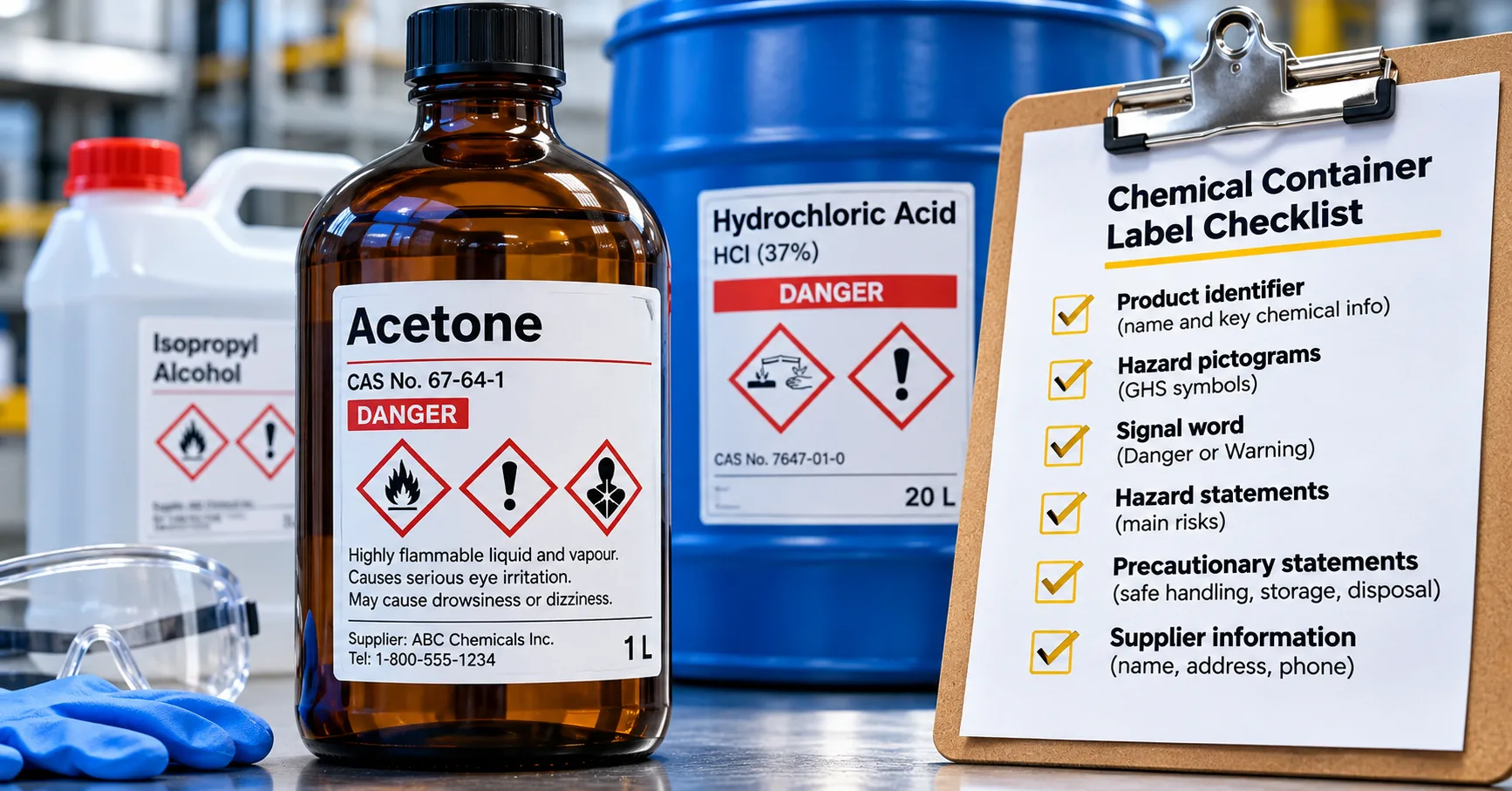
Chemical labels are the labels on containers of hazardous chemicals that tell the reader what the product is, how it can cause harm, how to handle it safely, and who supplied it. In the United States, a shipped chemical label must contain six elements under OSHA's Hazard Communication Standard: a product identifier, a signal word, hazard statements, pictograms, precautionary statements, and the name, address and telephone number of the responsible party.
Those six elements are the core, but a buyer usually needs more than one label. The same drum or bottle may also carry a workplace label, a transport diamond, an EU CLP label, or a reduced label sized for a small container. Each answers to a different rule, and each has to stay readable on a container that is splashed, wiped and handled for months.
What a Chemical Label Must Contain on a Shipped Container
Under 29 CFR 1910.1200(f)(1), the chemical manufacturer, importer or distributor must make sure each container of hazardous chemicals leaving the workplace is labeled, tagged or marked with six elements. The label buyer and the printer do not choose this content. It comes from the chemical's hazard classification, which is recorded in section 2 of its safety data sheet (SDS).
Label elementWhat it showsWhere it comes fromProduct identifierThe name or number used for the chemical on both the label and the SDS, so the two can be cross-referencedSDS section 1Signal wordDanger for the more severe hazards or Warning for the less severe; only one appears on the labelSDS section 2Hazard statementsStandard phrases describing the nature and degree of each hazard, for example "Highly flammable liquid and vapor"SDS section 2PictogramsBlack hazard symbols on a white background inside a red diamond frameSDS section 2Precautionary statementsRecommended measures for prevention, response, storage and disposalSDS section 2Responsible partyName, address and telephone number of the manufacturer, importer or other responsible partySDS section 1
OSHA also requires the label to be legible, in English, and prominently displayed on the container. Other languages can appear alongside English. OSHA does not set a minimum label, pictogram or font size, so buyers have to decide what "legible" means for each container (the size section further down gives a practical reference).
The standard changed recently. OSHA's 2024 final rule took effect on July 19, 2024, and gives manufacturers, importers and distributors until January 19, 2026 for substances and July 19, 2027 for mixtures to update labels and SDSs. Employers have until July 20, 2026 and January 19, 2028 to update workplace labeling, programs and training. Because some precautionary statements and classification categories were revised, label stock printed before the update can carry wording that no longer matches the current SDS. For a closer look at each element, Pryntiva's explainer on the six elements of a GHS label covers them one by one.
Chemical Labelling and Packaging Regulations by Market
The six elements come from the Globally Harmonized System of Classification and Labelling of Chemicals (GHS), a United Nations framework that each country adopts through its own law. The result is a shared core with local differences in language, extra information and format. A label made for one market is not automatically compliant in another.
Market or stageMain ruleWhat changes on the labelUnited States, shipped containersOSHA 29 CFR 1910.1200Six elements in English; red pictogram frame on shipped containers; no set minimum sizeEuropean UnionRegulation (EC) No 1272/2008 (CLP)Same core elements in the official language of each member state where the product is sold; nominal quantity on packages sold to the general public; supplemental information; minimum label and pictogram sizes by package capacityCanadaWHMIS 2015Supplier label in both English and FrenchUS transport49 CFR Part 172 (DOT)Hazard class diamonds on the outer package, at least 100 mm per sideSea freightIMDG CodeLabels on packages expected to stay legible after extended seawater exposure; BS 5609 is the test label makers commonly use to show this
The EU is also mid-way through a labeling overhaul. Regulation (EU) 2024/2865 amended CLP and added minimum font sizes measured as x-height, from 1.2 mm on packages up to 0.5 litres to 2.0 mm above 50 litres, along with line spacing of at least 120% of the font size and a single sans-serif font. Regulation (EU) 2025/2439 then pushed those formatting rules back to January 1, 2028. A further EU simplification package agreed in principle in June 2026 may shift that date again, so anyone redesigning EU artwork should confirm the current position with their regulatory team. Pryntiva's CLP labels page covers the European format in more detail.
Chemical Container Labels at Each Stage of the Container's Life
A single container can pass through several labeling rules between the filling line and the end user. Knowing which stage applies tells you which label to order.
Shipped containers
This is the full six-element label described above, applied by the manufacturer, importer or distributor. It stays on the container for its working life, and under (f)(9) an employer may not remove or deface it unless the container is immediately relabeled with the required information.
Workplace secondary containers
When a chemical is decanted into a spray bottle, wash bottle or transfer jug, the employer labels that container under (f)(6). The label can carry either the full shipped-container information or the product identifier plus words, pictures or symbols giving at least general hazard information, used together with the SDS and training. The (f)(8) exemption is narrow: it covers a portable container used only by the person who filled it, within the same work shift. Pryntiva's SDS labels and GHS secondary container labels are built for this stage.
Small containers
The 2024 update added paragraph (f)(12) for containers too small for a full label. A container of 100 mL or less may carry a reduced label with the product identifier, pictograms, signal word, manufacturer's name and phone number, and a statement that the full label information is on the immediate outer package. A container of 3 mL or less may carry only the product identifier where a label would interfere with normal use. In both cases the outer package must carry the complete label.
Transport packages
For shipping, the outer package takes the hazard class diamonds assigned in column 6 of the Hazardous Materials Table under 49 CFR 172.400. These labels sit beside the GHS product label rather than replacing it.
Chemical Class Label: How Transport Classes Map to Diamonds
A chemical class label is the square-on-point transport label that shows a package's hazard class or division by number, symbol and background color. The color scheme is fixed for each class, as summarized in PHMSA's DOT Chart 17.
ClassHazardLabel background1Explosives (Divisions 1.1 to 1.6)Orange2.1 / 2.2 / 2.3Flammable gas / Non-flammable gas / Poison gasRed / Green / White3Flammable liquidsRed4.1 / 4.2 / 4.3Flammable solid / Spontaneously combustible / Dangerous when wetWhite with red stripes / White over red / Blue5.1 / 5.2Oxidizer / Organic peroxideYellow / Red over yellow6.1 / 6.2Toxic / Infectious substanceWhite7RadioactiveWhite, or yellow over white8CorrosiveWhite over black9Miscellaneous dangerous goodsWhite with black vertical stripes in the upper half
A GHS hazard class, such as "Flammable liquids, Category 2", is not the same thing as a DOT hazard class, even though the two often line up. A drum of solvent will usually carry both: the GHS flame pictogram on its product label and a Class 3 diamond on the package. When a product has a second hazard, column 6 may also call for a subsidiary label. Pryntiva's hazard class labels page lists the label for every class and division.
Chemical Hazard Label Colors: What Each Color Means
Color carries meaning on a chemical label, but the meaning depends on which system the label uses. Three systems show up on chemical containers and in storage areas.
SystemColorsSeverity scaleTypical locationGHS pictogramBlack symbol on white inside a red diamond frameCategory 1 is the most severeProduct label on the containerNFPA 704Blue health, red flammability, yellow instability, white special hazards0 to 4, with 4 the most severeDoors, tanks and storage areas, for emergency respondersHMISBlue health, red flammability, orange physical hazard, white PPE0 to 4, with 4 the most severeWorkplace containers in plants using the system
Two points trip buyers up. First, OSHA requires the red pictogram frame on shipped containers, and every red frame on the label must contain a symbol, so a monochrome printer cannot produce a compliant shipped label on plain stock. Pre-framed blanks with the red diamonds already printed solve that, and Pryntiva supplies GHS pictogram labels as single stickers for adding beside an existing label. Second, the numbering runs in opposite directions: a GHS Category 1 hazard is the most severe, while an NFPA or HMIS rating of 1 is low. Mixing the two on one container invites misreading.
Chemical Labels for Bottles and Other Small Containers
Bottles are where label content and label space collide. Because OSHA sets no size, many US buyers size to the CLP table in Annex I of the EU regulation, which ties minimum label and pictogram dimensions to package capacity.
Package capacityMinimum label sizeMinimum pictogram sizeUp to 3 litres52 x 74 mm, if possible10 x 10 mm (16 x 16 mm if possible)Over 3 litres, up to 50 litres74 x 105 mm23 x 23 mmOver 50 litres, up to 500 litres105 x 148 mm32 x 32 mmOver 500 litres148 x 210 mm46 x 46 mm
CLP also requires each pictogram to cover at least one fifteenth of the label area and never less than 1 square centimeter. When the elements will not fit a small bottle at a readable size, the practical answer is more label area rather than smaller text: a wraparound that uses the full circumference, or a fold-out booklet label, which the revised CLP now allows for packages of any size.
According to Pryntiva, its reagent and solvent bottle labels are printed on solvent-resistant polyester or vinyl with a permanent acrylic adhesive sized to the bottle diameter, in wraparound and booklet formats, with a write-on version and laminate for hand-written dates and concentrations. For lab shelves, its laboratory reagent labels add lot fields and an overlaminate.
The Label Has to Survive the Chemical It Describes
The regulations set the content, not the construction. Yet a label whose text smears or lifts off is no longer legible, and legibility is part of the rule. A GHS label sits on the container of the chemical it describes, so drips, splashes and wipe-downs with that same product are its normal working conditions.
Pryntiva's published material guidance describes typical behavior by material class, which it is careful to separate from test results on a specific product:
- Polypropylene (PP) film for aqueous acids, alkalis and detergents in rigid bottles and pails.
- Polyester (PET) film for aromatic and ketone solvents, fuels and heat, where polyolefin films tend to swell or soften.
- Polyethylene (PE) film for squeeze bottles and blow-molded jerricans that flex.
- Paper for outer cartons only, since it absorbs liquids and weakens when wet.
The adhesive and the print matter as much as the film. High-density polyethylene (HDPE) drums have low surface energy and often carry mold release, so a general-purpose acrylic adhesive may never build a full bond; Pryntiva specifies a high-tack acrylic for that surface. On the print side, resin thermal transfer ribbons, UV-cured flexographic inks and pigment inkjet inks tend to resist solvent wipe, while wax ribbons and dye-based inks tend to smear.
For drums and IBCs going by sea, BS 5609 separates two things. Section 2 tests the unprinted stock, including three months of seawater immersion. Section 3 tests the printed label, so the stock and a specific print process are assessed together. "BS 5609 stock" printed on an untested in-house printer is not the same purchase as a Section 3 label.
Pryntiva makes the films and adhesives it prints on, and it quotes custom chemical labels from the chemical and container outward, with free samples for qualified B2B projects so buyers can splash and wipe them on their own containers before ordering. Large-format drum, IBC and pail labels are offered in BS 5609-type constructions, and blank label stock is available for buyers who print GHS content in-house.
Chemical Label Checklist Before You Order
- Confirm the stage. Shipped container, workplace secondary container, small container, transport package or a mix.
- Confirm the market. US OSHA, EU CLP, Canadian WHMIS or several, since language and format rules differ.
- Pull the content from the current SDS. Use section 1 for the identifier and supplier, section 2 for the hazard elements.
- Check the compliance dates. Make sure statements reflect the 2024 HazCom update for your substances and mixtures.
- Size the pictograms first. Then build the label around them, using the CLP table as a reference.
- Plan the red frame. Full-color printing, pre-framed blanks or a two-color printer.
- Match film, adhesive and print to the chemical and container. Name the SDS section 9 properties and the container plastic.
- Test samples on the real container. Apply, let the adhesive build, then splash, wipe and store as production would.
Frequently Asked Questions
What must a chemical label include?
A shipped hazardous chemical container in the United States must carry six elements under 29 CFR 1910.1200(f)(1). These are the product identifier, signal word, hazard statements, pictograms, precautionary statements, and the name, address and phone number of the responsible party. All six come from the chemical's classification in section 2 of the SDS, with the identifier and supplier details in section 1.
Do chemical labels need to be printed in color?
Shipped container labels under OSHA need the red pictogram frame, so at least one color is required. The symbol inside each frame is black on white, and OSHA does not allow an empty red frame on the label. Workplace labels have more flexibility, and transport diamonds use the fixed class colors set by DOT.
What is the difference between a GHS label and a hazard class label?
A GHS label is the product label on the chemical container and describes the chemical's health, physical and environmental hazards. A hazard class label is the 100 mm transport diamond on the outer package, required under 49 CFR Part 172. Many packages need both, and one does not replace the other.
Does a spray bottle filled from a labeled drum need its own label?
Usually, yes. OSHA exempts a portable container only when the chemical is used by the person who transferred it, within the same work shift. A bottle that is shared or left for the next shift needs at least the product identifier and general hazard information.
What size should a chemical label be?
OSHA sets no minimum size and requires only that the label be legible and prominently displayed. Most US buyers use the EU CLP table as a reference, which starts at 52 x 74 mm with pictograms of at least 10 x 10 mm for packages up to 3 litres. Larger containers step up to bigger labels and pictograms.
What happens to existing labels when the SDS changes?
Labels need updating when significant new hazard information comes to light. Under 1910.1200(f)(11), the label must be revised within six months of the manufacturer, importer, distributor or employer becoming newly aware of it. Pre-printed label stock with fixed statements can become waste at that point, which is one reason some buyers print variable text on demand onto pre-framed blanks.
Who is responsible for the content of chemical labels?
The chemical manufacturer, importer or distributor is responsible for shipped container labels, and the employer is responsible for workplace labels. A label printer reproduces the approved content; Pryntiva states that it prints from the customer's SDS or artwork and does not classify chemicals or write hazard statements. Classification stays with the supplier's regulatory team.
Are EU chemical label formatting rules changing?
Yes. The revised CLP adds minimum font sizes, line spacing and font rules, currently scheduled to apply from January 1, 2028 after a postponement. A further simplification package under negotiation in 2026 may adjust that date again, so EU artwork plans should be checked against the latest adopted text.
Get a Label That Carries the Right Content and Stays Readable
Getting the content right and getting the label to survive are two separate jobs. The first belongs to your SDS and regulatory team; the second depends on the film, adhesive and print chosen for your chemical and container. To specify chemical labels with Pryntiva, send the SDS, the container material and size, the shipping route and your printer details to its engineering team, or request free samples to test on your own containers first.