Char Dham Temples of Uttarakhand: History, Legends and Spiritual Significance
Uttarakhand is often called Devbhoomi, the Land of Gods, and for good reason. The Himalayan state is home to ancient temples, sacred rivers and pilgrimage routes that have been part of India's spiritual traditions for centuries.
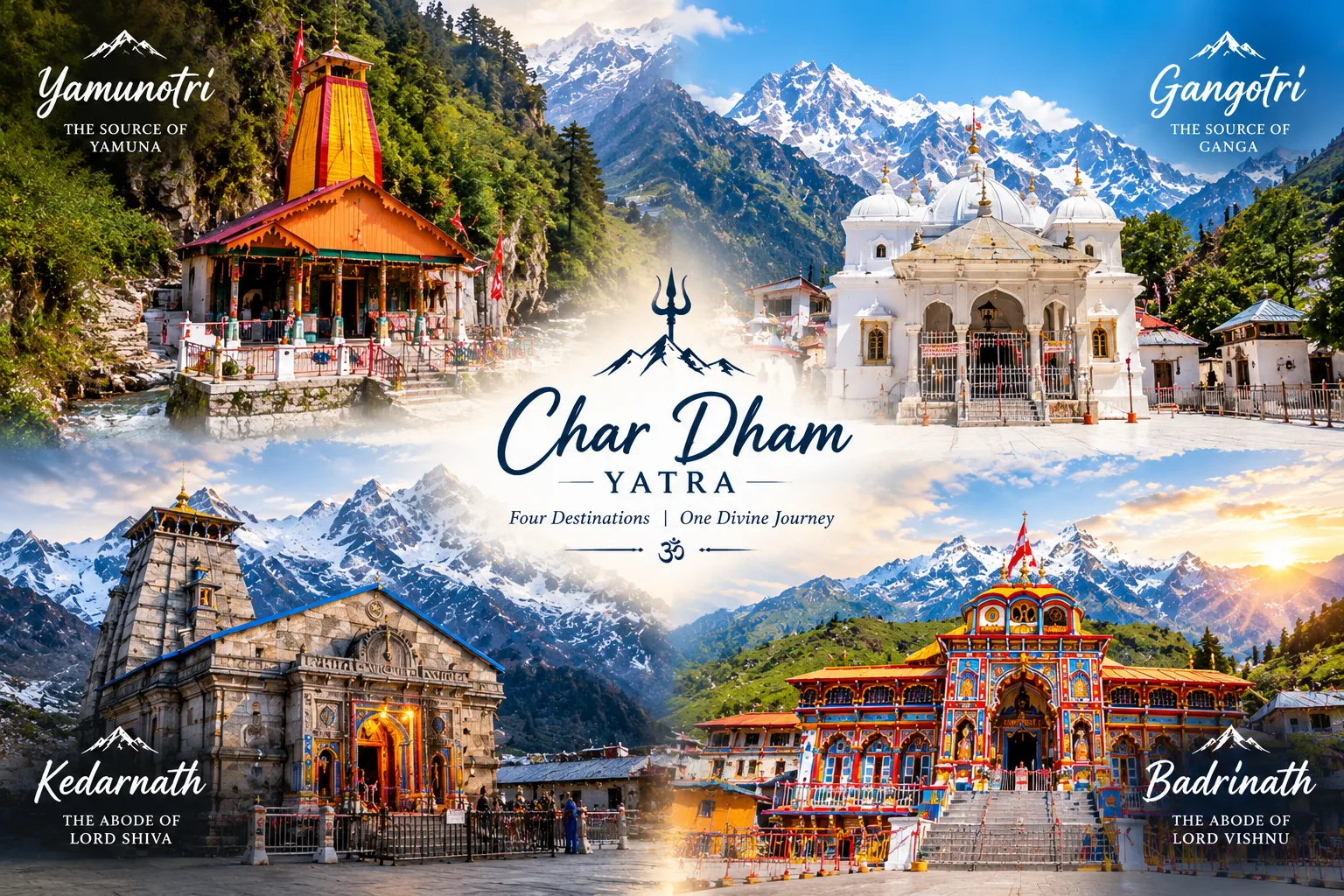
Among its many sacred places, the Char Dham Yatra of Uttarakhand holds a special place. The four holy destinations are Yamunotri, Gangotri, Kedarnath and Badrinath. Traditionally, the pilgrimage begins at Yamunotri, continues to Gangotri and Kedarnath, and concludes at Badrinath.
But what is the story behind these four temples? Let's take a closer look.
What Is Char Dham Yatra?
The word “Char” means four, while “Dham” refers to a sacred religious destination.
The Uttarakhand Char Dham circuit brings together four important Himalayan shrines:
- Yamunotri Dham – dedicated to Goddess Yamuna
- Gangotri Dham – dedicated to Goddess Ganga
- Kedarnath Dham – dedicated to Lord Shiva
- Badrinath Dham – dedicated to Lord Vishnu
Each temple has its own religious traditions, legends and history. Together, they form one of the most important pilgrimage circuits in Uttarakhand.
1. Yamunotri Temple – The Source of Faith
Yamunotri is traditionally the first stop of the Char Dham Yatra.
The temple is dedicated to Goddess Yamuna, and it is located in a narrow Himalayan valley near the source region of the Yamuna River. According to Hindu tradition, Yamuna is associated with Surya, the Sun God, and Yama, the god of death. Devotees therefore attach deep spiritual significance to the river.
The present Yamunotri temple is said to have been built in 1839 AD and later rebuilt in the 19th century. The temple is also known for the nearby Surya Kund and Gauri Kund, natural hot springs where devotees traditionally prepare offerings.
Reaching the temple is itself part of the pilgrimage. Travellers traditionally walk or use permitted local assistance from the Janki Chatti area to reach Yamunotri.
For many pilgrims, Yamunotri represents the beginning of a journey that combines faith, physical effort and the beauty of the Himalayas.
2. Gangotri Temple – The Story of Goddess Ganga
The second major stop is Gangotri, dedicated to Goddess Ganga.
According to Hindu tradition, King Bhagiratha performed intense penance to bring the Ganga from heaven to Earth. The descent of the mighty river was controlled by Lord Shiva, who received the river in his matted locks before allowing it to flow toward Earth.
Gangotri is therefore closely connected with the sacred story of the Ganga. Uttarakhand Tourism notes that the actual glacial source is at Gaumukh, around 19 km from Gangotri, while the river is known as Bhagirathi in its upper course and takes the name Ganga after the Alaknanda meets it at Devprayag.
The Gangotri temple stands at around 3,415 metres and is surrounded by the dramatic Garhwal Himalayas.
The journey here isn't only about visiting the temple. The river, mountains and surrounding landscape make Gangotri an important part of Uttarakhand's spiritual and natural heritage.
3. Kedarnath Temple – The Abode of Lord Shiva
Among the four Char Dham destinations, Kedarnath is perhaps one of the most famous.
The temple is dedicated to Lord Shiva and is also one of the twelve Jyotirlingas traditionally associated with Shiva worship in India. It stands at approximately 3,580 metres in the Garhwal Himalayas.
The Pandavas and Kedarnath Legend
One of the best-known legends connects Kedarnath with the Mahabharata.
According to the traditional story, after the Kurukshetra war, the Pandavas wanted to seek Lord Shiva's blessings. Shiva is said to have appeared in the form of a bull and attempted to avoid them. When the Pandavas recognised him, Shiva disappeared into the ground, leaving his hump visible at Kedarnath.
The remaining parts of the bull are traditionally associated with the other temples of Panch Kedar—Tungnath, Rudranath, Madhyamaheshwar and Kalpeshwar. This is a religious legend rather than a historically verified event.
History of the Temple
The present Kedarnath temple is traditionally associated with Adi Shankaracharya, and Uttarakhand Tourism describes the structure as more than 1,200 years old. The temple is built from large, evenly shaped stone slabs and has a distinctive Himalayan architectural character.
Its remote location and challenging mountain journey have made the pilgrimage particularly meaningful for devotees.
4. Badrinath Temple – The Sacred Home of Lord Vishnu
The final destination of the traditional Uttarakhand Char Dham route is Badrinath.
Badrinath Temple, also called Badrinarayan Temple, is dedicated to Lord Vishnu. It stands beside the Alaknanda River in the Garhwal Himalayas at an elevation of approximately 3,100 metres.
According to tradition, Lord Vishnu meditated in this region, while Goddess Lakshmi took the form of a Badri tree to provide him shade. The name Badrinath is traditionally connected with this story.
Uttarakhand Tourism states that the temple is believed to have been established by Adi Shankaracharya in the 8th century.
The temple's colourful entrance and Himalayan setting make Badrinath one of the most recognisable pilgrimage destinations in Uttarakhand.
Why Are These Four Temples So Important?
The Char Dham circuit brings together different aspects of Hindu religious tradition.
Yamunotri is associated with Goddess Yamuna and the sacred Yamuna River.
Gangotri is associated with Goddess Ganga and the story of the river's descent to Earth.
Kedarnath represents devotion to Lord Shiva and is also associated with the Jyotirlinga tradition.
Badrinath is dedicated to Lord Vishnu and is an important Vaishnavite pilgrimage centre.
The four destinations also take pilgrims through some of the most dramatic landscapes of the Garhwal Himalayas.
Why Is the Char Dham Journey Traditionally Done in This Order?
The traditional Uttarakhand Char Dham route follows a clockwise pilgrimage pattern, beginning with Yamunotri, followed by Gangotri, Kedarnath and Badrinath.
However, actual travel plans can depend on road conditions, weather, temple opening dates and local arrangements.
The shrines are located at high elevations and generally remain closed during the winter months because of heavy snowfall. During winter, worship associated with the deities continues at lower-altitude locations according to established local traditions.
Planning a Char Dham Yatra With Chaukhamba Travel
A Char Dham Yatra requires more than simply choosing four destinations. Accommodation, transportation, route planning, travel dates and mountain conditions all need attention.
If you are planning a Char Dham Yatra, Do Dham Yatra, Kedarnath Yatra or a customised Uttarakhand pilgrimage, you can explore Chaukhamba Travel for travel planning and package options.
Before booking, ask about:
- Complete itinerary
- Hotel and accommodation details
- Transportation
- Meals and inclusions
- Trek or local travel arrangements
- Additional charges
- Cancellation terms
- Current registration requirements
For official tourism information, travellers can also check Uttarakhand Tourism before starting their journey.
For pilgrimage registration and current travel information, use the official Uttarakhand Tourism Care portal.
Final Thoughts
The Char Dham temples are not simply four stops on a travel map.
They represent a combination of faith, mythology, history, tradition and Himalayan culture. From the sacred waters associated with Yamunotri and Gangotri to the Shiva temple of Kedarnath and the Vishnu shrine at Badrinath, every destination has a story of its own.
And perhaps that is what makes the Char Dham Yatra special—the journey is not only about reaching the temples. It is also about walking through the mountains, meeting fellow pilgrims, experiencing local traditions and taking a moment away from everyday life.
For many travellers, the road to Char Dham becomes a memory that stays long after the journey ends.