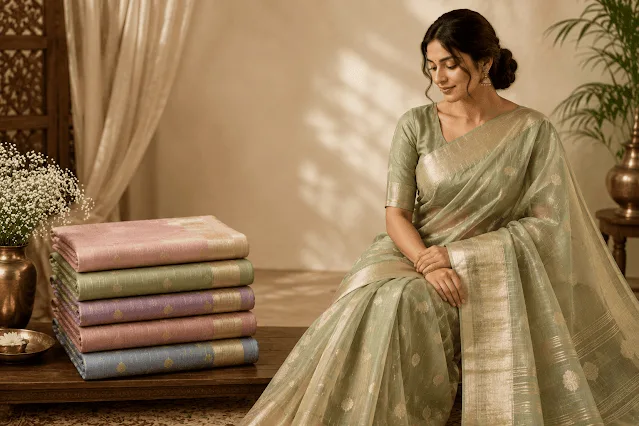
The Chanderi saree border is rarely the first thing people notice in a photograph, but it's often the detail that decides whether the drape falls cleanly or feels flat. On a fabric as sheer and lightweight as Chanderi, the border does more than frame the saree — it anchors the pallu, controls how the fabric pleats, and carries most of the saree's traditional motifs. Understanding how the border is made and why it varies across pieces makes it much easier to judge quality in a Chanderi silk saree before buying one.
What Makes the Chanderi Saree Border So Distinctive?
Chanderi's sheer, almost translucent body means the border carries a disproportionate share of the saree's visual weight and craftsmanship, which is why weavers historically treated it as the most detailed part of the piece.
The Role of Zari and Silk Thread in the Border
Most Chanderi borders are woven using zari — fine metallic thread, traditionally gold or silver-toned — combined with silk, which gives the edge its characteristic shimmer against the matte, lightweight body of the saree. This contrast between the sheer field and the denser, reflective border is a defining visual signature of Chanderi weaving. The zari also adds a small amount of structural weight, which subtly helps the border sit and fall more predictably than the rest of the fabric.
Traditional Motifs Woven Into the Border
Classic Chanderi borders feature motifs such as coins (ashrafi), peacocks (mor), and floral or geometric patterns, woven directly into the fabric rather than printed on afterward. These motifs are created using an extra-weft technique, where additional threads are woven in specifically to form the pattern along the border's length. Because these designs are structural rather than surface-printed, they remain a reliable way to judge whether a border reflects genuine handloom technique.
How Does the Border Affect the Drape of a Chanderi Silk Saree?
Because Chanderi fabric is so lightweight on its own, the border's density and placement directly influence how the saree hangs, pleats, and settles once worn.
Border Weight and Fall
A slightly heavier, zari-rich border adds just enough structure to help the saree's pleats fall in a defined line rather than floating loosely, which is common with very sheer, border-light fabrics. This is particularly noticeable at the hemline and pallu, where a well-balanced border keeps the edge from curling or looking limp. Too heavy a border, however, can pull unevenly against the sheer body, which is why border weight is usually calibrated carefully in well-made pieces.
Border Width and Visual Balance
Border width changes the saree's overall proportion — a narrow border keeps focus on the body's texture and pallu design, while a broader border makes a stronger style statement suited to festive wear. Wider borders also tend to add more visible structure to the drape, useful for those who find very sheer Chanderi sarees too delicate to pleat confidently. Choosing border width is often as much a styling decision as a technical one, depending on the occasion and personal draping preference.
What Types of Borders Are Found in Chanderi Sarees?
Border TypeKey FeatureBest Suited ForZari borderMetallic thread, reflective finishFestive and wedding wearTemple borderTraditional temple-tower motifTraditional and occasion wearSelf-color borderSame shade as the body, subtle finishOffice and everyday wearContrast borderDifferent color from the bodyStatement, semi-formal wearZari and Temple Borders
Zari borders remain the most recognized style, prized for their shimmer and traditional coin or floral motifs, and are commonly chosen for weddings and festive occasions. Temple borders, featuring the distinctive stepped, temple-tower pattern, are equally traditional and often paired with contrasting pallus for a more classic South-meets-Central-India aesthetic. Both styles tend to use denser zari work, which adds a bit more visible richness compared to simpler border designs.
Self-Color and Contrast Borders
Self-color borders, woven in the same shade as the saree's body, offer a subtler, more understated finish that works well for office wear or everyday draping. Contrast borders, on the other hand, use a different color entirely to create a bolder visual break between the body and the edge, often chosen for semi-formal events. Neither style is inherently more "authentic" than the other — the choice mainly comes down to how prominent you want the border to appear.
How Do You Identify an Authentic Chanderi Saree Border?
With Chanderi's popularity, printed or power-loom imitations are common, so checking specific border details helps confirm whether a piece reflects genuine handwoven technique.
Signs of Handwoven Authenticity
Run a finger gently along the border's motifs — genuine woven zari work will have a slight raised texture, while printed imitations sit flat against the fabric. Authentic Chanderi is also sheer enough that light passes through the body easily, a property that's harder to replicate convincingly in machine-made copies. Checking whether motifs repeat with slight natural variation, rather than mechanical uniformity, is another practical way to judge handloom origin.
GI Tag and Certification Markers
Genuine Chanderi textiles, including the border work, fall under a registered Geographical Indication (GI) tag, which legally protects the name for products woven in the Chanderi region of Madhya Pradesh using traditional methods. According to Incredible India, an official Ministry of Tourism platform, Chanderi's textiles are protected under this GI tag specifically to preserve traditional weaving practices tied to the region. Looking for GI or Handloom Mark certification when you buy Chanderi saree online adds a reliable layer of authenticity beyond visual inspection alone.
How Do You Choose a Chanderi Saree Border for Different Occasions?
Border style should generally match the formality and setting of the occasion, since a border that suits a wedding may feel overdone for daily office wear.
Borders for Festive and Wedding Wear
For weddings and festive events, a broad zari or temple border in a rich, contrasting color tends to photograph and drape best, adding the visual weight such occasions typically call for. Pairing a dense border with an equally detailed pallu creates a more cohesive, formal look overall. These heavier-border pieces are usually where Chanderi's silk-zari craftsmanship is most fully showcased.
Borders for Everyday and Office Wear
For daily or office wear, a narrow self-color or lightly detailed border keeps the saree comfortable to drape and manage through a full workday without excess weight or shine. Subtler borders also pair more easily with plain or lightly patterned blouses, keeping the overall look versatile across settings. This is often the more practical starting choice for anyone new to wearing Chanderi regularly.
Where Can You Buy Chanderi Saree Online With the Right Border?
Buying online makes it easier to compare border styles and widths across pieces, but it also means relying more heavily on product details and images to judge quality before purchase.
What to Check Before You Buy Chanderi Saree Online
Look closely at zoomed-in border images, checking for slight texture and thread variation rather than a perfectly flat, uniform print. Product descriptions should specify border type (zari, temple, self-color, or contrast), fabric composition, and any GI or Handloom Mark certification, since these details are harder to verify without seeing the saree in person. Reading return policies is also worth doing, given how much perceived quality in Chanderi can depend on seeing the actual drape and border sheen firsthand.
How Brands Like Indeloom Feature Border Craftsmanship
Several online Chanderi retailers now dedicate specific product sections to border detailing, given how central it is to the saree's overall look. Indeloom is among the brands that list Chanderi silk saree collections with border type and craftsmanship details called out directly in product descriptions, which can help buyers compare border style and weight before purchase. As with any online purchase, it's worth reviewing each listing's specific fabric and border details individually, since these can vary across collections.
How Do You Care for a Chanderi Silk Saree Border?
Because the border carries the heaviest thread work, it often needs slightly more careful handling than the rest of the saree during washing and storage.
Washing and Storage Tips
Dry cleaning is generally recommended for Chanderi sarees with zari borders, since water and detergent can dull the metallic thread's finish over repeated washes. When storing, fold along the original crease lines and wrap in a soft cotton cloth to prevent the zari border from snagging against other fabrics in the closet. Avoiding direct sunlight during storage also helps preserve both the border's shine and the body's natural sheen.
Preventing Zari Tarnish and Fraying
Keep zari borders away from direct contact with perfumes or deodorants, as these can accelerate tarnishing of the metallic thread over time. Gently pressing the border with a cloth barrier, rather than ironing it directly, helps prevent the thread from flattening or fraying at the edges. Periodically checking the border's edge for loose threads and addressing them early can also prevent minor fraying from spreading further into the weave.
FAQs
Why is the border considered the most important part of a Chanderi saree?
The border carries most of the saree's zari work and traditional motifs, and its weight and width directly influence how the sheer fabric drapes and pleats.
How can I tell if a Chanderi saree border is handwoven?
Genuine woven borders have a slightly raised, textured feel and small natural variations in the motifs, while printed imitations appear flat and mechanically uniform.
Does border width affect how a Chanderi saree is styled?
Yes, narrower borders suit everyday and office wear, while wider, more detailed borders are generally chosen for festive or wedding occasions.
What should I check before I buy Chanderi saree online?
Check zoomed-in border images for texture, confirm the border type and fabric composition in the description, and look for GI or Handloom Mark certification where listed.
Final Thoughts
The Chanderi saree border is a small detail with an outsized effect on how the entire saree looks and drapes, from the way the pleats fall to how the pallu catches light. Whether you're drawn to a rich zari border for festive wear or a subtle self-color edge for daily use, understanding border type, weight, and authenticity markers makes it far easier to choose confidently — whether you're examining a Chanderi silk saree in person or deciding to buy Chanderi saree online through a specialty retailer.