Introduction
Ask any parent in India what they would like less of at home right now, and screens come up within about ten seconds.
That is a big part of why wooden toys are back. Wood feels different in the hand. It is solid and warm, it does not flash or beep at 6 in the morning, and it survives being flung off the sofa more times than anyone bothered counting.
There is a practical reason too. A toy that sings and lights up is doing the playing for your child. A wooden one is not. Your child has to stack it, sort it, trace it or build something out of it, and that small demand is exactly what keeps them busy for twenty minutes instead of two.
Here are 15 wooden toys for kids worth buying in India this year, sorted by age, so you can shop for the stage your child is at today rather than the one on the box.
What Makes a Wooden Toy Safe and Worth the Money
Wood on its own guarantees nothing.
Non-toxic paint and smooth, splinter-free edges are the floor, not a feature to boast about. A toy can look beautifully natural and still have a rough joint waiting to catch a small finger.
BIS certification applies here too. Since 2020, every toy sold in India needs the ISI mark and compulsory certification. There is no exemption for wooden toys, or for anything else that happens to look handmade.
Then there is play value, which is the part parents underestimate. A toy earns its place if your child keeps coming back to it: stacking it again, sorting it again, building something different with it in week six. Pretty wears off fast. Repeatable does not.
Best Wooden Toys for Kids by Age Group
Infants and Toddlers (0 to 2 years)
Keep it simple here. Chunky pieces, easy grip, nothing with small parts.
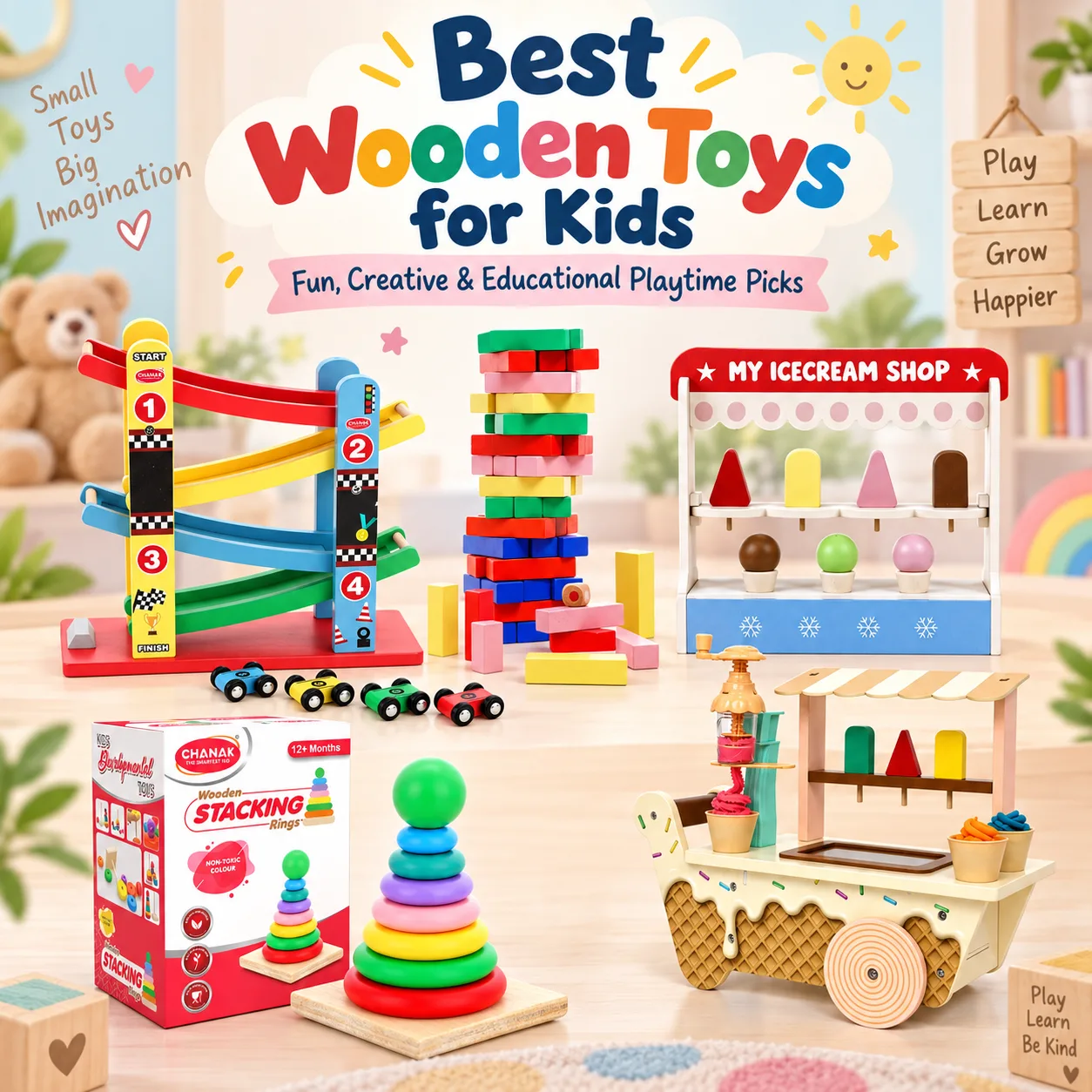
The Chanak Wooden Stacking Ring Toy introduces colour and size ordering through rainbow rings cut for tiny hands. Expect it to be knocked over roughly four hundred times. That is the point.
The Chanak Wooden Baby Walker is a sturdy manual push toy that builds balance and early walking confidence. No batteries, no music, no plastic wheels that give up after a month.
Preschoolers (3 to 5 years)
This is puzzle territory, and wooden puzzles are hard to beat.
The Chanak Wooden Alphabet Puzzle and Wooden Vegetable Puzzle build early vocabulary through hands-on matching, which sticks far better than flashcards at this age. The Chanak Wooden Human Body Parts Puzzle turns basic anatomy into something a four-year-old will happily explain back to you at dinner.
The Chanak 2-in-1 Wooden Easel Board gives them a proper surface for drawing and early letter practice, on a frame that stays upright when leaned on.
And the Chanak Colorful Wooden Domino Block Set brings 100 pieces across 9 colours. Stacking, sequencing, patience, and then the collapse, which is honestly half the appeal.
School-Age Kids (6 to 9 years)
Kids this age want more happening at once.
The Chanak Wooden Activity Bus is a 6-in-1 Montessori musical shape sorter, so it covers shapes, sounds and fine motor work in one solid build instead of three separate toys.
The Chanak Wooden MathTime Educational Card Set makes maths something they will play rather than something they will stall on. It reads as a card game, not a worksheet, and that difference matters more than any curriculum label.
The Chanak Wooden Ice Cream Cart Play Dough Set is the creative option in the group, pretend play with something to actually make at the end of it.
Pre-Teens (10 to 12 years)
Older kids need a problem worth sitting with.
A wooden strategy or logic game from Chanak’s Board Games collection does that well. It gives them a real challenge, a bit of friendly competition, and no screen in sight.
The Chanak Wooden Doll House also holds up better at this age than most parents expect. Four furnished rooms, sixteen pieces, and enough detail to keep a ten-year-old building storylines, often with a younger sibling roped in as co-director.
Wooden vs. Plastic Toys: What Actually Differs
Wooden toys usually outlive plastic ones by years. Solid wood does not crack or fade the way plastic does after heavy use, which is why a stacking toy that survived one toddler’s chewing and throwing phase is often still sitting intact when the next child is old enough for it.
The feel is different as well. Wood has weight to it. Plenty of kids find that calmer to handle than thin, hollow plastic, which can feel disposable from the first week.
But the idea that wood is automatically the safer material is not true, and it is worth saying plainly. Both need non-toxic finishes. Both need BIS certification. What separates a good toy from a risky one is manufacturing quality, not the material it started as.
How to Choose the Right Wooden Toy for Your Child
Buy for the stage, not the number on the box. Two five-year-olds can be miles apart. One is sorting shapes confidently while the other is still mostly interested in how things feel, and both are perfectly normal.
Inspect the finish before you commit. Smooth paint, rounded edges and tight joints tell you the toy was made properly. Rough patches, flaking colour or parts with a bit of wobble tell you the opposite, whatever the price tag says.
Spread your buying across skill types too. Something for motor skills, something for thinking, something for pretend play. Five puzzles in one toy box builds one skill five times over.
Common Mistakes Parents Make When Buying Wooden Toys
The first is assuming wooden means safe. A badly finished wooden toy with rough edges, flaking paint or loose joints carries the same risks as a badly made plastic one.
The second is skipping the BIS check because the toy looks traditional and trustworthy. Certification rules do not change with the material, and a natural finish is not evidence of anything.
The third is buying for the shelf. Decorative wooden toys photograph beautifully and often sit untouched. If your child never picks it up, it is doing nothing for them, however good it looks in the corner of the room.
Conclusion
A good wooden toy has three things going for it: proper certification, construction that lasts, and play your child returns to on their own. The natural material is a bonus, not the argument.
From stacking rings at one to strategy games at eleven, the real trick is matching the toy to where your child is right now.
If you want to compare across materials and ages, our age-wise guide to educational toys and the Toys Under ₹1000 collection cover a lot of the same ground. You can browse Chanak’s full wooden range at chanak.co. And if you want to read the rules for yourself, the official BIS press release on mandatory toy certification is short and worth five minutes.
Frequently Asked Questions
Are wooden toys safer than plastic toys for kids?
Not automatically. Both need non-toxic finishes and BIS certification, so safety comes down to how well the toy was made, not what it was made from.
What should I check before buying wooden toys for kids?
Look for the BIS mark, smooth non-toxic paint, rounded edges and joints that do not move when you press them.
What are the best wooden toys for a 2-year-old?
Stacking rings and simple push walkers. Both build grip strength and balance, and neither needs instructions.
Which wooden toys suit school-age kids best?
Toys that do more than one thing. Activity buses, maths card sets and building sets tend to hold their attention longest.
Are wooden toys better than plastic for child development?
Both work. Wood offers a different sensory experience, but the developmental value comes from how the toy is designed to be played with, not the material.
Do wooden toys last longer than plastic toys?
Usually yes. Solid wood resists cracking and fading far better, which is why wooden toys get passed down between siblings so often.
Are BIS-approved wooden toys available in India?
Yes, widely. And the check matters just as much for wooden toys as for any other kind.
How do I know if a wooden toy is worth the price?
Compare finish, joint strength and certification rather than price alone. A well-made mid-range toy often beats an expensive one with a sloppy finish.
Do wooden toys help reduce screen time for kids?
They help. A toy that is genuinely engaging gives a child something to do with their hands, which cuts down on the boredom that leads to asking for the tablet.
What wooden toys work well for group or sibling play?
Building blocks, domino sets and bigger activity toys like an activity bus. All of them work better with two pairs of hands.