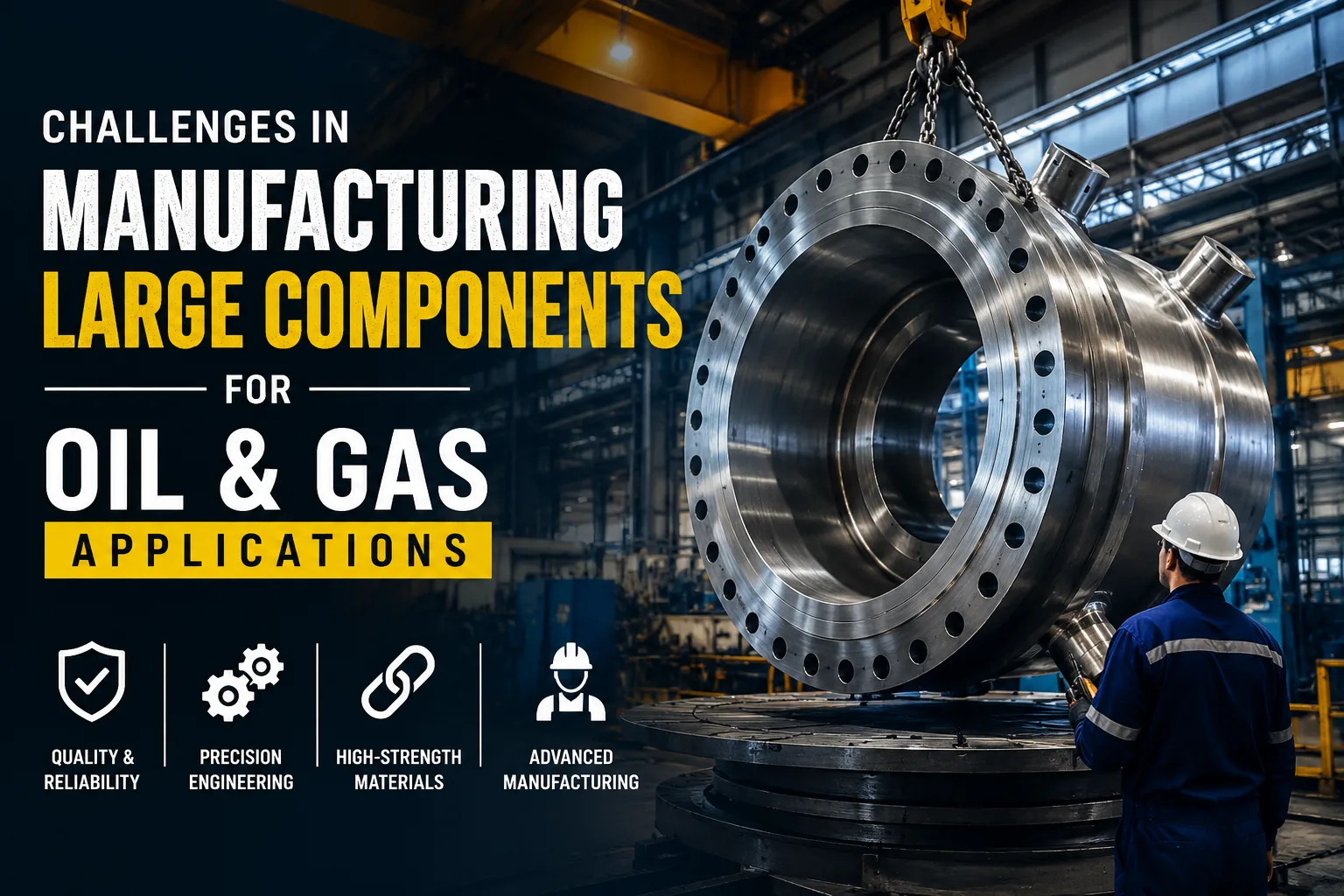
The oil and gas industry relies on high-performance forged components to support critical operations across offshore platforms, refineries, petrochemical plants, and pipeline networks. These environments demand exceptional reliability, making industrial forgings an essential part of modern energy infrastructure. As projects continue to increase in scale and complexity, the demand for large forged components and specialized oil and gas forgings is growing rapidly.
Manufacturing these components presents several challenges, ranging from material selection and process control to quality assurance and logistics. To meet industry requirements, every forging manufacturer must maintain strict standards throughout the production lifecycle.
Material Selection for Critical Applications
One of the biggest challenges in producing oil and gas forgings is selecting the appropriate material. Components operating under extreme pressure, high temperatures, and corrosive environments require materials that offer superior mechanical strength and long-term durability.
Commonly used materials include carbon steel, alloy steel, stainless steel, and specialized steel forgings designed for demanding industrial applications. The selection process must consider not only performance requirements but also manufacturability and life cycle costs.
Maintaining Structural Integrity in Heavy Forgings
Producing heavy forgings requires precise control over every stage of manufacturing. As component sizes increase, maintaining internal soundness and consistent mechanical properties becomes increasingly challenging.
Advanced open die forging techniques are often used to manufacture large shafts, rings, blocks, and other critical components. Proper deformation ratios, temperature control, and cooling procedures help ensure that these custom forged components achieve the required strength and grain structure for long-term service.
Achieving Precision in Large Forged Components
The oil and gas sector requires extremely tight tolerances, even for massive components. Whether manufacturing forged rings, pressure vessel parts, or other industrial forgings, dimensional accuracy is essential for ensuring proper assembly and performance.
Modern machining technologies and advanced inspection systems help manufacturers achieve the precision required for today's large-scale energy projects.
Heat Treatment Challenges
Heat treatment is critical to enhancing the performance of forged components used in demanding environments. However, ensuring uniform heating and cooling across large forged components can be difficult.
Improper heat treatment may lead to residual stresses, distortion, or inconsistent mechanical properties. As a result, manufacturers invest heavily in controlled processes and monitoring systems to maintain product quality.
Quality Assurance and Testing
Reliability is non-negotiable in the energy sector. Every forging manufacturer must implement rigorous testing procedures to verify the integrity of oil and gas forgings before they enter service.
Common inspection methods include:
- Ultrasonic Testing (UT)
- Magnetic Particle Inspection (MPI)
- Radiographic Testing (RT)
- Mechanical Property Testing
- Dimensional Inspection
These quality assurance measures help ensure that industrial forgings meet international standards and customer specifications.
Logistics and Supply Chain Complexity
Transporting heavy forgings and over sized components presents another major challenge. Large dimensions and substantial weight require specialized handling, transportation planning, and project coordination.
Manufacturers must carefully manage logistics to ensure timely delivery of custom forged components to energy projects around the world.
Conclusion
As global energy infrastructure continues to expand, the demand for reliable forged components, industrial forgings, and specialized oil and gas forgings will continue to grow. Successfully manufacturing these products requires expertise in open die forging, advanced metallurgy, precision machining, heat treatment, and quality assurance.
By overcoming these challenges, manufacturers can deliver high-performance large forged components that support the safe and efficient operation of critical oil and gas facilities worldwide.