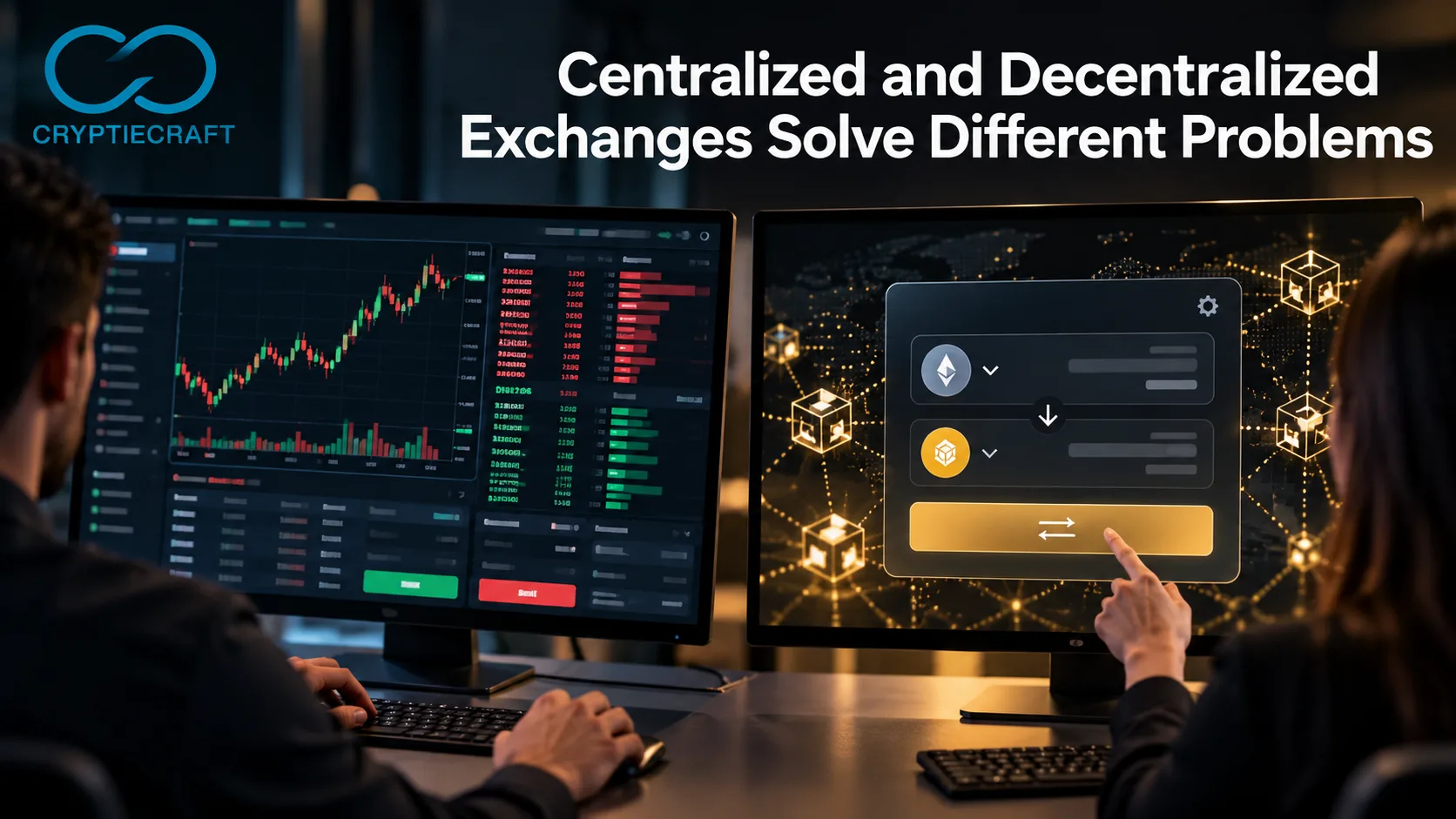
The difference between centralized and decentralized crypto exchanges is more significant than the trading screen. It affects custody, how orders execute, who operates the market, and what happens when something goes wrong.
Anyone comparing the types of cryptocurrency exchanges should first understand these responsibilities. The exchange model shapes both the customer experience and the technology needed to deliver it.
How centralized exchanges operate
A centralized exchange typically manages customer accounts and executes trades according to rules maintained by an operator. Customers may deposit assets into platform-controlled custody, then trade using an internal balance ledger and an order book.
This model can provide a familiar account experience, customer support, integrated fiat services, and high-frequency order processing. It also places substantial responsibility on the operator to secure assets, reconcile transactions, review suspicious activity, and maintain the service.
A centralized venue needs procedures for deposits, withdrawals, account recovery, trading interruptions, and financial reporting.
How decentralized exchanges operate
Many decentralized exchanges connect to users' external wallets and use smart contracts to execute trades. Automated market makers may use liquidity pools instead of a conventional centralized order book. Other designs support on-chain order books or hybrid execution.
Users may retain direct control of their keys, but they face other risks involving contract code, approvals, transaction fees, and network conditions. Smart-contract review and clear transaction previews matter because blockchain actions may be difficult to reverse.
Decentralization does not automatically remove all intermediaries or operator responsibilities. The actual design must be examined.
Compare the customer journey
On a centralized venue, users may register, verify identity where required, deposit funds, and place orders inside an account. On a wallet-connected DEX, they may approve contracts and sign transactions directly.
Each process has different sources of friction. Account recovery may be easier with an operator, while noncustodial users must protect their wallet access. Transaction settlement and fee visibility also differ.
The main types of crypto exchanges are easier to compare when custody, execution, settlement, support, and operational control are evaluated separately.
Consider liquidity and market structure
A centralized market needs buyers and sellers or external liquidity relationships. An automated market maker needs sufficiently funded pools and rules for pricing and fees. Thin liquidity can create significant slippage in either model.
Publishing a long asset list does not prove that customers can execute trades at useful prices. Market quality should be measured through actual depth, spreads, and execution outcomes.
Choose based on product fit
The suitable model depends on customer needs, supported assets, jurisdiction, custody approach, and the operating team's capabilities. Some projects value integrated accounts and service support; others prioritize wallet-controlled transactions and on-chain composability.
The two main types of crypto exchanges are not simply competing visual designs. They represent different assumptions about who controls assets and market operations. A reliable project starts by making those assumptions explicit before selecting a codebase or development partner.
Review customer education needs
Both models require clear explanations of price, fees, and transaction status. Centralized users need to understand deposits, account balances, reserved funds, and withdrawal approvals. Decentralized users must understand wallet signatures, token approvals, network fees, and the effect of failed transactions. The team should test whether a first-time customer can complete a trade without misunderstanding those steps. Customer education is not merely a marketing task; confusing workflows increase mistakes, support requests, and financial risk.
An exchange should explain which protections it provides and which responsibilities remain with the user. Accurate expectations are part of making either model usable.