There is a specific moment that happens to experienced AI engineers and technical leads sometime in 2026. They have been building with Claude for months. They know the API. They have shipped production systems. And then someone asks them to prove it, formally, in a way that a hiring manager or enterprise client can verify without taking their word for it.
That is exactly the problem the CCAR-P was built to solve.
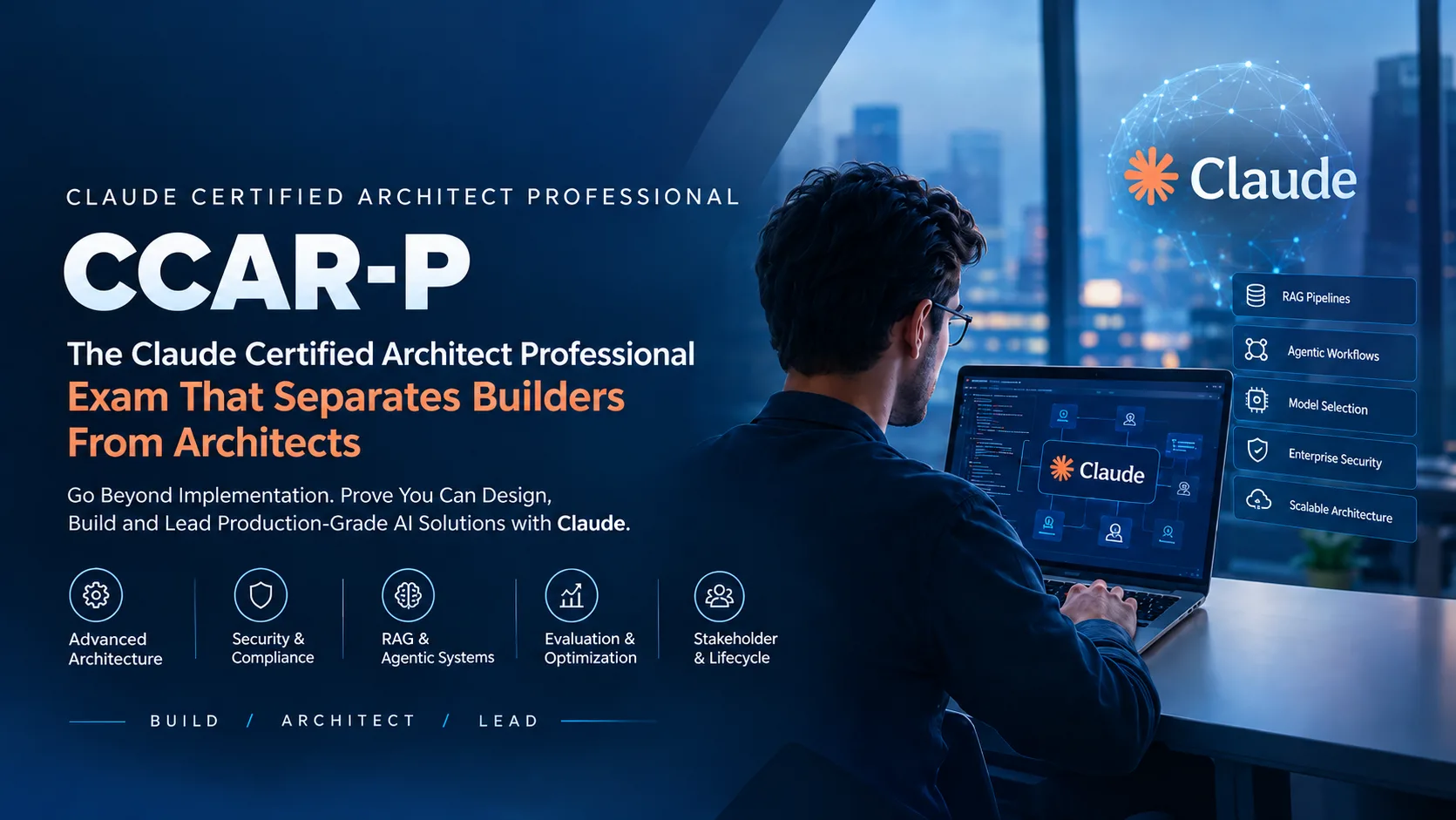
The Claude Certified Architect Professional is Anthropic's highest-level certification in the Claude program. It is not an entry-level credential and it is not designed for people who use Claude as a daily productivity tool. It is built for the people who design the systems that other people use. Solution architects. Technical leads. AI engineers who own production deployments end to end.
Before going further, one clarification that comes up constantly: what is Claude AI exactly, and why does it have a professional-level certification program? Claude is Anthropic's large language model, deployed across the enterprise as a platform for building AI-powered solutions. What is AI Claude at the professional level? It is the infrastructure behind agentic systems, RAG pipelines, multi-model orchestrations, and enterprise compliance frameworks. The CCAR-P certifies that you can design and deliver all of that in production, not just describe it.
Why CCAR-P Exists — And What Problem It Solves
Enterprise organizations deploying Claude at scale run into a consistent problem. They cannot easily distinguish between engineers who have read the documentation and engineers who have actually shipped production systems, debugged retrieval failures at 2am, designed least-privilege tool configurations for agentic workflows, and explained architectural trade-offs to a compliance team.
Resumes blur that distinction. The CCAR-P is designed to surface it.
The credential validates that the holder can design, build, and deliver production-grade AI solutions across the full solution lifecycle: from initial discovery through architecture, implementation, evaluation, governance, and ongoing operation. That is a broader scope than most technical certifications, and it is tested directly through scenario-based questions that present real architectural decisions with intentionally plausible wrong answers.
The Claude program currently has four credentials: the Associate Foundations for business professionals, the Developer Foundations for engineers building integrations, the Architect Foundations for those designing production Claude solutions at a foundational level, and the Architect Professional as the most senior credential. CCAR-P sits at the top of that structure. For detailed coverage of what Claude AI is and the full certification program entry point, the CCAO-F overview covers that ground in depth — this article is specifically about the Professional tier.
Who CCAR-P Is Actually For
Anthropic's recommended profile for CCAR-P candidates is specific: mid-to-senior solution architects, AI and ML engineers, technical leads, and senior software engineers with approximately three or more years in systems architecture and six or more months of hands-on Claude or LLM production experience. Experience delivering end-to-end systems from discovery through operation is the other key signal.
There are no mandatory prerequisites. No Foundations credential is required before attempting Professional. The credential is awarded on exam performance alone. That said, many candidates find CCAR-F a useful stepping stone before attempting Professional, particularly for the integration and architecture domains where Professional goes significantly deeper.
The exam is explicitly not for candidates who use Claude for their own work. That is Associate territory. It is not for engineers who build integrations at a foundational level. That is Developer. CCAR-P is for people who own architectural decisions across security, compliance, and executive stakeholder communication, not just technical implementation.
If you are designing RAG pipelines, making protocol selection decisions between MCP and API and agent-to-agent patterns, designing multi-agent orchestration systems, or managing enterprise compliance requirements for Claude deployments in regulated industries, CCAR-P is the credential that verifies those skills. If those scenarios are not your day-to-day, one of the other credentials in the program is a better fit.
The Seven CCAR-P Domains — What This Exam Actually Tests
The CCAR-P exam is built around seven domains from Anthropic's Exam Guide v1.0, effective July 2026. The weighting tells you where to concentrate your preparation, and the weighting here is not intuitive.
Domain 1: Integration — 19 percent
The largest domain by a meaningful margin. Integration covers evaluating tool and agent configurations for capability bloat, analyzing authentication and authorization designs for security gaps, accuracy and latency trade-offs, observability at scale, designing RAG pipelines including chunking, indexing, and retrieval strategies matched to data shape and query patterns, selecting integration protocols across MCP, API and CLI, and agent-to-agent approaches, and progressive discovery versus monolithic context strategies.
The most tested skills here are RAG design and least-privilege security. When a RAG system starts returning confident but incorrect answers after a document refresh, the exam expects you to investigate the retrieval and indexing step first, not the model. When an agent has tools it does not need, the exam expects you to remove those capabilities entirely rather than adding logging or confirmation steps as compensating controls.
Domain 2: Solution Design and Architecture — 17 percent
The second-largest domain. This covers translating business problems into Claude solutions, designing end-to-end architectures across input, processing, output, and feedback, selecting architectural patterns across workflow, agentic, augmented LLM, and multi-agent approaches, designing orchestration strategies, and aligning to business value pillars and performance SLAs.
The key skill this domain tests is diagnosing the dominant architectural problem before selecting a technology or pattern. Candidates who default to the most sophisticated architecture regardless of whether the scenario needs it get these questions wrong consistently. The exam rewards choosing the simplest pattern that meets every constraint, not the most technically impressive one.
Domain 3: Evaluation, Testing and Optimization — 16 percent
Defining evaluation metrics across accuracy, latency, cost, safety, and security. Designing evaluation datasets and test frameworks. A/B testing and iterative improvement processes. Diagnosing issues including prompt failures, hallucinations, and model mismatches. Optimizing across token usage, latency, and cost trade-offs. Monitoring with logging and observability frameworks.
The recurring exam scenario in this domain: a production system starts producing confident-but-wrong outputs. The question is what to investigate first. Prompt caching is the other heavily tested concept. When the same large stable system prompt and policy document are sent on every request, placing stable content first and enabling prompt caching cuts both time-to-first-token and per-request cost without losing context. Truncating content or blindly downsizing the model are the exam's distractors.
Domain 4: Governance, Safety and Risk Management — 14 percent
Implementing guardrails and safety controls. Identifying risks, limitations, and failure modes of LLM systems. Human-in-the-loop validation design. Compliance with GDPR, HIPAA, and FedRAMP. Ethical AI considerations including bias, fairness, and transparency.
This is the domain that engineering-focused candidates consistently underestimate. Governance and the next domain together account for 28 percent of the exam, which is more than either Solution Design or Evaluation individually. The compliance frameworks are specifically testable. Knowing the difference between a detective control and a preventive control is directly relevant to how the exam frames least-privilege questions.
Domain 5: Stakeholder Communication and Lifecycle Management — 14 percent
Conducting structured discovery and requirement gathering. Communicating architectural decisions and trade-offs to executive, legal, security, and operations audiences. Managing stakeholder feedback and SLA expectations. Documenting architectures with implementation guidance. Supporting lifecycle phases from discovery through design, handoff, monitoring, and iteration.
This domain is not filler. It is tested at the same weight as Governance and is genuinely scenario-based. Candidates who treat this as soft-skills background material and spend their preparation time exclusively on technical domains consistently report losing significant points here. Practice framing trade-off decisions for non-technical audiences. The exam expects you to know what to say to a compliance officer versus a product manager versus a security team, and those audiences have different concerns.
Domain 6: Claude Models, Prompting and Context Engineering — 13 percent
Selecting models based on capability and cost trade-offs. Designing system prompts, templates, and guardrails. Applying prompt techniques including zero-shot, few-shot, and chain-of-thought approaches. Optimizing context windows and token usage. Prompt reuse strategies including caching, modular prompts, and Skills.
The exam consistently tests model selection trade-offs at a decision-making level, not a feature-listing level. Knowing that Haiku fits high-volume simple tasks and Opus fits complex reasoning is the surface. Knowing which specific architectural context justifies that selection when cost, latency, and accuracy are all in tension is what the scenario questions actually test.
Domain 7: Developer Productivity and Operational Enablement — 7 percent
Configuring Claude tools and environments for teams, including Claude Code. Improving developer workflows using AI-assisted tooling. Supporting debugging and operational issue resolution.
The smallest domain. Give it proportionally less preparation time. Know how Claude Code fits into an operational enablement story and move on.
Exam Format, Cost, and Practical Details
The CCAR-P is 63 questions in 120 minutes through Pearson VUE, delivered either at a physical test centre or via online proctoring from home. The passing score is 720 on a scaled 100 to 1000 range. The exam is closed book, fully proctored, and prohibits notes, documentation, translation tools, and AI assistants during the session.
The exam fee is $175 USD per attempt, the highest in the Claude program. Retakes carry the full fee. Waiting periods after failed attempts: 14 days after a first failure, 30 days after a second, 90 days after a third. Maximum four attempts within a rolling 12-month period.
The credential is valid for 12 months. On-time renewal is free through a non-proctored assessment on the Anthropic Partner Academy. A lapsed credential requires the full exam and full fee to reinstate. Anthropic may require a full retake if exam content changes significantly, which at the pace Claude is evolving is a realistic consideration.
Registration requires an organizational email tied to a Claude Partner Network member organization. Personal email addresses are not accepted.
How to Prepare — What Actually Works
Six weeks is the realistic preparation timeline for candidates with the recommended background. The distribution of that time should reflect the domain weights, not be divided equally.
The first week is for reading the official exam guide thoroughly, rating yourself honestly across all seven domains, and beginning to build one real end-to-end Claude solution that you will continue improving through the preparation period. The official guide recommends this directly. A toy demonstration does not build the architectural judgment the exam tests. Something real, including RAG, evaluation, and observability, does.
Weeks two and three focus on Integration at 19 percent and Solution Design at 17 percent. Practice RAG pipeline design decisions. Work through authentication and authorization gap analysis for realistic agent configurations. Drill protocol selection decisions between MCP, direct API, and agent-to-agent approaches with specific justifications for each choice.
Week four covers Evaluation and Models and Prompting. Design evaluation frameworks. Practice root-cause diagnosis of production failures where the symptom pattern is the clue to which component failed. Drill prompt caching optimization scenarios and model selection trade-offs under realistic constraints.
Week five covers Governance and Stakeholder Communication and Developer Enablement. Study GDPR, HIPAA, and FedRAMP at the level of knowing what each requires architecturally, not just that they exist. Practice explaining architectural decisions and trade-offs to four different audience types: executive, legal, security, and operations.
Week six is entirely practice exams, a final domain self-assessment, and booking your exam date with buffer before any hard deadline.
For CCAR-P practice questions aligned to the current v1.0 exam blueprint, CertsInfinity offers verified practice materials for the Professional tier. Given how recently the program launched in July 2026, verifying that any resource you use reflects the current blueprint is essential before committing preparation time to it.
What CCAR-P Means for Your Career
The honest framing is the same one that applies to every Claude credential: this is a current-skills certification with a 12-month validity, not a career anchor. The platform is evolving fast enough that Anthropic built renewal requirements directly into the credential structure to keep holders current.
What the credential does well in 2026 specifically is differentiate. The pool of CCAR-P holders is still small. Organizations that have made significant Claude investments are actively seeking architects who can prove production-grade competency rather than just listing AI experience on a resume. At the Professional tier, that distinction has real market value.
The natural next conversation after CCAR-P is not another certification. It is the projects you can now lead, the roles you can now credibly pursue, and the enterprise deployments you can now own with a verified credential behind your experience.
For CertsInfinity's CCAR-P practice question catalog and current pricing: certsinfinity.com