You treated your cat for fleas. You cleaned the bedding. You vacuumed the house. Yet a few weeks later, you spot another flea.
Frustrating? Absolutely.
The problem may not be that your cat flea treatment failed. Fleas have a life cycle that makes them surprisingly difficult to eliminate. Adult fleas are only one part of the problem. Eggs, larvae, and pupae can remain hidden in carpets, furniture, bedding, and other areas around your home.
That is why effective flea control requires more than treating the cat once.
Let's look at why fleas keep returning, what makes a flea treatment work, and what you should consider when searching for the best flea treatment for cats.
Why Do Fleas Keep Coming Back?
The biggest mistake cat owners make is thinking every flea lives on the cat.
It doesn't.
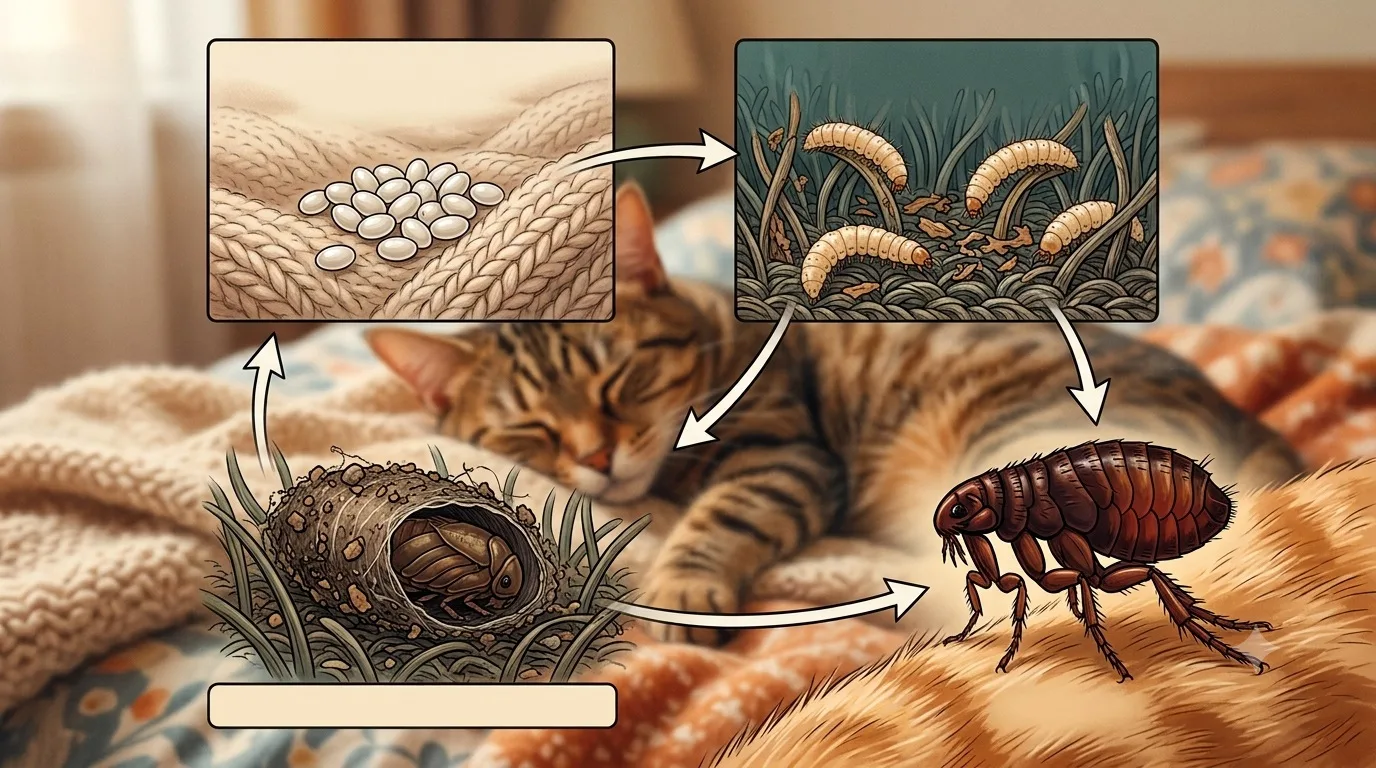
Adult fleas spend much of their time on an animal, but flea eggs can fall into the environment. Those eggs develop into larvae and then pupae. The pupal stage can remain protected inside a cocoon until conditions are right for an adult flea to emerge.
So even after you treat your cat, new adult fleas can emerge from the environment.
Imagine this:
You apply a flea treatment on Monday. The adult fleas currently feeding on your cat are killed. You check your cat on Tuesday and everything looks fine.
Then, several days later, a new flea emerges from a carpet or bedding and jumps onto your cat.
It can look like the treatment stopped working. In reality, you may be seeing a newly emerged flea from an existing environmental infestation.
This is one of the main reasons flea control can take time.
Understanding the Flea Life Cycle
To control fleas properly, it helps to understand what you're fighting.
1. Flea Eggs
Adult female fleas begin producing eggs after feeding.
These tiny eggs can fall from your cat into places where your pet spends time, such as:
- Carpets
- Cat beds
- Sofas
- Blankets
- Cracks and crevices
- Areas beneath furniture
You may never see the eggs because they are extremely small.
2. Flea Larvae
The eggs develop into larvae.
Larvae tend to hide in protected areas away from direct sunlight. They feed on organic material and flea debris found in the environment.
This is why simply treating the cat may not solve the entire problem.
3. Flea Pupae
The larval stage eventually develops into a pupa inside a protective cocoon.
This stage is particularly frustrating for pet owners because pupae can remain hidden in the environment and emerge later when they detect signals associated with a potential host.
Movement, warmth, and carbon dioxide can help trigger emergence.
4. Adult Fleas
Once an adult flea emerges, it looks for a host.
Your cat may then pick up the flea while moving around the home.
And the cycle starts again.
Why One Cat Flea Treatment May Not Be Enough
A common reaction is:
"I treated my cat, so why am I still seeing fleas?"
The answer is often the environment.
Established flea infestations can take weeks or even months to fully control because different flea stages are present at different times.
That doesn't necessarily mean your product isn't working.
A flea that emerges after treatment can still jump onto your cat. An effective flea product may then kill that adult flea, but the appearance of that flea can make the infestation seem worse than it actually is.
This is why consistency matters.
Stopping treatment as soon as you stop seeing fleas can give the remaining flea population another opportunity to rebuild.
What Makes the Best Flea Treatment for Cats?
There isn't one flea product that is automatically the best flea treatment for cats in every situation.
The right choice depends on factors such as:
- Your cat's age
- Weight
- Indoor or outdoor lifestyle
- Existing flea infestation
- Other pets in the household
- Your cat's health
- How often the product needs to be applied
- Whether it targets adult fleas only or also affects immature flea stages
Always choose a product specifically labeled for cats and follow the directions carefully.
Never assume a flea treatment designed for dogs is safe for cats. Cats can be especially sensitive to certain insecticides, and some dog flea products contain ingredients that can be dangerous to cats.
If you're unsure which option fits your cat, speak with your veterinarian.
What About Cheristin for Cats?
If you've been researching flea products online, you've probably encountered Cheristin for cats.
Cheristin is a topical flea treatment containing spinetoram. It is specifically formulated for cats and kittens that meet the product's minimum age and weight requirements.
The product is designed to kill adult fleas and is applied topically.
One reason it gets attention is its speed of action. According to the product information, Cheristin begins killing fleas within about 30 minutes and provides flea control for up to six weeks from a single application, although monthly application is recommended for ongoing prevention.
It is important to distinguish product duration claims from a complete flea-control strategy.
Even when a product kills adult fleas on your cat, fleas developing elsewhere in your home can continue emerging.
That is why seeing an occasional flea after treatment does not automatically mean the product has failed.
What Do Cheristin for Cats Reviews Tell You?
When reading Cheristin for cats reviews, look beyond individual experiences.
One cat owner might report that they saw no fleas after treatment. Another might say they still noticed fleas several days later.
Both experiences can happen without proving that the product is ineffective.
Why?
Because the environment matters.
If a home has an established flea population, newly emerging adult fleas can continue appearing for some time. A treated cat can encounter these fleas as they emerge.
When evaluating reviews, look for useful details such as:
- Was the product used according to the label?
- Were all cats and dogs in the household treated appropriately?
- Was the home cleaned regularly?
- Was the treatment continued consistently?
- How severe was the original infestation?
- How long did the owner use the product?
A single review cannot tell you whether a flea treatment is right for every cat.
Look for patterns instead.
Treat the Cat and the Environment
This is where many flea-control plans fall short.
Treating the cat is important, but environmental control matters too.
Start with the places your cat uses most.
Vacuum Regularly
Vacuum carpets, rugs, furniture, and areas under furniture.
Pay particular attention to places where your cat sleeps or spends a lot of time.
Regular vacuuming helps remove flea eggs, larvae, and other debris from the environment.
Wash Bedding
Wash pet bedding regularly according to the item's care instructions.
Don't forget blankets, washable covers, and other fabrics your cat frequently uses.
Don't Ignore Other Pets
If you have multiple pets, one untreated animal can help keep the flea cycle going.
Dogs, cats, and other household animals can all play a role in maintaining an infestation.
Talk with your veterinarian about appropriate flea prevention for each species.
Keep Going
This part requires patience.
You may continue to see some fleas after beginning treatment because immature stages already present in the environment can develop and emerge.
The goal is not simply to kill the flea you see today.
The goal is to break the flea life cycle and prevent the population from rebuilding.
Signs Your Cat May Have Fleas
Some cats show obvious signs. Others don't.
Watch for:
- Frequent scratching
- Excessive grooming
- Biting at the skin or fur
- Restlessness
- Hair loss from excessive grooming
- Small dark particles in the coat
- Red or irritated skin
- Visible fleas
That dark material is sometimes called flea dirt.
You can use a flea comb to inspect your cat's coat. If you find suspicious dark particles, placing them on a damp white paper towel can help determine whether they are flea feces.
If your cat has severe itching, skin irritation, hair loss, or other unusual symptoms, don't assume fleas are the only cause. Allergies, skin infections, parasites, and other conditions can produce similar signs.
Flea Allergy Can Make a Small Problem Look Big
Some cats are particularly sensitive to flea saliva.
A single flea bite can trigger significant itching in a sensitive cat.
This condition is commonly called flea allergy dermatitis.
A cat with flea allergy may scratch or groom excessively, leading to irritated skin and hair loss.
That's why seeing only a few fleas doesn't always mean the infestation is minor.
If your cat develops intense itching or skin problems, veterinary advice is important.
Mistakes That Can Keep Fleas Coming Back
Sometimes the problem isn't the product. It's the flea-control routine.
Stopping Too Early
You stop treatment because you haven't seen fleas for a week.
Then the remaining environmental stages emerge.
Consistency is important.
Treating Only the Cat
If fleas are established in the home, treating the animal alone may not be enough.
The environment needs attention too.
Missing Another Pet
One untreated pet can provide another host for fleas.
Make sure every animal receives an appropriate flea-control plan.
Using the Wrong Product
Never use a flea product simply because it is available.
Check the species, age, weight, application instructions, and warnings.
Applying More Than Recommended
More product does not mean better protection.
Follow the product label exactly. If you're concerned that a treatment isn't working, don't increase the dose or application frequency on your own.
Ask your veterinarian for guidance.
A Simple Flea-Control Routine
If you're dealing with recurring fleas, use this basic framework.
Step 1: Check your cat.
Use a flea comb and look for adult fleas or flea dirt.
Step 2: Choose an appropriate cat flea treatment.
Select a product labeled for your cat's species, age, and weight.
Step 3: Treat consistently.
Follow the product's application schedule instead of stopping when visible fleas disappear.
Step 4: Clean the environment.
Vacuum frequently and wash bedding and other washable fabrics your cat uses.
Step 5: Check other pets.
Ask your veterinarian about appropriate flea control for every pet in the household.
Step 6: Watch the trend.
Don't judge the entire treatment plan by whether you see one flea tomorrow. Look for a steady reduction in flea activity over time.
When Should You Call Your Veterinarian?
Some flea problems need professional help.
Contact your veterinarian if:
- Your cat is very young or elderly
- Your cat is pregnant or nursing
- Your cat has another health condition
- Your cat takes other medications
- Your cat develops severe skin irritation
- Your cat becomes unusually weak or lethargic
- Fleas continue despite correct treatment
- You aren't sure which product is appropriate
Your veterinarian can help determine whether fleas are the real cause of the problem and recommend a control plan suited to your cat.
Stop Treating Fleas One at a Time
Recurring fleas are frustrating because the flea you see today may not be the flea that started the problem.
The better approach is to break the entire cycle.
Choose an appropriate cat flea treatment, use it consistently, clean the areas where your cat spends time, and make sure other pets receive suitable flea prevention. If you're comparing the best flea treatment for cats or researching Cheristin for cats reviews, look at the product's labeled use and the overall flea-control strategy, not just one claim or one customer experience.
If fleas keep returning despite following the product directions and maintaining your home, that's the time to involve your veterinarian.
Don't wait for another infestation to build. Choose an appropriate flea-control plan and stay consistent with it.
Frequently Asked Questions About Cat Flea Treatment
How long does it take to get rid of fleas completely?
It depends on how established the infestation is and how consistently both the pet and environment are managed. Adult fleas can be killed relatively quickly, but immature stages already present in the home may continue developing and emerging.
Why do I still see fleas after treating my cat?
New adult fleas may be emerging from eggs, larvae, or pupae already present in the environment. Seeing a flea after treatment does not automatically mean the treatment failed.
What is the best flea treatment for cats?
There is no single best product for every cat. The right choice depends on your cat's age, weight, health, lifestyle, household situation, and the severity of the flea problem. Choose a product specifically labeled for cats and follow its directions.
Are Cheristin for cats reviews reliable?
Reviews can provide useful information about people's experiences, but individual results vary. Look for repeated patterns and consider whether reviewers treated all pets and addressed the household environment.
Should I treat my home for fleas too?
Yes, environmental control is an important part of managing an established flea infestation. Regular vacuuming, washing pet bedding, and following appropriate environmental-control recommendations can help reduce immature flea stages.