For garages and automotive technicians, choosing between an automotive diagnostic scanner and a basic OBD tool can significantly affect the speed and accuracy of vehicle diagnosis. While both devices are designed to identify problems, their capabilities, coverage, and intended uses can be quite different.
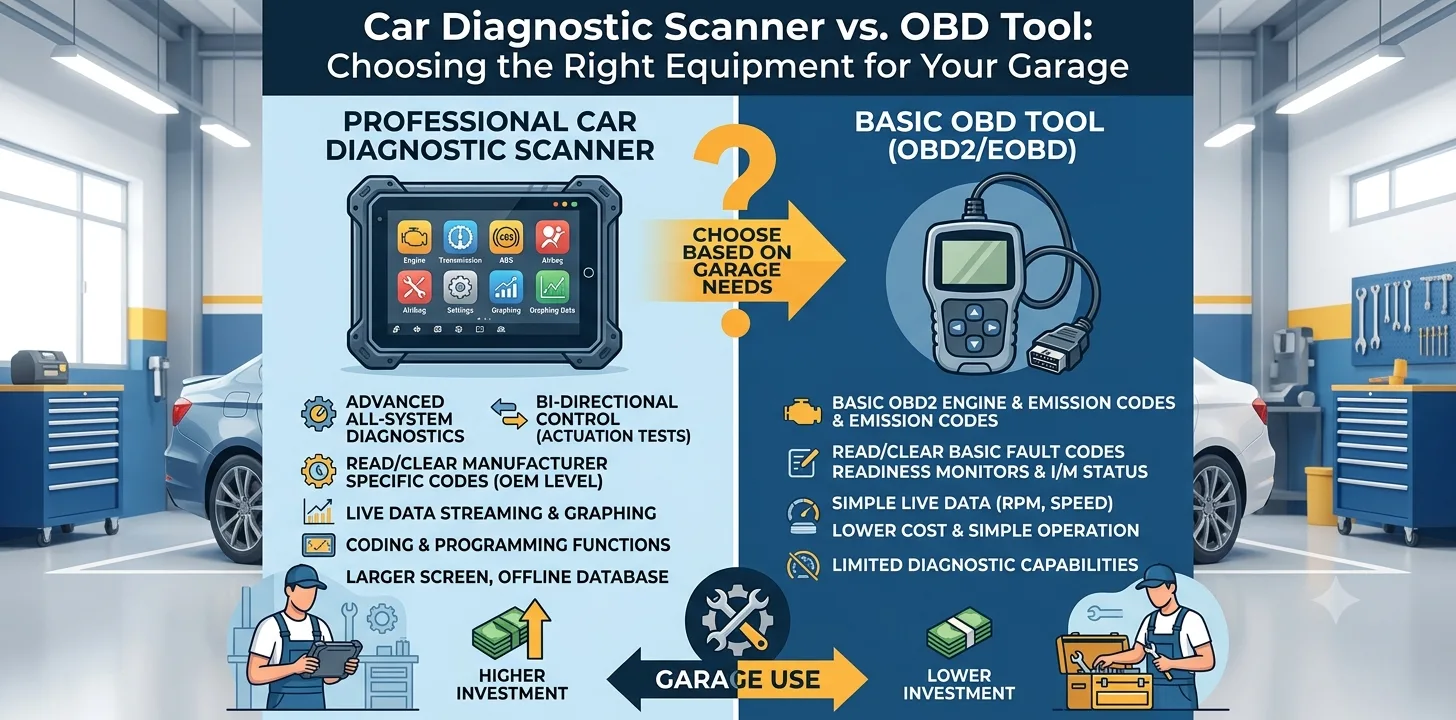
A basic OBD tool is generally designed to communicate with a vehicle's onboard diagnostic system. It can read and clear diagnostic trouble codes and may provide basic information related to engine and emissions systems. This makes an OBD scanner useful for simple checks and routine troubleshooting. However, its functionality can be limited when technicians need to investigate more complex vehicle systems.
An advanced automotive diagnostic scanner provides much broader diagnostic capabilities. Depending on the device, it can access multiple vehicle control modules, display live data, perform system tests, and support advanced diagnostic functions. This makes it particularly useful for professional workshops that regularly work on different vehicle makes and models.
When selecting car repair tools, garages should consider the type of vehicles they service and the level of diagnosis required. A basic OBD tool may be sufficient for a workshop that mainly handles straightforward engine-related issues. However, garages dealing with modern vehicles may benefit from more advanced equipment capable of accessing systems such as ABS, airbags, transmission, body control modules, and other electronic components.
The difference becomes even more important when comparing garage diagnostic equipment for professional use. Advanced scanners can provide technicians with more detailed information, helping them understand the underlying cause of a fault rather than simply identifying an error code. This can reduce unnecessary part replacements and help improve repair efficiency.
An effective OBD scanner comparison should therefore look beyond price. Important factors include vehicle coverage, diagnostic functions, software updates, data display capabilities, connectivity, ease of use, and support for advanced service functions. A cheaper device may work well for basic code reading, while a professional-grade scanner can provide significantly more functionality for complex repair work.
For garages searching for reliable OBD tools for garages, it is also important to consider future requirements. Vehicle technology continues to evolve, and newer models increasingly depend on sophisticated electronic systems. Investing in equipment with broad vehicle coverage and regular software updates can help workshops remain prepared for changing diagnostic requirements.
Accurate vehicle fault diagnosis is essential for reducing repair time and improving customer satisfaction. The right diagnostic equipment gives technicians better access to vehicle data and allows them to approach repairs with greater confidence.
Ultimately, the choice between an OBD tool and a professional diagnostic scanner depends on the garage's workload, vehicle coverage, and diagnostic needs. For basic troubleshooting, an OBD tool can be practical and affordable. For professional workshops handling complex vehicle problems, an advanced diagnostic scanner can offer the additional functions and system access needed for efficient diagnosis and repair.