
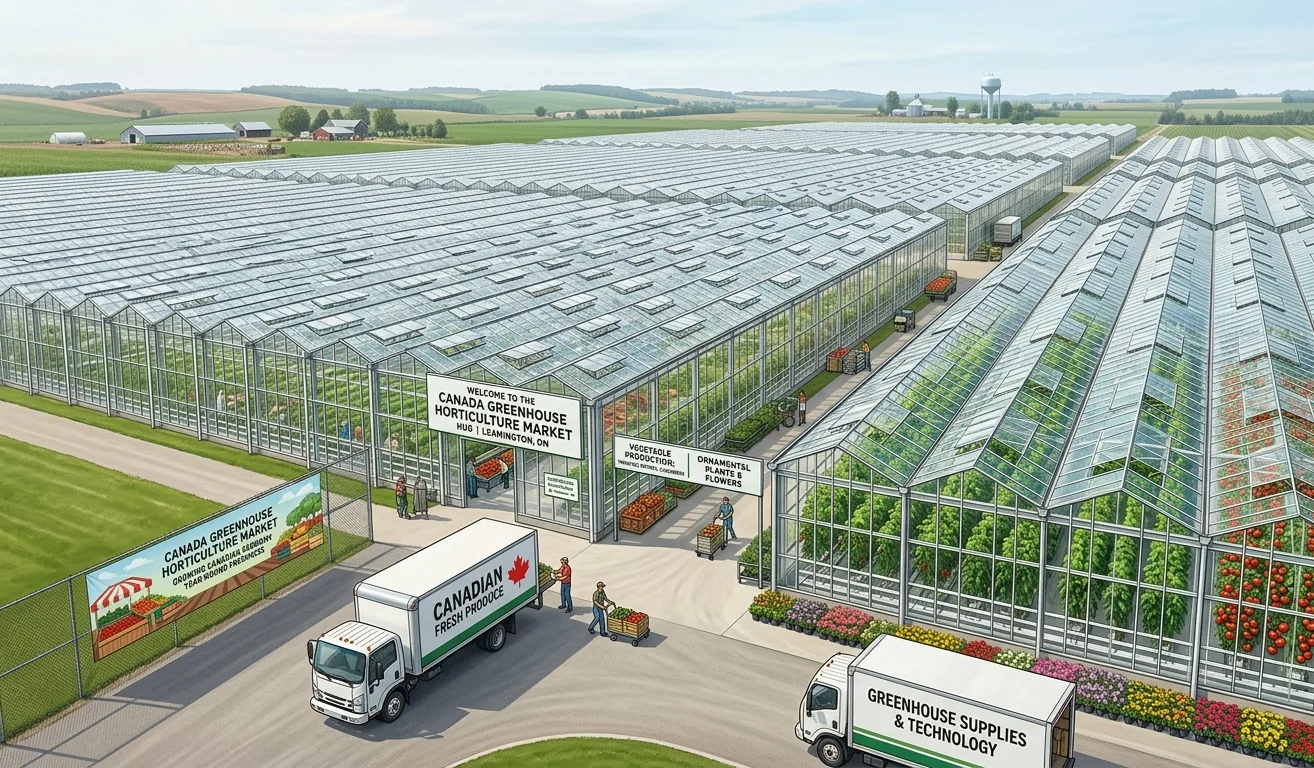
The Canada greenhouse horticulture market is witnessing robust growth, driven by increasing demand for locally grown fresh produce, advancements in controlled-environment agriculture, and strong government support. According to IMARC Group, the market reached USD 668.60 Million in 2024 and is projected to reach USD 1,501.97 Million by 2033, growing at a CAGR of 8.43% during 2025-2033.
This growth reflects Canada’s increasing focus on food security, sustainable farming practices, and year-round crop production despite harsh climatic conditions.
Canada Greenhouse Horticulture Market Overview (Canada Focus)
Greenhouse horticulture plays a critical role in Canada’s agricultural ecosystem, enabling the cultivation of fruits, vegetables, and ornamental plants in controlled environments. With unpredictable weather patterns and limited arable land, greenhouse farming offers a reliable solution for consistent, high-quality crop production.
Key market drivers include:
- Rising demand for locally grown, fresh, and pesticide-free produce
- Increasing adoption of controlled-environment agriculture (CEA)
- Government initiatives supporting greenhouse infrastructure
- Growing investments in automation, hydroponics, and AI-based monitoring systems
Expansion of export-oriented production
Study Assumption Years
- Historical Period: 2019–2024
- Base Year: 2024
- Forecast Period: 2025–2033
Key Market Takeaways
- Market size (2024): USD 668.60 Million
- Market forecast (2033): USD 1,501.97 Million
- CAGR (2025–2033): 8.43%
- Fruits and vegetables dominate crop production
- Ontario and Quebec lead regional growth
Technology adoption is a key competitive differentiator
Analyze the Canada Greenhouse Horticulture Market Download the IMARC Sample Report for Insights: https://www.imarcgroup.com/canada-greenhouse-horticulture-market/requestsample
Growth Drivers
1. Rising Demand for Year-Round Fresh Produce
Consumers are increasingly seeking fresh fruits and vegetables throughout the year, driving the adoption of greenhouse farming to overcome seasonal limitations.
2. Advancements in Greenhouse Technologies
Modern greenhouses are equipped with climate control systems, LED lighting, automated irrigation, and AI-driven monitoring tools that significantly improve productivity and crop quality.
3. Strong Government Support and Investments
Federal and provincial governments are actively supporting greenhouse expansion through funding programs, subsidies, and infrastructure investments.
4. Focus on Food Security and Local Production
Canada is prioritizing domestic food production to reduce reliance on imports and enhance supply chain resilience.
5. Sustainability and Resource Efficiency
Greenhouse farming reduces water usage, minimizes pesticide reliance, and supports renewable energy integration, aligning with environmental goals.
Canada Greenhouse Horticulture Market Segmentation
By Material Type
- Glass
- Plastic
By Crop Type
- Fruits and vegetables (dominant segment)
- Flowers and ornamentals
- Nursery crops
- Others
By Technology
- Heating systems
- Cooling systems
- Others
Regional Insights
- Ontario (Leading Region)
Ontario is the largest greenhouse hub in Canada, driven by advanced infrastructure, favorable policies, and strong export activity.
- Quebec
Rapid expansion supported by government investments and increased greenhouse production capacity.
- British Columbia
Strong presence of high-tech greenhouse operations and export-oriented production.
- Alberta
Growing adoption of sustainable greenhouse farming practices and local food production initiatives.
Key Trends in the Market
- Adoption of Smart Greenhouse Technologies
Automation, AI-based monitoring, and data analytics are transforming greenhouse operations, improving efficiency and reducing labor dependency.
- Shift Toward Sustainable Farming
Growers are increasingly adopting renewable energy, water recycling systems, and eco-friendly growing media.
- Expansion of Export-Oriented Production
Canadian greenhouse producers are scaling operations to meet international demand, particularly from the United States.
- Growth of Hydroponics and Vertical Farming
Soilless farming techniques are gaining traction, enabling higher yields and efficient space utilization.
Competitive Landscape
The Canada greenhouse horticulture market is moderately fragmented, with a mix of large-scale commercial growers and small-to-medium enterprises.
Key competitive strategies include:
- Investment in automation and smart agriculture technologies
- Expansion of greenhouse acreage and production capacity
- Focus on sustainable and certified production practices
- Strategic partnerships with retailers and export markets
Recent Developments
- 2025: Launch of advanced automated greenhouse facilities focused on high-efficiency lettuce production
- 2024: Government investments in sustainable agricultural infrastructure and research programs
- 2024: Expansion of large-scale greenhouse complexes to boost export capabilities
- 2023–2025: Increased adoption of hydroponic and climate-controlled systems
Canada Greenhouse Horticulture Market Outlook
The future of the Canada greenhouse horticulture market will be shaped by:
- Continued adoption of smart and automated greenhouse systems
- Rising demand for sustainable and locally grown produce
- Expansion of export markets and trade opportunities
- Integration of renewable energy in greenhouse operations
- Growth of vertical farming and urban agriculture
Frequently Asked Questions (FAQs)
1. What is the size of the Canada greenhouse horticulture market?
The market reached USD 668.60 Million in 2024 and is expected to reach USD 1,501.97 Million by 2033.
2. What is the growth rate of the market?
The market is projected to grow at a CAGR of 8.43% during 2025–2033.
3. What is greenhouse horticulture?
It is the cultivation of crops in controlled environments using structures like greenhouses to regulate temperature, humidity, and light.
4. Which segment dominates the market?
The fruits and vegetables segment dominates due to high consumer demand.
5. What are the key growth drivers?
Key drivers include demand for fresh produce, technological advancements, and government support.
6. Which region leads the market in Canada?
Ontario is the leading region due to its strong greenhouse infrastructure.
7. What are the key trends in the market?
Major trends include automation, sustainable farming, hydroponics, and export expansion.
Author IMARC Group
IMARC Group is a global management consulting firm that helps the world's most ambitious changemakers to create a lasting impact. The company provide a comprehensive suite of market entry and expansion services. IMARC offerings include thorough market assessment, feasibility studies, company incorporation assistance, factory setup support, regulatory approvals and licensing navigation, branding, marketing and sales strategies, competitive landscape and benchmarking analyses, pricing and cost research, and procurement research.
Contact Us
IMARC Group,
134 N 4th St. Brooklyn, NY 11249, USA,
Email: [email protected],
United States: +1-201971-6302