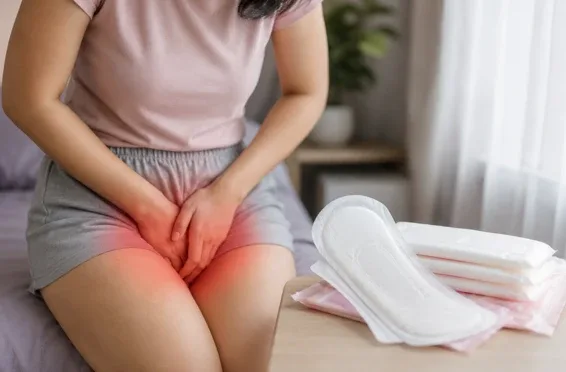
Pad rash, also known as contact dermatitis of the vulva, develops when moisture, friction, or chemical irritants build up against the skin during pad use. Rash-free pads avoid synthetic fragrance, dyes, and certain adhesives, and pair a breathable top sheet with a fast-absorbing core. Choosing the best pads for sensitive skin and changing them every three to four hours addresses most cases.
Quick Reads:
- Rashes from pads usually appear as redness, itching, small bumps, or a stinging sensation along the inner thigh, groin, or vulva
- Fragrance is the single biggest trigger, not the menstrual blood itself; synthetic scent compounds sit directly against sensitive skin with no hygienic benefit
- Plastic-backed pads trap heat and moisture against the skin, and that warm, damp environment is what allows irritation and bacteria to build up over a full day of wear
- Friction from a poorly fitted or shifting pad is a separate rash trigger in its own right, distinct from both fragrance and moisture
- Changing a pad every 4 to 6 hours reduces rash risk regardless of which brand or product is used, since the duration of contact matters as much as material
- Panty-style pads can help by improving fit and airflow compared with winged designs, reducing the sliding and rubbing that causes friction-based irritation
A rash appearing during a period is often blamed on the period itself, when the actual cause is usually the product being worn against the skin for hours at a time. This distinction matters because it changes what actually fixes the problem. No amount of extra washing solves a rash caused by fragrance or trapped moisture, but switching to rash free sanitary pads often does. Understanding what triggers this reaction and what to look for on a pad's packaging before buying is more useful than relying on trial and error across different brands.
What Causes a Sanitary Pad to Trigger a Rash?
Pad rash, also called contact dermatitis of the vulva, happens when the skin reacts to friction, trapped moisture, or a chemical in the pad rather than to blood itself. The vulvar area is more permeable than skin elsewhere on the body, which is part of why it reacts faster to irritants that skin on the arm or leg would tolerate.
A sanitary pad works by trapping fluid against the body, which also traps heat and moisture in an occlusive environment, similar in principle to the mechanism behind nappy rash in infants. That warm, low-oxygen microclimate softens the outer skin barrier over several hours, which is why a rash often appears only on the second or third day of a period.
Friction adds a second mechanism on top of moisture. Every step or shift in a chair moves the pad slightly against the skin, and that repeated shear stress can chafe skin that is already softened by trapped moisture, even with an unscented product.
What Should Rash Free Sanitary Pads Actually Avoid?
Sanitary pads are defined less by what's in them than by what's deliberately left out: synthetic fragrance, dye, and, where possible, rosin-based wing adhesives. Fragrance in particular is the easiest irritant to avoid, since it serves no real function and sits among the most common triggers behind vulvar contact dermatitis.
A rash-free sanitary pad, more precisely, is one formulated without added fragrance, dye, or known contact allergens in its adhesive, built around a breathable top sheet that keeps moisture from building up against the skin.
Material choice affects comfort as much as chemistry does. A cotton or cotton-like top sheet feels different from a standard non-woven plastic-feel top sheet, and it also changes how quickly moisture is pulled away from the skin rather than left sitting on the surface.
Checking a pad against this before buying takes only a few minutes and avoids weeks of trial and error later. The same steps double as a quick test for whether a product genuinely counts among the best pads for sensitive skin or is only marketed that way:
- Check the packaging for "unscented" or "fragrance-free," not just "gentle" or "soft," since the latter terms aren't regulated claims.
- Look for a cotton or cotton-blend top sheet rather than a plain plastic-feel surface.
- If wing adhesive has caused irritation before, look for pads marketed as rosin-free or hypoallergenic adhesive.
- Patch-test a new brand for one cycle before switching entirely, watching for symptoms starting within the first two to three days.
What Makes a Pad One of the Best Pads for Sensitive Skin?
The best pads for sensitive skin get several things right at once, not just one. A pad that nails a fragrance-free formulation but pairs it with a slow-absorbing core can end up causing just as much irritation on heavier days. So here's what's actually worth checking before you buy, ranked by how much difference each one tends to make:
- Fragrance-free, always: Added scent is one of the most common triggers of vulvar irritation and provides no functional benefit.
- A breathable, cotton-like top sheet: It pulls moisture away from the skin quickly instead of leaving it sitting on the surface, unlike a plain plastic-feel top sheet.
- A fast-absorbing core: Fluid needs to move away from the skin within seconds, not minutes, especially on heavier flow days.
- No dye or fluorescent brightening agents: These are added purely for appearance and can cause irritation in some users, alongside synthetic fragrance.
- A named material list on the packaging: A brand willing to say exactly what the top sheet and core are made of is a better sign than vague words like "soft" or "gentle."
- The right absorbency for the day, not just the cycle: A heavy-flow pad worn on a light day doesn't sit any softer against the skin, since a stiffer, bulkier core can rub just as much as the wrong material would.
How Do Panty-Style Pads Reduce Rash Risk?
Period panty, such as those of Sofy, wrap fully around the body, which removes one of the two main friction sources described earlier. Because the pad moves with the body as a single piece instead of shifting inside underwear, there's less repeated rubbing on the same patch of skin over several hours.
The trade-off is coverage versus familiarity. A panty-style pad offers wider back and side coverage suited to overnight use or heavy flow. However, it replaces regular underwear entirely for the duration of wear, which some menstruators find less convenient for daytime changes than a standard winged pad.
For anyone getting a rash specifically on the inner thigh, switching from a winged pad to a panty-style design for the heaviest day or two of the cycle is often the fix that actually works, simply because it deals with friction rather than chemistry.
If you get a rash specifically on the inner thigh, switching from a winged pad to a panty-style design for the heaviest day or two of your cycle often works, because it addresses friction rather than chemistry.
How Can Pad Rash Be Told Apart from an Infection?
Pad rash is confined to the area the pad actually touches and tends to appear or worsen within hours of starting a new pad. At the same time, an infection usually comes with symptoms unrelated to pad placement, such as unusual discharge or odour. Getting this distinction right matters, since treating an infection like a rash, or the reverse, delays proper care.
The checklist below is a starting point for distinguishing between the two, not a replacement for a doctor's diagnosis. It's worth running through even for someone already using rash free sanitary pads, since a new allergen or a change in flow can trigger symptoms that look identical to an old rash.
- Symptoms began or worsened within hours of trying a new pad brand
- Redness or itching appears in the exact area the pad covers, not more widely
- There is no thick, unusual, or strong-smelling discharge alongside the irritation
- Symptoms improve within two to three days of switching pads or going without one
- There are no blisters, ulcers, or sores present, which would need medical attention regardless of cause
Conclusion
Most pad. rash traces back to one of three fixable causes: trapped moisture, friction, or a specific chemical in the pad's fragrance or adhesive, which means most cases resolve within days once the actual trigger is identified Pad design keeps splitting into more specialised formats, rash free sanitary pads with cotton top sheets, panty-style coverage for heavy flow, and adhesive-free wing options.
Therefore, it is essential to be able to match a pad's actual construction to what's irritating in the first place. If a rash doesn't improve within a few days of removing the likely irritant, that's the clearest signal it's time to see a doctor rather than try another pad.