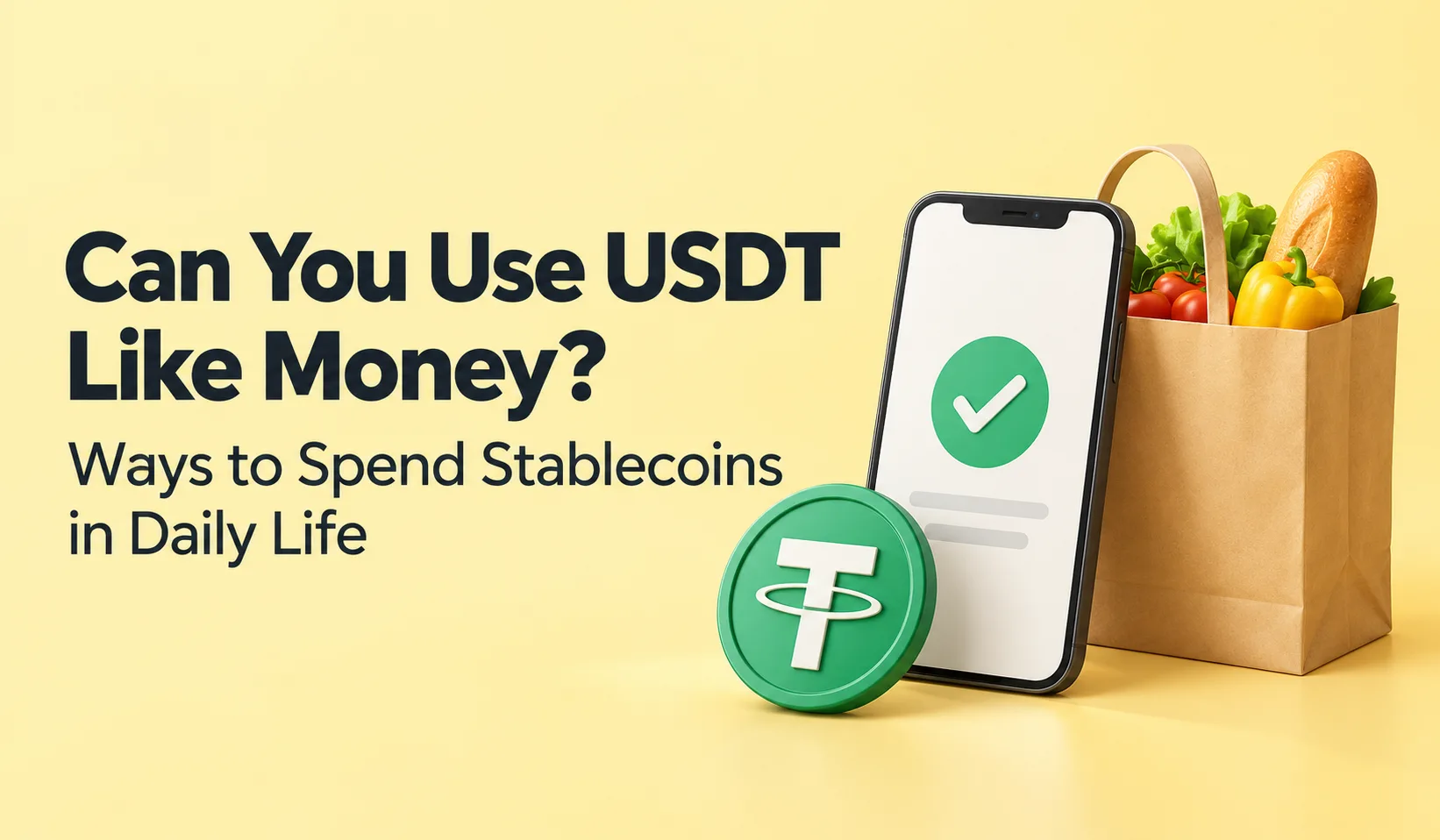
Imagine receiving your salary, freelance payment or business income in USDT. You have digital funds worth approximately the same amount in US dollars, but can you actually use them to buy groceries, pay bills or shop online?
The short answer is yes, in some situations. USDT can be used for payments when a merchant accepts it, or through supported services that convert cryptocurrency into a form accepted by the merchant.
Unlike traditional money in a bank account, USDT does not work everywhere. You need a compatible wallet, payment service or card to use it for everyday expenses.
For example, an eligible virtual crypto card may allow you to convert supported stablecoins into a separate spending balance for purchases at merchants that accept its card network.
So, how practical is USDT for daily spending?
This guide explains how USDT works as a payment method, where you can spend it and what to consider before using stablecoins for everyday purchases.
What Is USDT, and Can It Be Used Like Regular Money?
USDT, also known as Tether, is a stablecoin designed to maintain a value close to one US dollar.
Unlike Bitcoin or Ethereum, whose prices can change significantly, USDT aims to provide a more predictable value for transfers and payments.
For example, if you receive 100 USDT, its intended market value is approximately $100, although the actual amount you can exchange or spend may differ.
USDT can be transferred between compatible blockchain wallets and used for purchases when merchants support it.
However, USDT is not the same as money held in an insured bank account. Its value is not guaranteed, and it is not universally accepted as a payment method.
Availability and legal treatment also vary by country.
How Can You Spend USDT in Everyday Life?
There are several ways to use USDT for daily expenses. The most suitable method depends on the merchant, your location and the payment services available.
1. Pay Merchants That Accept USDT
Some online businesses accept USDT directly through cryptocurrency checkout services.
For example, a website may offer a crypto payment option alongside traditional card payments.
You select USDT, confirm the supported blockchain network and send the required amount from your wallet.
Before paying, check the recipient address, network, amount and payment deadline.
Direct blockchain transfers are generally difficult to reverse once confirmed.
2. Use a Crypto Card for Shopping
A crypto card can provide another way to use USDT when merchants do not accept cryptocurrency directly.
Depending on the provider, you may need to convert USDT into a separate card spending balance before making purchases.
The card can then be used at eligible merchants that accept its payment network.
For example, someone holding 200 USDT might convert part of that amount into a spending balance for online shopping or everyday purchases.
The merchant receives a card payment rather than USDT directly.
3. Pay for Software and Online Services
Some digital service providers accept cryptocurrency payments for products such as website hosting, software and online subscriptions.
USDT may be useful for freelancers and businesses that already receive stablecoin payments.
If a service only accepts cards, an eligible crypto-funded card may provide another option.
However, recurring payments are not supported by every card or merchant, so check the terms before using one for subscriptions.
4. Use USDT for Travel Expenses
Some travel booking services accept cryptocurrency for eligible flights, accommodation and other reservations.
A supported crypto card may also work for certain travel-related purchases.
For example, a traveller might use a crypto-funded card to pay for an eligible hotel booking.
However, card acceptance, deposits, foreign transaction fees and regional restrictions can affect the payment.
Always check the booking provider's payment terms before confirming.
5. Send Payments to Freelancers or Businesses
USDT can be used for payments between individuals and businesses when both parties agree to accept it.
For example, a company may pay an overseas freelancer 500 USDT for a completed project.
The recipient can receive the payment through a compatible wallet and decide whether to hold, transfer or convert the funds.
Both parties should agree on the payment amount, blockchain network and responsibility for transaction fees.
What Do You Need to Start Spending USDT?
Before using USDT for everyday payments, you need access to a compatible wallet or payment service.
A decentralized wallet for crypto can help you manage supported digital assets, receive USDT and send payments to compatible addresses.
You should also confirm which blockchain network your USDT uses.
For example, USDT is available on multiple networks, and sending funds through an unsupported network can result in lost or inaccessible assets.
Finally, make sure you have enough funds to cover both the payment amount and any applicable network fees.
If you plan to use a crypto card, check its supported assets, country availability, funding process and transaction limits.
Can You Pay Everyday Bills With USDT?
It depends on the bill provider and payment services available in your country.
Some businesses may accept cryptocurrency directly, while others only support bank transfers, debit cards or traditional payment methods.
For example, you may be able to pay an online service provider using USDT if it offers a supported crypto checkout option.
For bills that do not accept cryptocurrency, you may need to convert USDT into local currency or use an eligible payment service.
Avoid assuming that rent, utilities or government payments can be made directly with stablecoins.
Before paying, confirm the provider's accepted methods and any applicable fees.
Is USDT Better Than Bitcoin for Daily Spending?
USDT and Bitcoin serve different purposes.
Bitcoin has a market price that can change significantly over short periods. USDT is designed to maintain a value close to the US dollar.
This can make USDT more convenient when you want to calculate a payment amount in dollars.
However, USDT carries risks related to its issuer, reserves and ability to maintain its intended value.
Bitcoin has different risks, including market volatility and network fees.
The better payment option depends on merchant acceptance, network compatibility and total costs.
What About USDC and Other Stablecoins?
USDT is not the only stablecoin that can be used for payments.
USDC is another widely used digital asset designed to maintain a value close to one US dollar.
Some wallets, exchanges and payment services support both USDT and USDC, while others accept only one.
The right choice depends on which stablecoin your payment service supports, the available blockchain networks and the fees involved.
Neither USDT nor USDC is guaranteed to maintain its intended value.
What Fees Apply When Spending USDT?
Spending USDT may involve different costs depending on the payment method.
Network fees: Charges associated with transferring USDT on a blockchain.
Conversion fees: Costs of exchanging USDT for another cryptocurrency or traditional currency.
Card fees: Charges that may apply when converting USDT into a card spending balance or making certain purchases.
Withdrawal fees: Costs associated with transferring funds from exchanges or payment platforms.
Not every transaction includes all these fees.
For example, sending USDT directly to a merchant may involve a network fee, while using a crypto card may involve conversion and card-related charges.
Compare the total cost before choosing a payment method.
Is It Safe to Use USDT for Everyday Payments?
USDT payments involve financial and technical risks.
The stablecoin may lose its intended value, transactions may be sent to incorrect addresses, and payment services can experience operational problems.
To reduce avoidable risks, verify recipient addresses, use trusted services and protect your wallet's recovery information.
Never share private keys or recovery phrases with anyone.
Also, keep records of your transactions. Spending or converting USDT may have tax consequences depending on your country.
Final Thoughts
USDT can be used like money for certain payments, but it does not replace traditional currency in every situation.
You can spend USDT directly when a merchant accepts it, use a compatible crypto card for eligible purchases or convert it into local currency through a supported service.
The most practical option depends on where you live, what the merchant accepts and the fees involved.
Before spending USDT, check the supported blockchain network, payment amount, transaction costs and service restrictions.
Understanding these details can help you use stablecoins for everyday expenses while managing the risks.