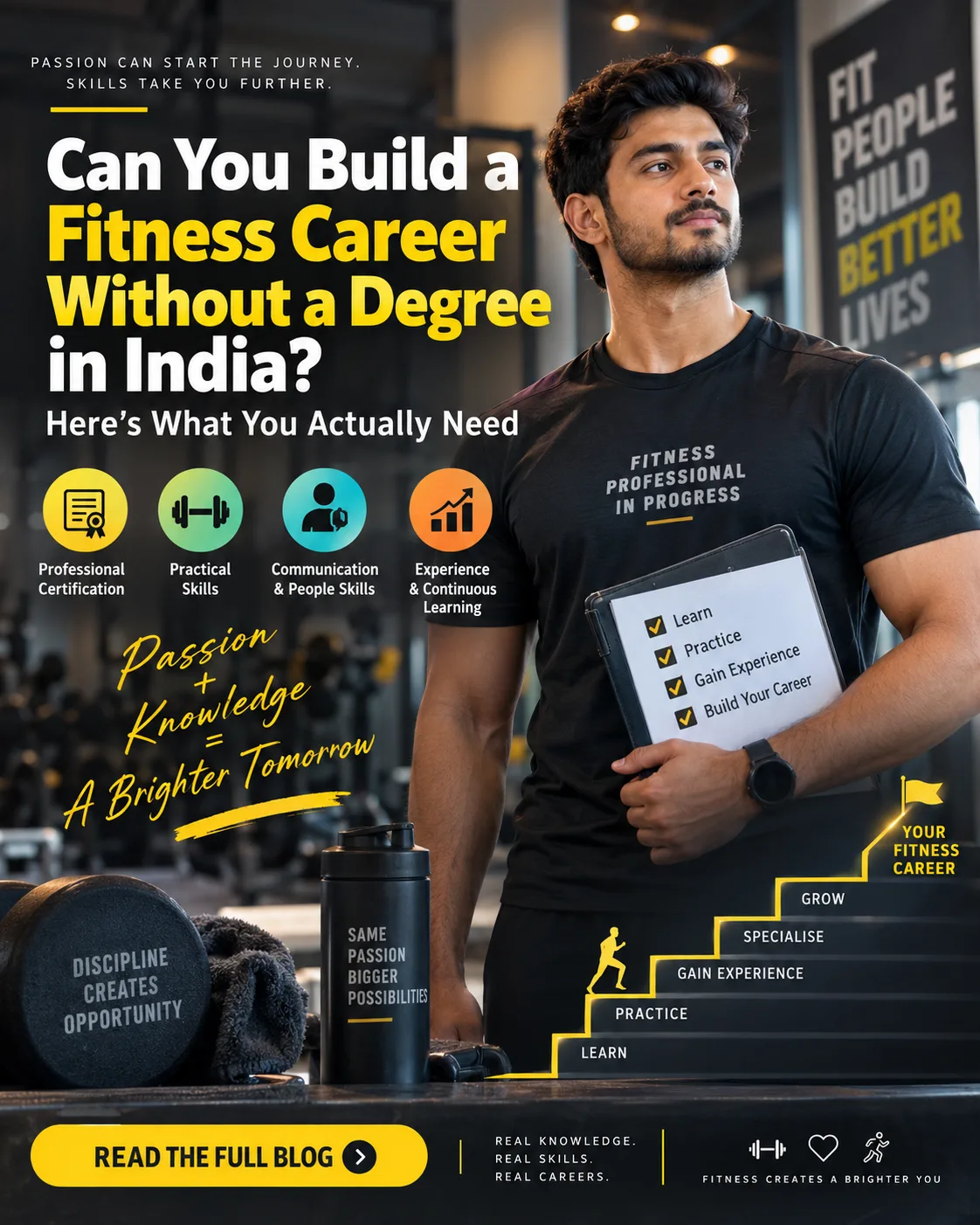
Thinking about becoming a fitness professional but worried that you don’t have a Sports Science degree? You’re not alone. The Indian fitness industry is expanding rapidly, creating opportunities for personal trainers, fitness coaches, group exercise instructors, wellness professionals, and specialised fitness educators.
The good news is that a traditional university degree is not always essential to start a successful fitness career. What matters more is having the right knowledge, practical skills, recognised training, communication ability, and a commitment to continuous learning.
If you're exploring a fitness career without degree India, this guide explains what you actually need to get started—and how you can turn your passion for fitness into a professional career.
Is a Degree Really Necessary for a Fitness Career?
A Sports Science or related degree can certainly provide an extensive academic foundation. However, many fitness roles are skill-based and focus heavily on practical competency.
For aspiring professionals, a suitable fitness certification in India can provide focused education in areas such as exercise techniques, anatomy, physiology, programme design, client assessment, and fitness coaching.
Your career path can depend on the role you want to pursue. For example:
- Personal Trainer
- Fitness Trainer
- Gym Instructor
- Group Exercise Instructor
- Pilates Instructor
- Strength & Conditioning Coach
- Wellness Coach
- Fitness Entrepreneur
- Online Fitness Coach
The key is to choose education that matches your intended career path and gives you both theoretical understanding and practical exposure.
1. Start With a Recognised Fitness Certification
If you don't have a Sports Science degree, professional certification can become one of the most important foundations of your career.
A quality fitness trainer certification should help you understand not just what exercise to perform, but why and how it should be performed safely and effectively.
Look for training that covers:
- Basic anatomy and physiology
- Exercise science fundamentals
- Fitness assessment
- Exercise programming
- Strength and conditioning principles
- Cardiovascular training
- Flexibility and mobility
- Warm-up and cool-down protocols
- Client safety
- Professional ethics
- Practical training
A certificate alone does not automatically make someone an expert. The real value comes from combining education with supervised practice and experience.
Why practical learning matters
Fitness is a hands-on profession. Knowing the theory is important, but you also need to confidently demonstrate exercises, correct technique, communicate instructions, and adapt workouts to different clients.
That is why practical exposure should be a major consideration when selecting a course.
2. Build Practical Skills That Clients Actually Value
Imagine two trainers.
One has memorised hundreds of exercises but struggles to communicate with clients.
The other understands exercise fundamentals, observes movement carefully, explains techniques clearly, modifies exercises when required, and creates structured programmes.
Which trainer is more likely to build long-term client relationships?
In most real-world fitness environments, practical fitness training makes a significant difference.
As you develop your skills, focus on becoming comfortable with:
- Demonstrating correct exercise technique
- Identifying common movement mistakes
- Creating beginner-friendly programmes
- Progressing exercises gradually
- Adjusting workouts according to individual goals
- Tracking client progress
- Giving clear instructions
- Motivating different types of clients
These skills can help transform theoretical knowledge into professional competence.
3. Develop Your Specialisation
The fitness industry is no longer limited to traditional gym training. Clients increasingly look for professionals with specific expertise.
Once you have your foundational qualification, consider developing a specialisation.
Popular areas include:
- Personal trainer course India
- Strength & conditioning
- Group fitness
- Pilates
- Yoga and mobility
- Functional training
- Senior fitness
- Women's fitness
- Sports conditioning
- Weight-management-focused fitness coaching
- Corrective exercise foundations
Choosing a niche can help you differentiate yourself in a competitive market.
For example, instead of simply marketing yourself as a "fitness trainer," you could develop expertise in beginner strength training, functional fitness, Pilates, or sports conditioning.
Remember: Specialisation should build on a strong foundation. Don't rush into advanced areas without understanding basic exercise science first.
4. Communication Skills Can Be as Important as Fitness Knowledge
Being physically fit doesn't automatically make someone a good trainer.
A professional trainer works with people from different backgrounds, fitness levels, personalities, and motivations.
Some clients may be highly motivated. Others may need constant encouragement. Some may want performance-focused training, while others simply want to become more active.
That's why communication is a major career skill.
A successful fitness professional should be able to:
- Listen to clients
- Understand their goals
- Explain exercises simply
- Give constructive feedback
- Build trust
- Maintain professional boundaries
- Motivate without intimidating
- Create a welcoming environment
Your clients aren't just paying for exercises. They are paying for guidance, accountability, expertise, and experience.
5. Experience Builds Your Professional Reputation
Certification can help you enter the industry, but experience helps you grow.
If you're starting your fitness career without degree India, don't underestimate the value of getting practical experience early.
You could begin by:
- Working in a gym or fitness centre
- Assisting an experienced trainer
- Conducting supervised sessions
- Participating in fitness workshops
- Building your own training portfolio
- Practising programme design
- Learning client assessment techniques
- Collecting professional testimonials over time
Your first few months may be about learning rather than earning a huge income.
Think of every client interaction as an opportunity to improve your coaching skills.
Build a professional portfolio
Keep track of your professional development through:
- Certifications
- Workshops attended
- Skills learned
- Client success stories, with permission
- Training programmes you've designed
- Professional photographs/videos
- Continuing education
A strong portfolio can help demonstrate your capabilities to potential employers and clients.
6. Keep Learning as the Industry Evolves
Fitness is constantly changing.
New training methodologies, technologies, research, equipment, and client expectations continue to influence the industry.
Therefore, completing one course should be viewed as the beginning—not the end—of your education.
Successful fitness professionals continuously improve their knowledge through:
- Advanced certifications
- Workshops
- Seminars
- Industry events
- Continuing education
- Evidence-based fitness resources
- Practical experience
- Learning from experienced professionals
This mindset can give you a significant advantage, particularly if you don't have a traditional academic background in Sports Science.
Don't chase every trend
"Trendy" doesn't always mean effective.
Social media is full of viral workouts, extreme challenges, quick-fix diets, and fitness myths. A professional trainer should learn to distinguish between popular content and sound fitness principles.
Your credibility depends on providing responsible, practical, and evidence-informed guidance.
What Career Opportunities Are Available Without a Sports Science Degree?
A degree isn't the only route into the fitness industry.
Depending on your training, qualifications, experience, and local requirements, potential career paths may include:
Career PathKey SkillsPersonal TrainerProgramme design, coaching, communicationGym TrainerExercise instruction, client supportGroup Fitness InstructorLeadership, demonstration, energyPilates InstructorMovement control, technique, programmingStrength & Conditioning CoachPerformance training, programmingOnline Fitness CoachDigital communication, programmingFitness EntrepreneurBusiness, marketing, client managementHowever, professionals should always understand the scope of their qualifications and avoid working beyond their competence. Medical diagnosis, injury treatment, and clinical nutrition may require appropriately qualified healthcare professionals.
How to Start Your Fitness Career: A Simple Roadmap
If you're wondering where to begin, here's a practical roadmap:
Step 1: Decide what type of fitness career you want.
Step 2: Choose a suitable foundational certification.
Step 3: Learn anatomy, exercise science, assessment, and programme design.
Step 4: Prioritise hands-on practical training.
Step 5: Gain experience under qualified professionals.
Step 6: Develop communication and client-management skills.
Step 7: Choose a specialisation that matches your interests.
Step 8: Build your professional portfolio and personal brand.
Step 9: Continue learning through workshops and advanced education.
Step 10: Grow your network and professional reputation.
This approach can help turn an interest in fitness into a sustainable career.
Start Building Your Fitness Career Today
If you're a fitness enthusiast, don't let the absence of a Sports Science degree stop you from exploring professional opportunities.
If you're a college student or career changer, professional fitness education can provide a focused pathway into an industry you're passionate about.
If you're an existing gym professional, upgrading your knowledge and adding specialised certifications can help you expand your career options.
And if you're planning to become a personal trainer, focus on more than just getting certified. Build knowledge, practical competence, communication skills, and professional credibility.
The most successful fitness professionals aren't necessarily the people with the longest list of qualifications. They are the ones who keep learning, coach responsibly, understand their clients, and consistently deliver value.
Ready to Take the Next Step?
Explore professional fitness education designed to develop practical skills, industry knowledge, and career-ready confidence.
👉 Start your fitness education journey today and take the first step towards becoming a qualified fitness professional.
Conclusion
So, can you build a fitness career without degree India? Yes—you can.
A Sports Science degree can be valuable, but it isn't necessarily the only pathway into the fitness industry. A strong fitness trainer certification, practical experience, specialised training, communication skills, and continuous professional development can help you establish yourself as a capable fitness professional.
Your qualification may open the door—but your knowledge, practical ability, professionalism, and results can determine how far you go.
If fitness is your passion, start by getting the right education, gaining practical experience, and building your expertise one step at a time. Your fitness career doesn't have to begin with a university degree. It can begin with the right decision to learn and become a better professional.
Frequently Asked Questions
1. Can I become a fitness trainer without a Sports Science degree?
Yes. Depending on the role and applicable regulations, you can pursue professional fitness education and certifications without holding a Sports Science degree. Practical skills, knowledge, experience, and recognised qualifications are important.
2. What qualification do I need to become a personal trainer in India?
A relevant personal trainer course India can provide foundational knowledge and practical skills required for personal training. Choose a programme that includes exercise science, assessment, programming, practical training, and professional development.
3. Is fitness certification enough to get a job?
Certification can improve your eligibility and credibility, but employers and clients may also consider practical ability, communication, experience, specialisations, and professionalism.
4. Can I specialise in fitness without a degree?
Yes. After establishing foundational knowledge, you can pursue additional education in areas such as Pilates, strength and conditioning, group fitness, functional training, mobility, and other specialised fields.
5. Is a career in fitness good for beginners?
It can be a rewarding career for people who genuinely enjoy fitness, working with people, learning continuously, and helping clients achieve realistic goals. Starting with a solid fitness certification in India and gaining practical experience can provide a strong foundation.