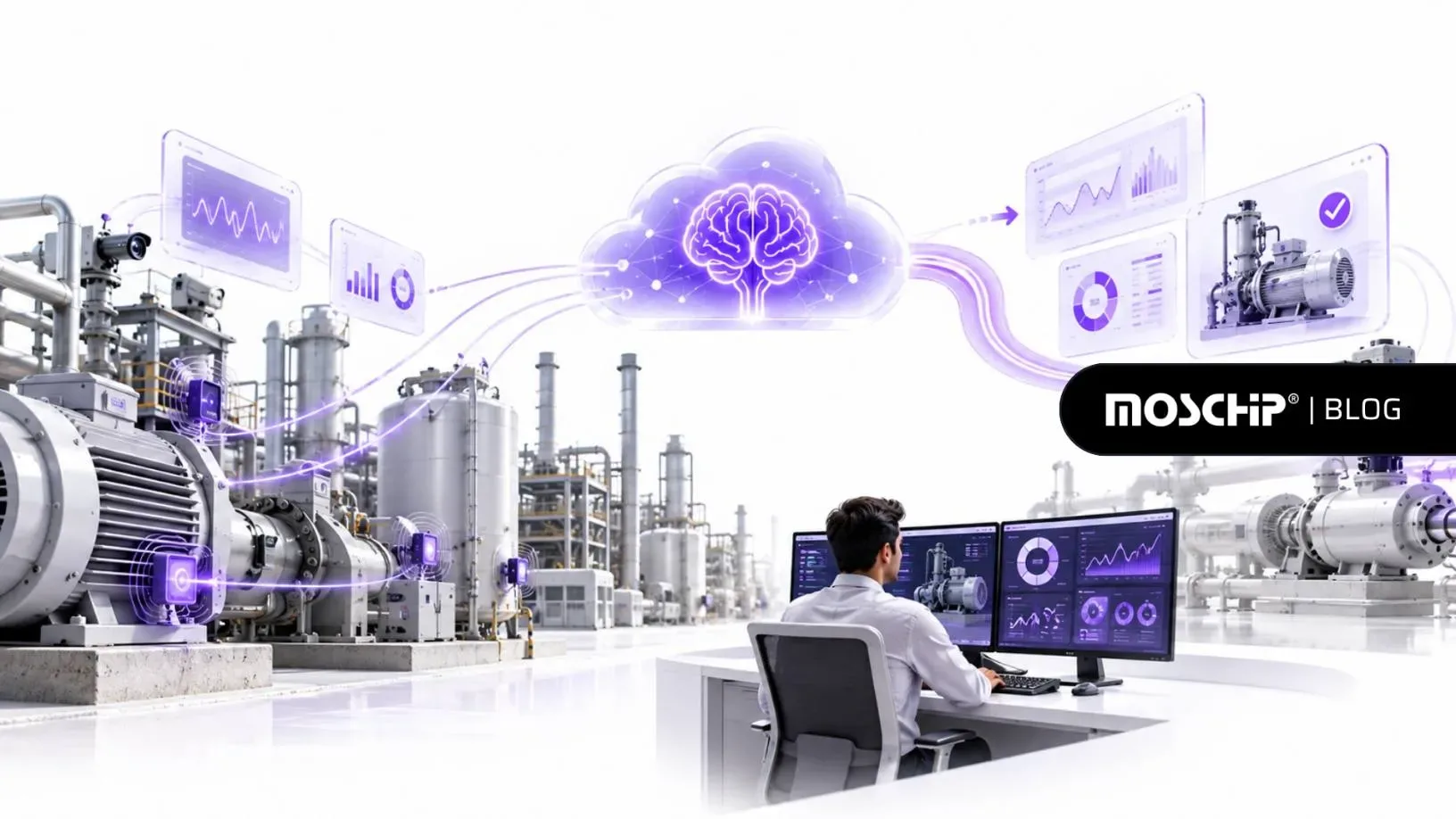
As industries evolve by adopting advanced technologies to meet growing market demands, IoT, cloud, and edge computing have made remote equipment monitoring more connected and accessible than ever. But connectivity alone is not enough to achieve complete plant operational visibility, asset health, operational efficiency, and continuous production.
So, connected ecosystems or connectivity itself does not mean that a plant can automatically work under any situation. Industries are still working with legacy infrastructure, facing connectivity challenges, and not having a skilled workforce, as well as various other challenges which stops modern manufacturers from moving towards fully automated plant operations.
This gap is evident in industry research. Based on Rockwell Automation’s research report (State of Manufacturing Report), more than 40% of modern industries are still struggling to adopt full smart automation across their operations, due to the challenges mentioned above.
These challenges become clearer when we look at what is happening once machines generate data. As we know, machines are constantly generating data, raising alerts based on various abnormal situations, and showing machine health and performance metrics, but machines still require human intervention to solve the challenges and understand the situational context. This creates an open-loop operation and requires human intervention to close the loop, because machines do not have the ability to understand the context and decide what to do next themselves.
As we know, modern plants already use rule-based systems to automate some of these actions. If any known condition occurs, pre-defined rules can respond to the situation and trigger alerts. But the challenge begins when the abnormalities do not fit with pre-defined rules, which leads to delayed decision-making. Because this depends on current machine operations, previous machine behavior, outcome requirements, or information coming from other systems.
This means the next step is not simply creating more rules, but enabling the system to understand changing conditions and decide what action makes sense in that situation.
This is where Agentic AI comes in.
Before exploring this transformation, let us first understand the key challenges faced by industries with conventional remote monitoring.
The Growing Challenges Facing Modern Remote Equipment Monitoring Systems
As we see, machines generate continuous data that flows throughout the plant floor. But data alone does not equate to making better decisions in each situation. The real challenge is putting that data into context and converting it into a timely operational response.
This is where the limitations of today’s AI-enabled remote monitoring systems begin to appear.
Operational Bottlenecks Limiting Current Deployments
1. Alert Flooding and Context-Blind Alert Fatigue
Remote monitoring systems generate several alerts during abnormalities in real-time running operations for various abnormalities without understanding the actual context or severity.
This breeds confusion in operator brain to fetch actual severe operations and which alert to be answer first; this delay leads to the plant operation in stall condition.
2. Open-Loop Delays Between Detection and Response
Remote monitoring can identify the abnormalities, but the system still depends on human intervention to make decisions and take necessary actions.
This creates an open-loop gap where no direct sensing and continuous learning take place inside the system itself (from detection to response level), where on the plant floor every second matters most.
3. 24/7 Continuous Operations and Response Gaps
The manufacturing plants operate continuously as per the production schedule, where skilled engineers work during specific time periods. But if any abnormality happens when engineers or operators are not available during working hours, traditional systems can simply raise an alert message to the engineer, but they cannot make decisions on their own.
4. Modal Fragmentation and Context Loss
In industrial environments, remote monitoring collects data from several sources, but the collected signals and data operate independently rather than in a connected, process-based way.
About us: Turnkey ASIC, Product & AI Engineering - India & USA - MosChip