
Empty fruit bunches (EFB) are a major fibrous residue generated by palm oil processing. The material can be difficult to handle in its loose form because of its high moisture content, irregular structure, and relatively low bulk density.
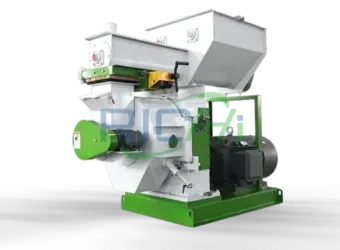
Pelletizing provides a method of converting prepared EFB into a denser and more uniform biomass product. A 2 ton per hour EFB pellet machine is designed for projects targeting approximately two tons of finished pellets per hour under suitable operating conditions.
The actual production rate depends on raw material properties, pretreatment, moisture content, particle size, die configuration, and the capacity of the supporting equipment.
Raw Material Characteristics
EFB is composed primarily of fibrous plant material remaining after the palm fruit bunches have been processed.
Fresh EFB may contain considerable moisture. It can also contain residual organic material, soil, stones, and other foreign matter depending on how the material is collected and stored.
These characteristics influence the design of the pellet production system.
For consistent operation, the raw material normally requires inspection and preparation before entering the pellet mill.
Production Process
A typical production process can be represented as:
EFB Receiving → Cleaning → Crushing → Drying → Grinding → Pelletizing → Cooling → Screening → Packaging
The exact process varies according to the condition of the EFB.
Cleaning
Foreign materials can damage crushing and pelletizing equipment. Separation or screening equipment may therefore be installed before size reduction.
Crushing
Long EFB fibers are reduced into smaller pieces to improve subsequent feeding and processing.
Drying
When moisture is above the appropriate processing range, the material passes through a drying system.
For a two-ton-per-hour project, the dryer must be sized according to both the desired pellet output and the amount of water that needs to be removed.
Grinding
Additional grinding can produce a more uniform particle structure before pelletizing.
Pelletizing
Prepared EFB enters the pellet mill through a controlled feeding system. Mechanical pressure compresses the material through die openings, forming cylindrical pellets.
Cooling and Screening
The newly formed pellets are cooled and screened before storage or packaging. Fines can be separated from the finished product and may be returned to the production process depending on the system design.
How Is Two-Ton Capacity Determined?
The term two tons per hour generally refers to a target production rate under specified raw material and operating conditions.
It should not automatically be interpreted as two tons of fresh EFB entering the factory every hour.
Fresh EFB contains moisture that is removed during drying. Consequently, the mass of incoming wet material can be substantially higher than the mass of finished pellets.
Capacity calculations should therefore distinguish between:
- Fresh EFB input
- Dried biomass input
- Finished pellet output
This distinction is important when sizing conveyors, dryers, storage equipment, and other components.
Factors Affecting Output
Several variables can affect actual production.
Moisture Content
Moisture influences drying requirements and pellet formation. Significant variation in moisture can lead to changes in production stability.
Particle Size
Oversized fibers may reduce feeding consistency. Appropriate crushing and grinding can improve material uniformity.
Die Specification
Die hole diameter affects pellet dimensions and can influence production performance.
Feeding Rate
A stable feeding system helps maintain consistent machine loading.
Raw Material Composition
Different EFB sources may have different fiber structures and residual material content.
For projects using multiple biomass materials, an EFB pellet machine price per ton comparison should be made only after establishing the actual feedstock and required processing configuration.
Equipment Matching
A two-ton-per-hour pelletizing system requires more than a pellet mill.
The supporting equipment should be coordinated with the target production rate.
For example, if the pellet mill is designed for two tons per hour but the dryer cannot provide enough prepared material, the pellet mill will operate below its potential capacity.
A typical system may therefore include:
- Raw material hopper
- Cleaning equipment
- Crusher
- Dryer
- Grinder
- Pellet mill
- Cooler
- Screener
- Conveyors
- Electrical control system
- Finished-product storage
The equipment configuration can be expanded with automatic feeding and packaging systems for larger commercial operations.
Pellet Specifications
The required pellet dimensions depend on the intended application.
Pellet diameter is primarily determined by the die, while pellet length is influenced by the cutting mechanism.
Other characteristics, including moisture, bulk density, durability, and ash content, can also be important for biomass fuel applications.
Before equipment selection, the desired finished-pellet specifications should therefore be established.
Equipment Selection
A manufacturer may recommend different configurations depending on the EFB condition and project requirements.
For comparison, a vertical ring die pellet machine represents another type of pelletizing equipment used for biomass applications, but the appropriate machine depends on the characteristics of the material and the required production process.
A Richi Pellet Mill can be configured as part of a complete biomass pellet production system, with auxiliary equipment selected according to the project's pretreatment and handling requirements.
Testing and Commissioning
Material testing can provide useful information before installation.
Representative EFB samples can be evaluated for moisture, particle size, pellet formation, and production behavior.
After installation, commissioning allows operators to adjust feeding, drying, pelletizing, cooling, and screening parameters.
Monitoring these stages can help establish stable operating conditions.
For additional click here for more info, technical references can be reviewed when comparing biomass pellet production methods.
Conclusion
A two-ton-per-hour EFB pellet project requires coordinated design across the entire processing line. The pellet mill is only one component of the system.
Moisture removal, crushing, grinding, feeding, cooling, and screening all influence the final output. Capacity should therefore be calculated from the characteristics of the incoming EFB and the required finished-pellet production rate.
With appropriate pretreatment and balanced equipment, a two-ton-per-hour system can provide a practical approach to converting palm oil processing residues into a denser and more manageable biomass product.