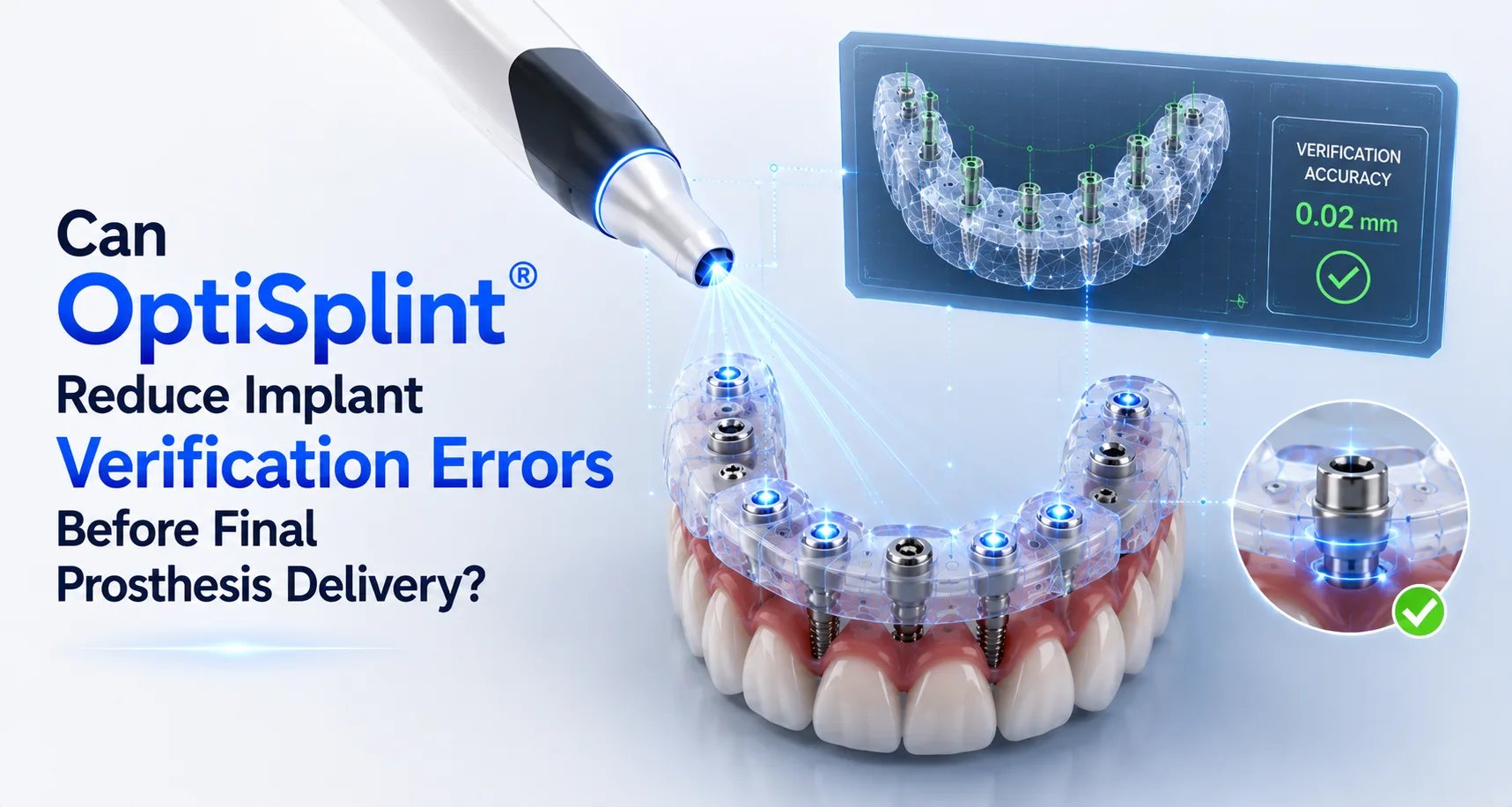
Verification steps built around an OptiSplint® dental workflow for full-arch implant cases are designed to catch implant-position discrepancies while the framework can still be corrected, not after it's already been delivered. Clinical research on framework misfit explains why that timing matters so much in full-arch cases.
What Counts as a Verification Error?
A verification error is a mismatch between where an implant actually sits in the mouth and where the digital or physical model says it sits. That mismatch, known as misfit, can originate at any step: impression-taking, cast fabrication, scanning, or milling.
In full-arch restorations, this matters more than in single-unit work. One prosthesis is sharing the load of every implant beneath it, so an error at one position doesn't stay isolated. It gets built into the whole framework.
For context on how these systems compare more broadly, digital and conventional verification jig accuracy has been covered separately. This piece focuses specifically on what happens when verification errors go uncaught.
Why This Matters Before Final Delivery
A 2026 narrative review in Applied Sciences, screening clinical evidence on implant screw complications, is worth walking through here because it ties framework accuracy directly to measurable outcomes, not just theory.
The review's findings include:
- Framework misfit is directly linked to mechanical complications. Early long-term evaluations associated inaccurate framework fit with frequent loose gold screws in full-arch prostheses after 5 years. A later study found that greater framework misfit correlated with more screw loosening and fracture over more than a decade of follow-up.
- Full-arch restorations carry a meaningfully high complication range. A broader synthesis of full-arch implant-supported restorations reported screw loosening rates between 5% and 15%.
- One maxillary full-arch study found even higher rates, with prosthetic and abutment screw loosening occurring in 16.6% and 8.1% of cases respectively, more common with angulated abutments, longer cantilevers, and distal implant positioning.
- The mechanism is biomechanical, not incidental. Misfit produces uneven preload distribution during tightening, which concentrates stress on the screw and accelerates loosening, even when the same torque is applied every time.
The review's own clinical recommendation states it plainly: ensuring an accurate, passive prosthetic fit is a key objective during fabrication and delivery, precisely because framework misfit drives the complications above.
This lines up with earlier work too. A recent ITI clinical review on verification jigs makes the same point from a different angle: a poorly fitting implant superstructure can produce both mechanical complications, like screw loosening, and biological ones, including adverse tissue reactions and marginal bone loss. Verification exists to catch the fit problem before either category of complication becomes relevant.
How Verification Catches This Before It's Locked In
A 2025 narrative review in the Australian Dental Journal that screened 52 studies on implant verification jigs reached a specific, practical conclusion: selective use of a verification jig prior to fabricating the definitive prosthesis can reduce the likelihood of misfit reaching the final restoration.
That's the functional difference verification is meant to provide. Instead of discovering a positioning discrepancy after the framework is milled and delivered, a verification step checks the master cast against the actual implant positions while correction is still straightforward.
Scannable systems fit into this checkpoint role directly. Rather than sending a cast out for lab fabrication and waiting on a return visit, a unit that links scan bodies together and can be scanned chairside lets a clinician confirm implant-to-implant relationships in the same appointment. OptiSplint® is built around that principle for full-arch cases: it unites multiple scan bodies into a single scannable unit, compatible with guided, navigation, or freehand surgical approaches, so the check happens before the case moves further down the fabrication pipeline rather than after.
Before vs. After Delivery: Where the Cost of an Error Changes
- Caught during verification: typically means a chairside adjustment or a corrected cast, before the final framework is committed to
- Caught after delivery: may mean sectioning and reconnecting the framework, remaking the prosthesis, or managing a mechanical complication such as screw loosening or fracture down the line
The biomechanical evidence above is what explains that gap. Once a misfitting framework is torqued into place, the uneven stress it creates doesn't resolve on its own. It tends to show up later as one of the complications the research describes, sometimes within the first year of function, sometimes only after years of otherwise normal use.
That timing detail matters clinically. A framework that seats without obvious problems at delivery can still be carrying the kind of preload imbalance the Applied Sciences review describes, one that only becomes apparent once a screw eventually loosens. Verification before delivery is what catches that imbalance while it's still just a measurable discrepancy on a scan, rather than a clinical complication months or years later.
FAQs
Can a verification step guarantee zero misfit? No single step eliminates misfit entirely. Research on implant-supported restorations consistently describes achieving a truly strain-free fit as a practical target rather than an absolute guarantee, which is exactly why verification before final fabrication functions as a checkpoint rather than a one-time fix.
What happens if verification is skipped in a full-arch case? Based on the complication rates above, skipping or under-verifying implant position raises the likelihood that misfit isn't caught until after delivery, when the fix is more involved and the biomechanical risks (screw loosening, fracture) are already in play.
Does adding a verification step meaningfully slow down the workflow? A scannable, chairside verification step is generally faster than sending a jig out for lab fabrication and waiting on a separate appointment, since the check happens within the same visit as the scan.
Is this only relevant for full-arch cases? Verification matters for single-unit restorations too, but the stakes are higher in full-arch work because one prosthesis depends on every implant position being accurate simultaneously.
Final Takeaway
The research on framework misfit makes the underlying logic clear: verification exists because catching a positioning error before final fabrication is consistently less costly, biomechanically and clinically, than correcting one afterward. Scannable, chairside-verifiable systems are one way full-arch workflows are shifting that check earlier, closer to the point where a discrepancy is still easy to fix.