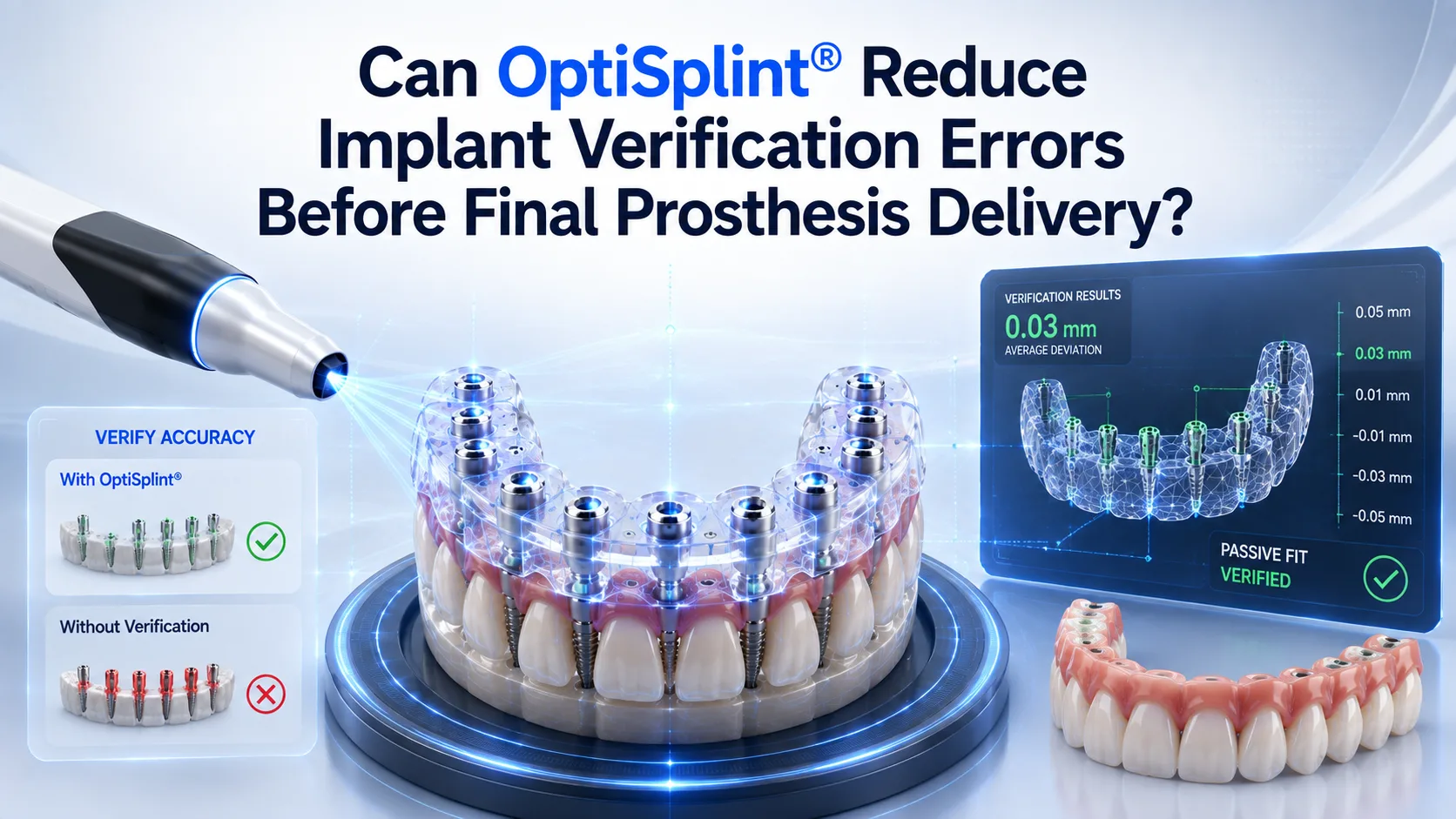
Successful full-arch implant restorations depend on accurate implant verification before the final prosthesis is manufactured. Even with advances in intraoral scanning, photogrammetry, and CAD/CAM technology, errors introduced during implant position verification can affect framework fit, occlusion, and prosthesis delivery. Modern verification systems such as OptiSplint® are designed to improve the accuracy of implant position transfer, helping clinicians validate digital records before fabrication and reducing the likelihood of restorative complications later in the workflow.
Why Implant Verification Matters Before Prosthesis Delivery
Verification is the process of confirming that implant position records accurately represent the clinical situation before the laboratory fabricates the definitive restoration.
For full-arch restorations, this step is especially important because multiple implants must function together within a single prosthetic framework.
Proper verification helps clinicians:
- Confirm implant positions
- Validate digital records
- Improve laboratory communication
- Support passive framework fit
- Increase restorative predictability
According to the National Center for Biotechnology Information (NCBI), accurate implant position transfer is a key factor in achieving precise implant-supported prostheses and minimizing restorative complications.
Common Implant Verification Errors
Although digital workflows have improved significantly, implant verification errors can still occur if implant positions are not captured consistently.
Common issues include:
- Minor discrepancies in implant position records
- Movement during verification procedures
- Digital registration inaccuracies
- Distortion between clinical and laboratory records
- Incomplete verification before prosthesis fabrication
These seemingly small inaccuracies may result in additional laboratory adjustments or chairside modifications during prosthesis delivery.
How Verification Errors Affect Full-Arch Restorations
Unlike single-unit restorations, full-arch prostheses rely on the precise relationship between multiple implants.
Verification errors may contribute to:
- Passive fit challenges
- Occlusal discrepancies
- Framework misfit
- Increased prosthetic adjustments
- Laboratory remakes
- Additional patient appointments
Preventing these problems before fabrication is generally more efficient than correcting them after the final prosthesis has been manufactured.
Research published in the Journal of Prosthetic Dentistry has consistently shown that accurate implant verification contributes to better restorative precision and improved prosthetic outcomes.
Why Digital Workflows Still Require Verification
Modern digital workflows have reduced many limitations associated with conventional impressions, but they do not eliminate the need to verify implant positions.
Digital technologies such as:
- Intraoral scanning
- Photogrammetry
- CAD software
- CBCT imaging
all depend on accurate clinical data.
Verification serves as the final quality-control step before restorative manufacturing begins.
How Splinted Verification Improves Accuracy
Many clinicians use splinted verification techniques because stabilizing implant relationships during data capture helps reduce variability.
Potential benefits include:
- Better implant position consistency
- Improved digital accuracy
- More reliable laboratory records
- Reduced movement during verification
- Greater confidence before fabrication
Splinted verification has become an increasingly common component of modern AOX restorative workflows.
How OptiSplint® Helps Reduce Verification Errors
As digital implant dentistry continues to evolve, clinicians are adopting dedicated verification systems that improve implant position accuracy before prosthesis fabrication. Solutions such as OptiSplint® for accurate implant verification in full-arch digital workflows are designed to stabilize implant relationships during verification, helping clinicians transfer more reliable implant position data into the digital restorative workflow.
Integrated within the Digital Arches ecosystem, OptiSplint® supports workflows that include intraoral scanning, photogrammetry, CAD planning, and laboratory collaboration. By improving verification accuracy before the final prosthesis is manufactured, clinicians can reduce uncertainty and improve confidence throughout treatment planning.
Clinicians interested in learning more about digital verification and full-arch workflows can also explore the educational resources available through the Digital Arches Blog.
Improving Communication With Dental Laboratories
Accurate verification benefits not only clinicians but also dental laboratories.
Reliable implant position records help laboratories:
- Design frameworks more confidently
- Reduce prosthetic revisions
- Improve passive fit planning
- Minimize manufacturing delays
- Increase restorative consistency
Clear digital communication reduces uncertainty throughout the restorative process.
Benefits Before Final Prosthesis Delivery
When implant verification is completed accurately before manufacturing, the entire workflow becomes more predictable.
Potential benefits include:
- Better passive framework adaptation
- Fewer chairside adjustments
- Reduced laboratory remakes
- More predictable prosthesis delivery
- Improved restorative efficiency
- Greater confidence for both clinicians and technicians
While no verification system can eliminate every clinical variable, improving the quality of implant position records helps reduce avoidable restorative complications.
Why Verification Will Continue to Be Essential
Digital dentistry continues to advance through AI-assisted planning, photogrammetry, CAD/CAM manufacturing, and digital treatment planning. Despite these innovations, accurate verification remains a critical step because every downstream process depends on reliable implant position data.
Future digital workflows will likely place even greater emphasis on:
- Accurate digital records
- Standardized verification protocols
- Better data integration
- Predictable restorative planning
- Efficient interdisciplinary collaboration
The American Academy of Implant Dentistry (AAID) recognizes digital technologies and accurate treatment planning as important contributors to successful implant rehabilitation.
Frequently Asked Questions
Why is implant verification important before final prosthesis delivery?
Verification confirms that implant position records accurately represent the clinical situation before the definitive restoration is fabricated, reducing the likelihood of restorative inaccuracies.
Can digital scans replace implant verification?
Digital scans improve workflow efficiency, but verification remains important for confirming that implant positions have been accurately transferred into the restorative workflow.
How can verification errors affect a full-arch prosthesis?
Verification errors may contribute to framework misfit, passive fit problems, occlusal discrepancies, laboratory remakes, and additional chairside adjustments.
How does OptiSplint® support digital implant workflows?
OptiSplint® is designed to stabilize implant relationships during verification, helping clinicians capture more accurate implant position records before prosthesis fabrication and supporting predictable full-arch restorative workflows.
Final Insight
The quality of a full-arch implant restoration depends on every stage of the digital workflow, but verification remains one of the most important checkpoints before final prosthesis delivery. Even highly advanced digital technologies rely on accurate implant position records to produce restorations that fit predictably.
Modern verification systems such as OptiSplint® demonstrate how improving implant position transfer can strengthen digital workflows, enhance collaboration between clinicians and dental laboratories, and reduce the likelihood of verification-related restorative errors. As digital implant dentistry continues to evolve, accurate verification will remain essential for delivering predictable, efficient, and long-lasting full-arch restorations.