
Electric vehicle manufacturers face a difficult balancing act.
Drivers want longer range, faster charging, and reliable battery life, but they also expect electric cars to become more affordable. Improving one area can sometimes make another harder.
High-energy battery chemistries can provide excellent driving range, but they can rely heavily on expensive materials such as nickel and cobalt. Lower-cost lithium iron phosphate batteries offer good durability and affordability, but their lower energy density can require larger or heavier battery packs for long-range vehicles.
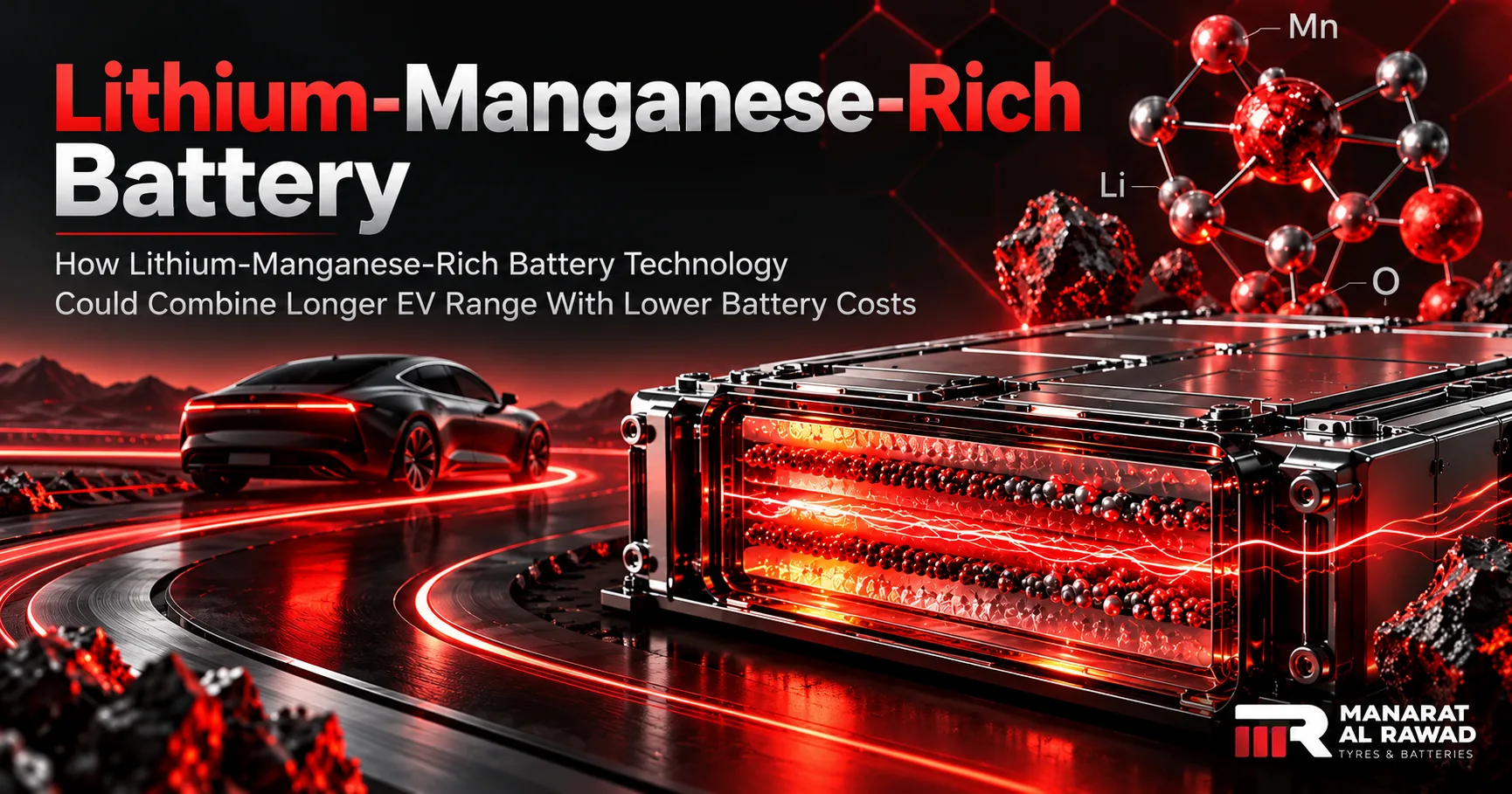
A technology known as the Lithium-Manganese-Rich Battery, or LMR battery, is emerging as another possible option.
General Motors and LG Energy Solution recently announced plans to prepare their Tennessee battery facility for commercial production of LMR prismatic cells for future GM electric vehicles. Facility upgrades are expected to begin in 2026 and be completed in 2028.
What Is a Lithium-Manganese-Rich Battery?
LMR batteries are a type of lithium-ion battery that uses a cathode containing a relatively high proportion of manganese.
Manganese is already used in several battery chemistries, but LMR technology attempts to increase its role while lessening reliance on more expensive materials.
The goal is obvious: produce a battery that delivers relatively high energy density while remaining economically competitive.
GM says its planned LMR cells are designed to provide approximately 33% greater energy density than lithium iron phosphate batteries at a comparable cost.
If those targets can be achieved at commercial scale, the technology could help address one of the industry's most lasting challenges.
Why Energy Density Matters
Energy density describes how much energy a battery can store relative to its weight or volume.
Higher energy density gives automotive engineers more flexibility.
A manufacturer could use the technology to increase driving range without making the battery pack significantly larger, or achieve similar range while reducing battery size and weight.
Lower vehicle weight can also benefit efficiency.
This is particularly important for larger SUVs, pickup trucks, and commercial vehicles where battery packs may already represent a substantial portion of total vehicle mass.
Why Manganese Is Attracting Attention
Battery chemistry has major consequences for manufacturing costs.
Nickel-rich lithium-ion batteries can provide excellent performance but require significant quantities of nickel and, depending on the chemistry, cobalt.
LFP batteries avoid nickel and cobalt but typically sacrifice some energy density.
LMR represents an attempt to equalize these approaches.
Rather than searching for one battery chemistry to power every electric vehicle, automakers increasingly appear to be developing different batteries for different applications.
GM has indicated that high-nickel batteries will continue serving applications where maximum range is especially important, while LMR is intended to provide another lower-cost option with stronger energy density than LFP.
One EV Brand Could Use Several Battery Chemistries
Such diversification is important.
A compact city EV may prioritize affordability and durability. A large electric SUV may need significantly more energy storage. A performance vehicle may value rapid power delivery.
Using exactly the same chemistry for every vehicle can create unnecessary compromises.
Future automotive platforms may therefore support several battery types depending on the vehicle's intended purpose.
Prismatic Cells Could Change Battery Packaging
GM and LG plan to manufacture the new LMR chemistry in a prismatic cell format.
Prismatic cells are larger, rectangular cells that pack efficiently inside a battery enclosure.
Battery manufacturers currently use several form factors, including cylindrical, pouch, and prismatic cells.
None is universally superior. Each offers different advantages in packaging, cooling, manufacturing, and structural integration.
Growing interest in prismatic designs shows how battery innovation is happening at several levels at once.
Chemistry is changing, but cell shape, battery management software, and pack architecture are evolving as well.
Better EV Batteries Still Require Better Diagnostics
More advanced battery technology does not eliminate ordinary vehicle electrical problems.
Modern electric, hybrid, and combustion vehicles still depend on low-voltage electrical systems for functions such as computers, security systems, sensors, lighting, and vehicle startup.
A vehicle may therefore experience an electrical problem even when its main traction battery is functioning normally.
When motorists experience slow starting, battery warnings, or an unexpected no-start situation, mobile car battery testing in the UAE can help determine whether the issue involves the conventional battery, charging system, or another electrical component before considering replacement.
Accurate diagnosis becomes increasingly important as vehicles contain more complex electrical architectures.
Could LMR Batteries Lower EV Prices?
Battery packs remain one of the most expensive parts of an electric vehicle.
Reducing battery cost without significantly sacrificing range could therefore meaningfully affect vehicle pricing.
That does not mean LMR technology will automatically make EVs dramatically cheaper.
Vehicle prices depend on manufacturing scale, software, electronics, motors, labor, logistics, and many other factors.
But battery chemistry remains one of the largest opportunities for cost reduction.
If manufacturers manage to achieve high energy density with more affordable material combinations, they may be able to produce long-range vehicles with less expensive battery packs.
Battery Innovation Is Becoming a Competition Between Chemistries
LMR is arriving during an unusually active period for battery development.
Automakers and battery companies are concurrently investing in LFP, sodium-ion, solid-state, high-nickel, and manganese-rich technologies.
This makes the future of EV batteries increasingly diverse.
Rather than one chemistry replacing all others, different solutions are able to coexist.
Affordable city vehicles may use one chemistry while luxury or long-distance EVs use another.
Conclusion
The Lithium-Manganese-Rich Battery could become an important middle ground in electric vehicle development.
Its appeal rests in the potential to combine relatively high energy density with costs closer to lower-priced battery chemistries.
GM and LG's decision to prepare for commercial LMR production suggests the technology is moving beyond laboratory research toward real automotive manufacturing.
Important problems remain, including manufacturing scale, real-world durability, and long-term cost.
But if LMR batteries perform as expected, the next generation of electric vehicles may not simply travel farther.
They could deliver useful driving range with cheaper-to-manufacture battery packs, helping make electric mobility available to a wider group of drivers.