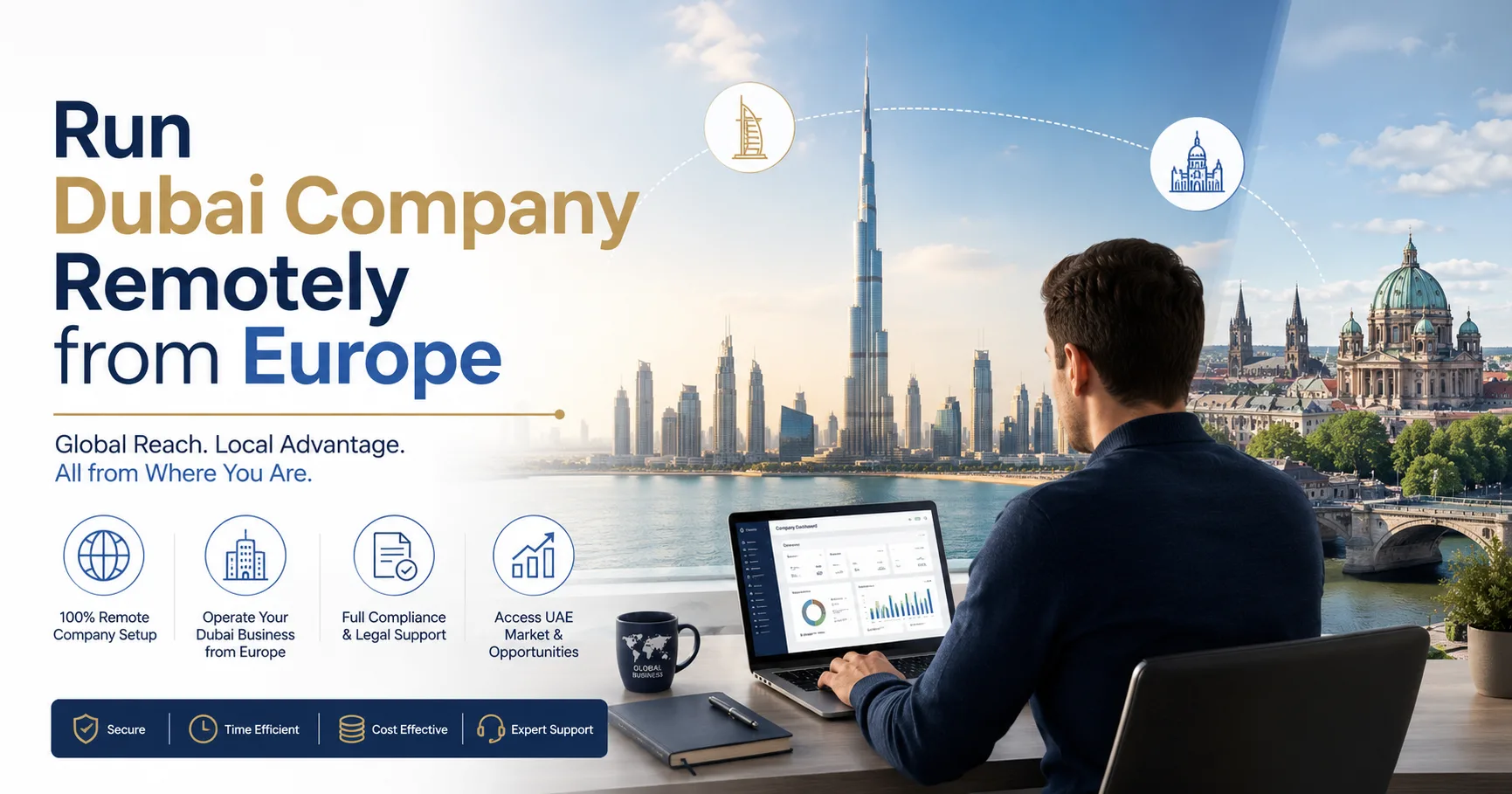
Yes You can run a Dubai company remotely from Europe and in 2026, the process is easier than most people expect. What used to require flights, notarised paperwork, and weeks of waiting on the ground in Dubai has largely moved online. Company registration, document signing, visa applications, and even banking have all shifted to digital-first systems.
That said, there are a few things you need to get right from the start, almost 80 per cent of the work can be done online now and what is possible, what has changed in 2026, what the costs look like, and where the real risks are for European founders managing a UAE company from abroad.
Is It Actually Legal to Manage a UAE Company From Abroad?
Yes and it is more common than you might think. In 2025, over 38% of new DIFC Innovation Licences were issued to founders who had never set foot in the UAE before incorporation. A remote Dubai business is a fully registered, fully compliant UAE company. The only difference from a standard setup is where the owner happens to be based.
Your company is registered in Dubai, operates under UAE law, holds a valid trade licence, and meets all its legal obligations just like any other business in the country. You manage it from Europe handling clients, coordinating your team, issuing invoices while the entity itself remains legally anchored in the UAE.
The UAE government has actively built the infrastructure to make this work. The Digital First policy introduced over the last few years means that most government interactions, document submissions, and approvals can be completed through online portals without any physical presence. That is not a loophole, it is the intended design.
What Has Changed in 2026: Key Updates
TopicAnswerE-NotarisationDocuments can now be notarised remotely via video link through UAE Pass no in-person appointment needed.Remote POAA Power of Attorney can be notarised by video conference via the Ministry of Justice, Dubai Courts, or Abu Dhabi Civil Courts. No travel required.E-SignaturesLegally equivalent to wet signatures on official company documents. Widely accepted across free zone portals.2026 Mainland RuleSince February 2026, mainland companies owned by a foreign corporate entity must appoint a UAE-resident manager with a valid Emirates ID. Individual owners and free zone companies are generally exempt.FTA Digital ReportingThe Federal Tax Authority now requires real-time digital compliance reporting. A local accountant or CSP (Corporate Service Provider) on the ground is effectively mandatory for mainland companies.BankingDigital-first banks like Wio and Mashreq Neo allow account opening via video KYC for free zone companies. Traditional banks may still require one in-person visit.
Sources: CorpLex UAE 2026, Ministry of Justice UAE, Dubai DET, Federal Tax Authority
Free Zone vs Mainland: Which Works Better for Remote Management?
This is the most important structural decision for European founders who want to operate a UAE company from Europe. The two setups are not equal when it comes to remote management.
Free Zone is the better option for most remote founders.
Free zones were designed specifically for international businesses. The entire incorporation process can be completed remotely; digital KYC, e-signatures, and online document submission are all standard. There is no mandatory UAE-resident manager requirement. You get 100% foreign ownership, a registered address in Dubai, and a valid trade licence, all without getting on a plane.
Popular options for European founders include IFZA (International Free Zone Authority), DMCC (Dubai Multi Commodities Centre), and Meydan Free Zone. IFZA and Meydan are typically the most cost-efficient starting points, with licence packages starting from around AED 12,000 to AED 15,000 per year. DMCC is more expensive but carries significant credibility for trading and commodities businesses.
Mainland possible but more complex remotely.
Mainland companies can also be managed remotely from Europe, but the 2026 rule requiring a UAE-resident manager for corporate-owned entities adds a layer of complexity. If you are an individual owner rather than a corporate shareholder, you are generally exempt from this requirement. Either way, you will need a local Corporate Service Provider to handle government submissions, mail, and compliance. That is an ongoing cost, not a one-time setup fee.
Mainland is worth the extra effort if your business needs to trade directly with the UAE local market. If your clients are in Europe or internationally, a free zone is almost always the cleaner choice.
What Does It Actually Cost to Run a Remote Dubai Business?
Costs vary by zone, licence type, and how much local support you need. Here is an honest breakdown based on current market data:
Cost ItemTypical Range (2026)NotesFree Zone Licence FeeAED 12,000 AED 50,000/yearVaries by zone and activity typeRegistered Address / DeskAED 5,000 AED 15,000/yearMandatory for all UAE companiesCorporate Service ProviderAED 5,000 AED 15,000/yearHandles mail, compliance, govt submissionsInvestor / Residence VisaAED 3,000 AED 6,000 per visaOptional needed only if you want UAE residencyFTA RegistrationFree but filing costs applyMandatory for all UAE businesses from 2023Corporate Bank AccountNo direct fee 4–8 weeks processingDigital banks faster; traditional banks may need one visitAnnual RenewalAED 10,000 AED 40,000/yearLicence + address + CSP combinedAccountant / BookkeeperAED 5,000 AED 20,000/yearRequired for corporate tax filings
Sources: IFZA, Meydan, Bizvise, CorpLex current Q1 2026 pricing
For a simple service or consulting business with a flexi-desk, one visa, and a CSP managing local compliance, a realistic all-in year-one budget is AED 30,000 to AED 50,000. That is approximately £6,500 to £10,800 or €7,500 to €12,500.
The Tax Picture: What European Founders Need to Know
This is the part that most articles skip over and it is the part that matters most if you are serious about making this work properly.
UAE Corporate Tax (from June 2023):
All UAE businesses including free zone companies must register with the Federal Tax Authority. Free zone companies that meet the qualifying criteria continue to pay 0% corporate tax on qualifying income. Mainland companies pay 9% on taxable profits above AED 375,000 (roughly £81,000 or €95,000). Below that threshold, nothing is owed. Registration and annual filing are mandatory regardless of whether any tax is due.
Your home country tax rules still apply to you personally:
This is where European founders run into problems. Setting up a company in Dubai does not automatically remove your personal tax liability in the country where you live. Germany, France, the Netherlands, Spain all of them have rules that determine where you are personally taxed, and simply owning a Dubai company does not change your residence status.
Most European countries also have Controlled Foreign Company (CFC) rules. In the UK, for example, if more than 25% of a low-taxed foreign company is owned by UK residents, HMRC may attribute the undistributed profits back to the UK shareholders and tax them directly. The key test is whether the company has genuine commercial substance in the UAE real operations, real employees or contractors, actual decisions made in Dubai rather than being a shell structure that exists purely to shift profits offshore.
The good news: free zone companies that demonstrate genuine economic substance a registered address, a local CSP managing compliance, and real business activity generally pass these tests. The CFC rules exist to catch artificial arrangements, not legitimate businesses.
Management and control:
Most European tax authorities follow the principle that a company is a tax resident where it is managed and controlled, not just where it is registered. If all key decisions about your Dubai company are being made from your home in Berlin or Amsterdam, your home tax authority may argue the company is effectively resident there. This is the single most important compliance risk for European founders running a remote Dubai business. The solution is straightforward: ensure that actual business decisions, board resolutions, and significant client relationships are documented as being conducted through the UAE entity, not from your European home address.
Do You Need to Visit Dubai at All?
TopicAnswerCompany registration (Free Zone)No visit required fully remote via digital portals and e-signaturesCompany registration (Mainland)Largely remote some notarisation steps may need a UAE-based POA holderInvestor visa (if you want it)Yes one visit required for medical test, biometrics, and Emirates ID collectionCorporate bank account (digital bank)No visit video KYC is sufficient for most digital-first UAE banksCorporate bank account (traditional bank)One visit usually required most traditional UAE banks want to meet the account holderAnnual renewalNo visit required fully remote for most free zone companiesFTA / corporate tax filingNo visit required online portal submissionsGuidance based on IFZA, Kaizen, CorpLex, and Dubai Invest 2026 practice notes
For a free zone setup where you are not applying for a UAE residence visa, the entire process from start to finish can be completed without ever visiting Dubai. If you want an investor visa which gives you UAE tax residency and a 10-year Golden Visa option at the AED 2 million property threshold one short visit is needed for the biometric and medical process. That is typically a 3 to 5 day trip and can be planned around any other business reason to be in the UAE.
What Types of Business Work Best as a Remote Dubai Business?
Not every business model is equally well-suited to remote management from Europe. Here is a clear breakdown:
Business TypeRemote SuitabilityNotesConsulting & Professional ServicesExcellent fully remote, client work delivered digitallyNo physical UAE presence neededDigital Marketing & AgenciesExcellent campaigns managed online, clients billed through UAE entityCommon setup for European agency ownersTech Startups & SaaSExcellent product built remotely, entity provides legal billing structureWidely adopted by European tech foundersE-commerceGood UAE entity for global sales; logistics partner needed for fulfilmentMainstream free zone activityImport / Export / TradingGood UAE entity provides credibility and tax efficiency; some admin on ground neededDMCC is the preferred zoneFinancial ServicesPossible DIFC or ADGM licences; stricter substance and compliance requirementsRequires specialist regulatory adviceRetail / Physical F&BNot suited physical presence and staff required; mainland licence neededRemote management not practicalReal Estate BrokeragePossible licence needed; transactions require on-the-ground coordinationBetter suited to UAE-resident operators
Source: Vista Corp, IFZA 2026 activity guide, DMCC permitted activities list
Common Mistakes European Founders Make
- Choosing mainland when a free zone would have worked and then dealing with the UAE-resident manager requirement from February 2026 without a plan.
- Ignoring home country tax obligations, registering a Dubai company does not make you tax-free in Germany, France, Spain, or the UK. Your personal residency rules still apply.
- Skipping the Corporate Service Provider, a UAE company still needs a registered address, someone to receive government mail, and local help for FTA compliance. Cutting this cost creates compliance gaps.
- Underestimating banking timelines, digital banks are faster, but if you need a traditional UAE bank account, build 4 to 8 weeks into your timeline.
- Not documenting where decisions are made keeping records of where key business decisions happen is essential to proving genuine UAE substance if your home tax authority ever asks.
So, Should You Run a Company Remotely from Europe?
The answer to 'Can I run a Dubai company remotely from Europe?' is clearly yes and in 2026, the UAE has made it easier than ever before to do so properly. The combination of digital portals, e-signatures, remote notarisation, and digital banking means that for most service-based businesses, the entire setup and ongoing management can be handled from a laptop anywhere in Europe.
If you are exploring how to structure a remote Dubai business, specialists like AE Setup work with European and international founders on exactly this from choosing the right zone and licence to setting up the compliance framework that makes a remote UAE company sustainable long-term, not just on paper at registration. Getting the structure right at the start is the one thing that makes everything else easier.