Making smart business decisions often depends on understanding and using data effectively. Business Analytics certifications help you learn how to work with data, find patterns, and use that information to improve results. These certifications are beneficial for students, working professionals, or anyone seeking to acquire new skills. They teach important concepts, such as data analysis, reporting, and decision-making, simply and practically. With more companies relying on data, having a business analytics certification can improve your chances of getting better job roles and growing in your career. It's a helpful step for anyone interested in the business and data field.
What Is a Business Analytics Certification?
A Business Analytics Certification is a professional credential that validates your ability to analyze data, derive insights, and support data-driven business decisions. These certifications are designed to equip learners with both technical and strategic skills, using real-world tools and scenarios. Whether you're a beginner or an experienced professional, certification programs offer structured learning paths tailored to different levels.
Key components typically covered in a Business Analytics Certification:
- Data analysis tools: Learn to work with Excel, SQL, Python, and R for data manipulation and querying
- Data visualization: Use tools like Tableau or Power BI to turn raw data into clear, actionable visuals
- Reporting and dashboards: Build interactive dashboards and automate reporting for business monitoring
- Predictive analytics: Apply statistical methods and machine learning models to forecast trends
- Case-based learning: Solve real-world business problems using data, enhancing practical understanding
- Business insights: Learn to communicate findings and support decision-making across departments
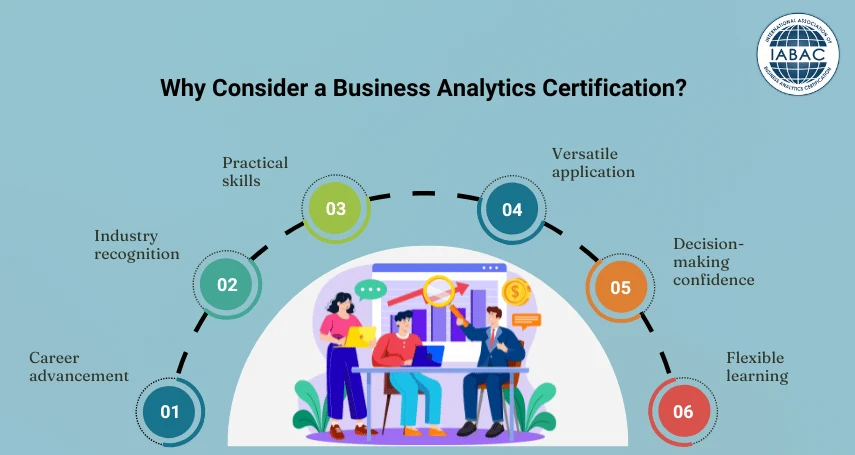
Why Consider a Business Analytics Certification?
A Business Analytics Certification can be a valuable investment in your career, whether you're entering the field or looking to level up your skills. It helps bridge the gap between raw data and business decisions by equipping you with practical tools, industry-relevant knowledge, and recognized credentials.
Here’s why pursuing a certification is worth considering:
- Career advancement: Certifications strengthen your resume and open doors to roles like data analyst, business analyst, or analytics consultant
- Industry recognition: Being certified demonstrates your expertise and commitment to staying relevant in a competitive job market.
- Practical skills: You gain hands-on experience with real tools, case studies, and business challenges
- Versatile application: Business analytics is used across industries—finance, healthcare, marketing, logistics, and more
- Decision-making confidence: Learn how to interpret data correctly and make informed business recommendations
- Flexible learning: Many programs are self-paced or online, allowing you to learn on your schedule.
Who Should Get Certified?
A Business Analytics Certification is not limited to data professionals—it’s valuable for anyone who wants to make better, data-informed decisions. Whether you're starting or looking to deepen your analytical skills, certification programs can help you gain practical knowledge and improve career prospects.
Here’s who can benefit from getting certified:
- Students and recent graduates: Build job-ready skills and stand out in a competitive job market
- Career switchers: Transition into analytics roles from non-technical backgrounds with guided, structured learning
- Working professionals: Upskill in your current role to contribute more effectively to data-driven projects
- Managers and team leads: Learn how to interpret analytics to guide teams and support strategic decisions
- Entrepreneurs and business owners: Understand how to leverage data to improve operations, marketing, and customer experience
- IT and software professionals: Expand into the business side of data, combining technical know-how with business insights.
Popular Topics Covered in Certification Courses
Business analytics certification courses are designed to provide a mix of theoretical understanding and hands-on skills. They typically cover a range of topics that reflect real-world applications and industry demands. While the exact content may vary by provider, most courses focus on building core competencies in data analysis, interpretation, and business decision-making.
Here are some commonly covered topics:
- Data analysis fundamentals: Understanding data types, data cleaning, and exploratory data analysis (EDA)
- Statistical methods: Descriptive and inferential statistics, hypothesis testing, regression analysis
- Data visualization: Creating charts, dashboards, and reports using tools like Tableau or Power BI
- Excel and SQL skills: Working with spreadsheets and databases to organize and extract insights
- Python or R for analytics: Automating analysis, using libraries like Pandas, NumPy, or ggplot2
- Predictive modeling: Applying machine learning techniques such as classification and forecasting
- Business problem-solving: Using case studies to apply analytics in marketing, finance, HR, and operations
- Reporting and storytelling: Communicating insights effectively to stakeholders through reports and presentations
- Real-time data and dashboards: Basics of stream analytics and live reporting tools
- Ethics and data governance: Ensuring responsible use of data, privacy, and compliance.
Top Certifications to Consider
If you're looking to gain a globally recognized credential in business analytics, the International Association of Business Analytics Certification (IABAC) offers a variety of programs designed for different career stages and skill levels. These certifications are industry-aligned, practical, and widely accepted by employers across sectors.
Here are some popular IABAC certifications to consider:
- Certified Business Analytics Expert: Ideal for beginners, this certification covers foundational concepts, tools, and techniques used in business analytics.
- Certified Data Scientist: Aimed at those with some technical background, this program dives deeper into machine learning, data mining, and predictive modeling.
- Certified Business Analytics Expert (CBAE): An advanced-level certification for professionals looking to master analytics strategy, real-time dashboards, and complex problem-solving.
How to Choose the Right Certification
Not all certifications are created equal. Keep the following in mind when selecting one:
- Level of experience required: Beginners should start with foundational courses, while professionals may prefer expert-level options.
- Tools covered: Look for programs that teach in-demand tools like Excel, SQL, Power BI, or Python.
- Project work: Courses with capstone projects or real-world examples offer better learning.
- Recognition and accreditation: Choose programs from well-known universities, platforms, or certification bodies.
- Cost and duration: Consider your budget and time availability—some courses are free or affordable, while others are premium and intensive.
Career Benefits After Certification
Completing a Business Analytics Certification can lead to several career advantages:
- Better job prospects: Certification increases your chances of landing roles in data analytics, reporting, or business strategy.
- Higher salary potential: Certified professionals often earn more than non-certified peers in similar roles.
- Promotion opportunities: It helps you stand out when applying for internal growth roles.
- Freelancing or consulting: You can offer your analytics services independently or as part of a consulting team
Getting a Business Analytics Certification is a useful step for anyone who wants to learn how to understand and work with data. It helps you build practical skills, improve your job options, and feel more confident making business decisions. Whether you're a student, professional, or just curious about data, this certification can be a valuable part of your learning journey.