
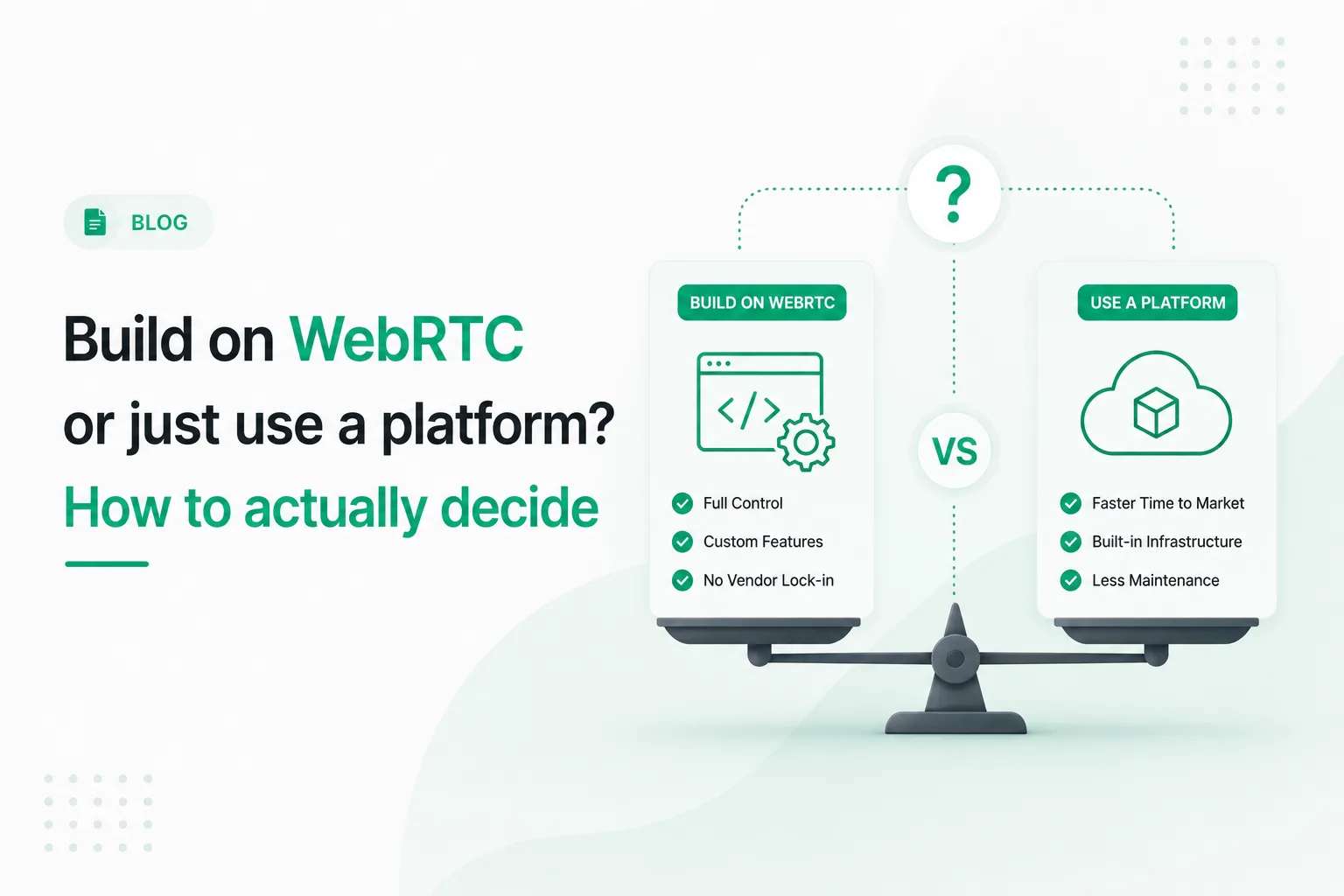
Every team building real time voice or video hits this fork sooner or later. On one side, a hosted platform that hands you an SDK and a monthly bill. On the other, building on raw WebRTC yourself. People argue about it online like it is some kind of moral question. It is not. It is a tradeoff, and which way you should go depends almost entirely on where your product sits right now.
Let me lay out both sides honestly, because most articles oversell whichever one the author happens to be selling.
The case for a platform
If real time communication is a feature inside your product rather than the product itself, a platform is usually the right call, at least to start. You get calling that works today. Someone else runs the relay servers. You never have to learn what a MOS score is at two in the morning. For an MVP, or for a team that needs to prove the idea before investing in infrastructure, that head start is worth real money.
The catch shows up later, and it shows up in two places. Cost, because per-minute pricing that felt like nothing at ten users gets very real at ten thousand. And control, because the day you need something the platform did not plan for, you are stuck waiting on their roadmap instead of shipping on yours.
The case for building on WebRTC
If real time is core to what you do, or if those platform bills are starting to look like a second payroll, building on WebRTC directly starts to make sense. You own the stack. You tune it for your exact use case. You stop paying a margin on every single minute, forever.
The honest cost is that you are now on the hook for the hard parts the platform was quietly handling. Signaling. TURN relays sitting in the right regions. Media servers once rooms get large. Monitoring, so you catch quality problems before your users start complaining. This is genuine engineering work, and it is a specific flavor of it that general web developers usually have not touched.
How to actually decide
A few questions cut through most of the noise.
Is real time your product, or a feature of it? Product leans build. Feature leans platform.
What do the platform bills look like at your projected scale, not today's? Run the numbers a year out. It is often sobering.
Do you have anyone in house who has actually run WebRTC media infrastructure? If not, building means either learning it slowly and painfully, or bringing in people who already know it.
That last question is where a lot of teams get stuck. They decide building is right for them, then realize the skills to do it well are not on the team. The usual move at that point is to work with a WebRTC development company that has done this before, or to hire WebRTC developers who have already run this kind of system in production and can embed with your existing engineers. Either beats a general team feeling their way through NAT traversal for the first time on a live product.
The unsexy answer
For plenty of teams, the right path is neither one in its pure form. Start on a platform to move fast, then build out the pieces that matter as scale and cost pressure grow. Nobody hands out a prize for building everything from scratch on day one. Nobody hands out one for paying platform margins forever either.
Pick based on where your product actually is, not where you picture it a few years from now. You can revisit the call later. Most teams end up doing exactly that.